Step 1: Understanding the importance of forests.
Forests play a crucial role in the Indian economy by contributing to a wide range of sectors including agriculture, industry, and tourism. They provide essential resources such as timber, fuelwood, medicinal plants, and non-timber products. Step 2: Forests' role in environmental protection.
Forests also help in maintaining environmental stability. They prevent soil erosion, regulate the water cycle, and act as carbon sinks, contributing to the reduction of climate change impacts. Step 3: Contribution to employment and rural economy.
Forests provide direct employment to millions of people, especially in rural areas, through activities such as wood collection, forest-based crafts, and ecotourism. Step 4: Forests and biodiversity.
India's forests are rich in biodiversity, supporting a wide range of wildlife. This biodiversity is not only essential for ecological balance but also forms the basis for eco-tourism, which contributes significantly to the economy.
02
PYQ 2026
medium
geographyID: icse-cla
Identify the option which is most similar to:
Tropical Evergreen vegetation : Tall trees and hardwood
1
Tropical Deciduous vegetation : Pure stands
2
Tropical Desert vegetation : Small leaves and spines
3
Coniferous forests : Mountain
4
Littoral vegetation : Boat making
Official Solution
Correct Option: (2)
Step 1: Understanding Tropical Evergreen vegetation.
Tropical Evergreen vegetation is characterized by tall trees and hardwood, as these areas receive heavy rainfall throughout the year. The vegetation remains lush and dense.
Step 2: Analysis of options.
- (a) Incorrect: Tropical Deciduous vegetation has seasonal shedding of leaves, unlike the evergreen nature of tropical vegetation.
- (b) Correct: Tropical Desert vegetation features small leaves and spines to conserve water, a similar adaptation to the dense, moisture-conserving nature of tropical evergreen vegetation.
- (c) Incorrect: Coniferous forests grow in mountain regions, but this does not match the characteristics of tropical evergreen vegetation.
- (d) Incorrect: Littoral vegetation refers to plants near the coast, often adapted for saltwater, which does not directly compare to tropical evergreen vegetation.
Step 3: Conclusion.
The correct answer is (b), as Tropical Desert vegetation is similar in its adaptive features (small leaves and spines) compared to the tropical evergreen vegetation's ability to conserve moisture. Final Answer: Tropical Desert vegetation : Small leaves and spines.
03
PYQ 2026
medium
geographyID: icse-cla
Tropical Monsoon Forests are also called 'Tropical Deciduous Forests'.
Official Solution
Correct Option: (1)
Tropical Monsoon Forests are often referred to as Tropical Deciduous Forests because of their characteristic seasonal behavior. These forests experience distinct wet and dry seasons, and during the dry season, most of the trees shed their leaves to conserve water. This leaf-shedding process is what classifies them as deciduous forests. Step 1: Seasonal shedding of leaves.
In tropical monsoon forests, trees lose their leaves in the dry season as a response to water scarcity. This is a characteristic feature of deciduous forests, which shed their leaves annually in response to the changing weather conditions. Step 2: Adaptation to monsoon climates.
Tropical monsoon forests are adapted to regions with distinct wet and dry seasons, typical of tropical regions. The monsoon season provides a significant amount of rainfall, but during the dry season, the lack of water causes many trees to shed their leaves, thus adapting to the environment's seasonal changes. Step 3: Biodiversity and productivity.
Despite the dry season, tropical monsoon forests remain highly productive and biodiverse, supporting a wide range of plant and animal species. The seasonal shedding of leaves helps conserve moisture and protect the trees during the harsh dry periods.
04
PYQ 2026
medium
geographyID: icse-cla
At higher altitudes, trees are often conical in shape.
Official Solution
Correct Option: (1)
At higher altitudes, trees are often conical in shape as an adaptation to the cold and heavy snowfall. The conical shape allows snow to slide off the tree more easily, preventing the branches from breaking under the weight of snow accumulation. Step 1: Protection from snow.
In regions with heavy snowfall, the conical shape ensures that the snow doesn't accumulate on the branches, which could cause them to bend or break. Instead, the snow slides off, preserving the structural integrity of the tree. Step 2: Wind resistance.
The conical shape also helps reduce the wind resistance. In high-altitude areas, where wind speeds are often strong, the narrow top and wide base of conical trees reduce wind drag, preventing damage to the tree's structure. Step 3: Adaptation to extreme conditions.
This adaptation allows trees to thrive in the cold, windy, and snowy environments of higher altitudes, where trees with broader canopies might struggle to survive.
05
PYQ 2026
medium
geographyID: icse-cla
A sustainable system of managing a piece of land through combined production of agricultural crops, forest crops, and animal rearing.
Official Solution
Correct Option: (1)
The system described in the question is known as Agroforestry. Agroforestry is a sustainable land management practice that integrates trees with agricultural crops and livestock on the same land. This system is designed to optimize the use of land and resources in a way that benefits both the environment and the people involved in farming. Step 1: Agroforestry’s role in land management.
Agroforestry systems involve cultivating crops (food crops or forest crops), managing trees or forests, and rearing livestock together. This combination maximizes land use efficiency, as trees provide shade for crops, preventing soil erosion and improving water retention. Additionally, trees contribute organic matter to the soil, enhancing soil fertility over time. Step 2: Environmental benefits.
Agroforestry practices have significant environmental benefits, such as improving biodiversity, reducing soil erosion, and increasing carbon sequestration. The integration of trees in farming systems helps to conserve the ecosystem, promoting a healthy environment while still being productive. Step 3: Economic benefits.
For farmers, agroforestry provides diversified income sources from crops, timber, fruits, and livestock, making them less dependent on a single crop. The practice also helps in reducing the need for chemical fertilizers and pesticides, lowering the cost of production and improving long-term soil health.
06
PYQ 2026
medium
geographyID: icse-cla
Mention one adaptive feature of the trees of this vegetation.
Official Solution
Correct Option: (1)
One of the most important adaptive features of mangrove trees is the presence of aerial roots, also known as \textit{pneumatophores}. These roots grow above the surface of the soil or water and allow the tree to take in oxygen from the air. The soil in which mangroves grow is often waterlogged and lacks oxygen, so aerial roots enable the mangrove trees to survive in such low-oxygen conditions. Step 1: Function of Aerial Roots.
The aerial roots of mangrove trees grow upwards from the ground and extend above the water's surface, allowing the plant to obtain oxygen directly from the air. This adaptation is critical in areas where the soil remains submerged for long periods, as it ensures that the tree can breathe and survive in waterlogged environments. Step 2: Other Adaptations.
In addition to aerial roots, mangrove trees also have specialized salt glands that help them excrete excess salt. This allows them to survive in the saline environment of coastal waters. The roots of mangrove trees also serve to stabilize the soil and reduce erosion, acting as a natural barrier to protect the coastline.
07
PYQ 2026
medium
geographyID: icse-cla
Planting of trees along the side of roads, railway lines and on hill slopes.
Official Solution
Correct Option: (1)
The practice of planting trees along the side of roads, railway lines, and on hill slopes is known as Afforestation. This process involves the establishment of forests or planting trees in areas where there were no previous forests or trees. It is often carried out in areas that are prone to soil erosion or where land restoration is required. Step 1: Preventing soil erosion.
One of the primary benefits of afforestation is its ability to prevent soil erosion. Trees planted on hill slopes and along roadsides act as a barrier against wind and water, reducing the velocity of runoff. This helps in stabilizing the soil and preventing it from being washed away during heavy rains, which is particularly important in regions with steep terrain. Step 2: Improving air quality.
Afforestation also improves air quality. Trees act as natural air filters, absorbing carbon dioxide and releasing oxygen. The increase in greenery around roadways and railway lines contributes to the reduction of air pollution, making the environment healthier for people living in these areas. Step 3: Enhancing biodiversity.
Afforestation promotes biodiversity by providing habitats for wildlife, thus improving the ecological balance. Trees along roads and railway lines also provide a natural corridor for animals to move, ensuring that wildlife can thrive and migrate across landscapes that have been fragmented by human activity. Step 4: Aesthetic value and climate regulation.
Additionally, afforestation along these areas helps improve the aesthetic value of the environment. The greenery also plays a role in regulating the microclimate by providing shade, reducing heat, and improving the overall climatic conditions of the area.
08
PYQ 2026
medium
geographyID: icse-cla
Name a region where this type of vegetation is commonly found in India.
Official Solution
Correct Option: (1)
Mangrove forests are commonly found in the Sundarbans region, located in the coastal areas of West Bengal, India. The Sundarbans is the largest mangrove forest in India and one of the largest in the world. It is a UNESCO World Heritage Site and is known for its rich biodiversity, including the Bengal tiger, and its role in protecting the coastline from natural disasters such as storms and cyclones. Step 1: Features of the Sundarbans.
The Sundarbans is a vast network of tidal waterways, mudflats, and islands, where mangrove forests thrive. The region is critical for both local communities and wildlife, offering essential ecosystem services such as coastal protection, carbon sequestration, and providing a breeding ground for marine species. Step 2: Importance of Mangrove Forests in Sundarbans.
The mangrove forests of the Sundarbans play a vital role in maintaining the balance of the ecosystem. They act as a buffer against the encroachment of seawater, prevent soil erosion, and support rich biodiversity, including endangered species like the Bengal tiger. The region is also home to numerous species of fish, crustaceans, and migratory birds.
09
PYQ 2026
medium
geographyID: icse-cla
Desert vegetation has long roots.
Official Solution
Correct Option: (1)
Desert vegetation typically has long roots as an adaptation to survive in the harsh conditions of arid regions. These long roots allow the plants to reach deep underground water sources, which are essential for their survival in the absence of regular rainfall. Step 1: Adaptation to limited water supply.
In deserts, water is scarce, so plants need to adapt to these conditions. Long roots enable the plants to tap into groundwater, which is often deep beneath the surface. This adaptation is crucial for maintaining the plant's water supply throughout the year. Step 2: Function of deep roots.
Besides accessing water, deep roots also anchor the plants firmly in the soil, helping them withstand strong winds and preventing them from being uprooted in the loose, sandy soils typical of deserts.
10
PYQ 2026
medium
geographyID: icse-cla
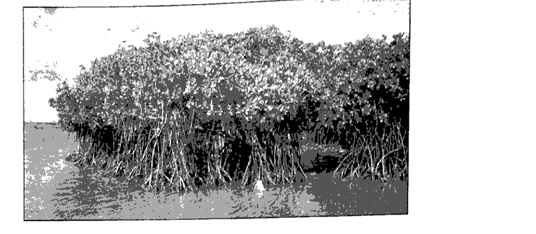
Name the type of vegetation seen in the given image.
Official Solution
Correct Option: (1)
The type of vegetation seen in the above image is Mangrove Forest. Mangrove forests are specialized ecosystems found along coastal areas where saltwater and freshwater mix. These forests are primarily located in the intertidal zones of tropical and subtropical regions. Mangrove trees are uniquely adapted to survive in saline, waterlogged soils with fluctuating tides. Step 1: Characteristics of Mangrove Forests.
Mangrove forests have unique characteristics that enable them to thrive in challenging environments. The vegetation seen in the image is dominated by mangrove trees, which are adapted to brackish water and tidal flooding. These forests help in preventing coastal erosion, supporting marine biodiversity, and acting as a natural barrier during storms and cyclones. Step 2: Importance of Mangrove Forests.
Mangrove forests are crucial for the ecosystem as they serve as nurseries for many marine species, provide habitat for a wide range of wildlife, and help protect coastal areas from storm surges and erosion. The roots of mangrove trees stabilize the sediment, reducing the risk of soil erosion and protecting the shoreline.