The resistance of a heating coil in a heating appliance operating at is .
[(a)] Which alloy is used to make heating coil of heating appliances?
[(b)] Calculate the amount of heat produced if electricity flows through this appliance for 5 minutes.
[(c)] If another appliance with a resistance less than is operated at the same voltage for 5 minutes, will the amount of heat produced increase or decrease? What is your justification?
Official Solution
Correct Option:
(1)
(a) Alloy used Concept: Heating elements
Heating coils are made of materials with high resistivity and high melting point. Answer:(b) Heat produced Concept: Joule’s Law of Heating Step 1: Given data} Step 2: Substitute values} Step 3: Calculation} Conclusion (b):(c) Effect of decreasing resistance Step 1: Formula relation} Step 2: Observation}
At constant voltage and time:
Step 3: Conclusion}
If resistance decreases:
Final Answer (c):
02
PYQ 2026
medium
physicsID: kerala-s
(A) A heating appliance produces heat in 2 hours.
[(a)] What is the energy change in a heating appliance?
[(b)] Calculate the power of the appliance.
OR(B) An electric grinder with a power of is working.
[(a)] What is the energy change in this equipment?
[(b)] Calculate the work done by this grinder in 1 minute.
Official Solution
Correct Option:
(1)
(A) Heating appliance (a) Energy change Concept:
A heating appliance converts:
Conclusion (a):(b) Power calculation Step 1: Given data} Step 2: Formula} Step 3: Calculation} Conclusion (b):(B) Electric grinder (a) Energy change Concept:
An electric grinder converts:
Conclusion (a):(b) Work done Step 1: Given data} Step 2: Formula} Step 3: Calculation} Conclusion (b):
03
PYQ 2026
medium
physicsID: kerala-s
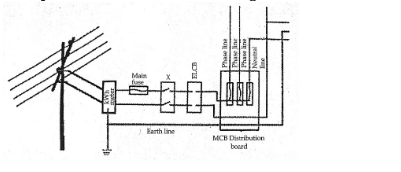
A portion of electric circuit diagram of a household wiring is given.
[(a)] What does the part marked as “X” represent in the circuit?
[(b)] Draw a circuit diagram of a branch circuit which includes one three pin socket with switch.
Official Solution
Correct Option:
(1)
(a) Identification of part “X” Concept: Household wiring components
In a typical household circuit, the sequence includes:
Step 1: Position of X}
The part “X” is placed after the main fuse and before ELCB. Step 2: Identify the component}
This component measures electrical energy consumed. Conclusion (a):(b) Circuit diagram of a branch circuit with three-pin socket and switch Concept: Three-pin socket connection
A three-pin socket has:
Live (L)
Neutral (N)
Earth (E)
Step 1: Connections}
Live wire passes through a switch to the socket.
Neutral wire directly connects to the socket.
Earth wire connects to the earth pin.
Step 2: Diagram} Step 3: Explanation}
Switch is always connected in live wire for safety.
Earth wire prevents electric shock.
Conclusion (b):
04
PYQ 2026
medium
physicsID: kerala-s
What does the term “Ohmic Heating” indicate?
1
Heating in a microwave oven
2
Heating in an induction cooker
3
Joule heating
4
Heating through radiation
Official Solution
Correct Option:
(3)
Concept: Ohmic Heating
Ohmic heating refers to the heat produced when an electric current flows through a conductor due to its resistance. This phenomenon is governed by Joule’s law. Step 1: Joule’s Law of Heating}
The heat produced in a conductor is given by:
where:
= current
= resistance
= time
Step 2: Meaning of Ohmic Heating}
When current passes through a resistive material, electrical energy is converted into heat energy. This is called:
Step 3: Identify correct option}
Among the given options:
Microwave → electromagnetic waves
Induction → magnetic heating
Radiation → heat transfer method
Joule heating → correct definition
Conclusion:
About Current Electricity - KERALA-SSLC-EXAM
Current Electricity is a vital chapter for KERALA-SSLC-EXAM aspirants. Mastering the concepts covered in this chapter is essential for securing a top rank.
By rigorously practicing the previous year questions associated with this chapter, you can identify high-yield topics, understand the examiner's perspective, and boost your confidence during the actual exam.
Frequently Asked Questions
Why focus on Current Electricity PYQs?
Analyzing PYQs for this specific chapter reveals the most frequently tested concepts and the typical complexity of questions, allowing you to tailor your study plan efficiently.
How to best use this analysis?
Review the topic breakdown to see which sub-topics within Current Electricity carry the most weight. Then, tackle the questions iteratively to solidify your understanding.