An object is placed 20 cm away from a concave lens with a focal length of 10 cm.
[(a)] Calculate the distance to the image from the lens.
[(b)] Write down the characteristics of the image.
OR A convex lens forms a virtual image at a distance of 7.5 cm away from it. Focal length of the lens is 15 cm.
[(a)] Calculate the distance between lens and the object.
[(b)] Write any two instances where a convex lens is used in this manner.
Official Solution
Correct Option: (1)
(A) (a) Image distance Concept: Lens formula Step 1: Sign convention}
For concave lens:
Step 2: Substitute values} Conclusion (a):(b) Characteristics of image
Virtual
Erect
Diminished
Formed on the same side as object
(B) (a) Object distance Step 1: Sign convention}}
Convex lens:
Step 2: Lens formula}} Step 3: Calculation}} Conclusion (a):(b) Uses of convex lens in this manner
Magnifying glass
Simple microscope
02
PYQ 2026
medium
physicsID: kerala-s
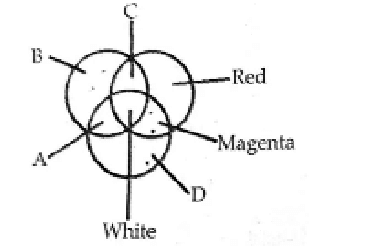
Observe the figure where three coloured lights are made to fall on a screen.
[(a)] Which colours are labelled as A and D?
[(b)] Among the colours A, B, C and D identify the primary colours and write down the colours.
[(c)] There is a complementary colour pair among A, B, C and D. Pick them out and write down.
Official Solution
Correct Option: (1)
Concept: Addition of Colours (RGB Model)
Primary colours of light:
Their combinations produce:
Red + Blue = Magenta
Red + Green = Yellow
Blue + Green = Cyan
Red + Green + Blue = White
(a) Identify colours A and D Step 1: From the diagram}
Given:
One region is marked Red
One region is Magenta (Red + Blue)
Center is White (all three)
Step 2: Deduce remaining colours}
Thus:
Conclusion (a):(b) Primary colours Step 1: Primary colours of light} Step 2: From labels} Conclusion (b):(c) Complementary colour pair Concept:
Complementary colours combine to form white light. Step 1: Identify pair} Step 2: From given labels}
Magenta is present, so:
Conclusion (c):
03
PYQ 2026
medium
physicsID: kerala-s
The Sun appears red or yellow or orange during sunrise and sunset. But normally the sky appears blue in colour. Describe an experiment that would be helpful in explaining the cause of these phenomena.OR In winter, path of light through the gaps of the branches of trees can be seen clearly due to scattering.
[(a)] By what name is the phenomenon known where the path of light becomes visible in this manner? Through what type of medium does light travel when this occurs?
[(b)] What does the intensity of scattering depend on?
Official Solution
Correct Option: (1)
(A) Experiment to explain scattering of light Concept: Scattering of light (Tyndall effect)
The color of the sky and the Sun is explained by scattering of light by small particles in the atmosphere. Experiment:
Take a glass tank filled with clean water.
Add a few drops of milk (to create a colloidal solution).
Pass a beam of white light (torch or laser) through the solution.
Observation:
The path of light becomes visible due to scattering.
Light coming out from the side appears bluish.
Light observed at the far end appears reddish.
Explanation:
Shorter wavelengths (blue light) scatter more → sky appears blue.
At sunrise/sunset, light travels a longer path → blue light scatters away → longer wavelengths (red/orange) dominate.
Conclusion:(B) Scattering of light in atmosphere (a) Name of the phenomenon Step 1: Identify phenomenon}
The visible path of light is called:
Step 2: Type of medium}
This occurs when light passes through a:
Conclusion (a):(b) Intensity of scattering Step 1: Dependence on wavelength}
Scattering depends on wavelength:
Step 2: Other factors}
Size of particles
Number of particles
Nature of medium
Conclusion (b):
04
PYQ 2026
medium
physicsID: kerala-s
When passing through water droplets while forming rainbow light rays undergo:
[(i)] Increase in speed.
[(ii)] Internal reflection.
[(iii)] Total internal reflection.
[(iv)] Refraction.
1
(i) and (ii) are correct
2
(ii) and (iii) are correct
3
(i), (ii) and (iv) are correct
4
(ii) and (iv) are correct
Official Solution
Correct Option: (2)
Concept: Formation of Rainbow
A rainbow is formed due to the interaction of sunlight with water droplets involving refraction and internal reflection. Step 1: Entry of light into droplet}
When light enters a water droplet:
It slows down (not increases speed)
It undergoes refraction
So, statement (i) is incorrect. Step 2: Inside the droplet}
Light reflects inside the droplet:
This is internal reflection
In rainbow formation, it is specifically total internal reflection
So, (ii) and (iii) are correct. Step 3: Exit of light}
Light again refracts when exiting the droplet, but the key distinguishing phenomenon is total internal reflection. Step 4: Conclusion}
Correct statements:
05
PYQ 2026
medium
physicsID: kerala-s
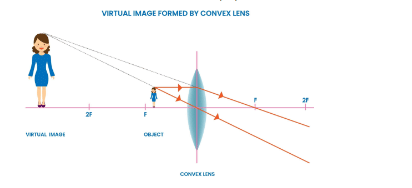
Draw a ray diagram showing the formation of a virtual image by a convex lens.
Official Solution
Correct Option: (1)
Concept: Image formation by a convex lens
A convex lens can form a virtual, erect, and magnified image when the object is placed between the optical centre (O) and the principal focus (F). Step 1: Position of object}
Place the object between:
Step 2: Draw principal rays}
From the top of the object:
Draw a ray parallel to the principal axis; after refraction, it passes through the focus on the other side.
Draw a ray through the optical centre; it passes undeviated.
Step 3: Extend rays backward}
The refracted rays diverge, so extend them backward. Their extensions meet on the same side of the lens. Step 4: Nature of image}