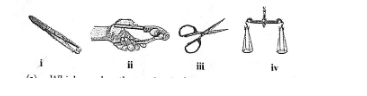
[(a)] Which one has the mechanical advantage less than one?
[(b)] State the principle of a lever.
[(c)] The mechanical advantage of a lever is 2. If the length of its effort arm is 1 m, calculate the length of the load arm.
OR Crowbar can be used as a lever.
[(a)] What do you mean by a lever?
[(b)] Among Effort, Load, and Fulcrum, state which one comes in the middle for a second order lever and for a third order lever.
[(c)] A metre scale is suspended in equilibrium position. If a weight of 60 g is suspended at a distance of 25 cm from the balanced point, what weight must be suspended on the other side at a distance of 30 cm to keep the metre scale in equilibrium?
Official Solution
Correct Option:
(1)
(A) (a) Mechanical advantage less than 1 Concept:
Mechanical advantage (MA) less than 1 occurs in third-class levers. Answer: (b) Principle of a lever Principle:(c) Calculation of load arm Step 1: Formula}}
Step 2: Given}}
Step 3: Calculation}}
Conclusion (c):(B) (a) Definition of lever A lever is a rigid bar that rotates about a fixed point called the fulcrum to lift or move a load. (b) Position in levers
Second order lever → Load is in the middle
Third order lever → Effort is in the middle
(c) Equilibrium of metre scale Step 1: Apply principle of moments}}
Step 2: Given}}
Step 3: Calculation}}
Conclusion (c):
02
PYQ 2026
medium
physicsID: kerala-s
A load of is lifted with a wheel and axle system that has a wheel of radius and an axle of radius .
[(a)] Calculate the mechanical advantage of this wheel and axle.
[(b)] How should a wheel and axle be designed to obtain increased mechanical advantage?
Official Solution
Correct Option:
(1)
Concept: Wheel and Axle
Mechanical advantage (MA) of a wheel and axle is given by:
(a) Calculation of Mechanical Advantage Step 1: Given data} Step 2: Apply formula} Conclusion (a):(b) Increasing Mechanical Advantage Step 1: From formula} Step 2: Ways to increase MA}
Increase the radius of the wheel ( )
Decrease the radius of the axle ( )
Conclusion (b):
About Work Energy And Power - KERALA-SSLC-EXAM
Work Energy And Power is a vital chapter for KERALA-SSLC-EXAM aspirants. Mastering the concepts covered in this chapter is essential for securing a top rank.
By rigorously practicing the previous year questions associated with this chapter, you can identify high-yield topics, understand the examiner's perspective, and boost your confidence during the actual exam.
Frequently Asked Questions
Why focus on Work Energy And Power PYQs?
Analyzing PYQs for this specific chapter reveals the most frequently tested concepts and the typical complexity of questions, allowing you to tailor your study plan efficiently.
How to best use this analysis?
Review the topic breakdown to see which sub-topics within Work Energy And Power carry the most weight. Then, tackle the questions iteratively to solidify your understanding.