Reading Comprehension
40 previous year questions.
High-Yield Trend
Chapter Questions 40 MCQs
‘Can’t hear’, said one, ‘the breakers roar?
For methinks we should be near the shore’.
‘Now where we are I cannot tell,
But I wish I could hear the Inchcape Bell’.
They hear no sound, the swell is strong;
Though the wind hath fallen they drift along,
Till the vessel strikes with a shivering shock,
‘O Christ! it is the Inchcape Rock!’
Sir Ralph the rover tore his hair;
He cursed himself in his despair;
The waves rush in every side,
The ship is sinking beneath the tide.
But even in his dying fear
One dreadful sound could the Rover hear,
A sound as if with the Inchcape Bell,
The Devil below was ringing his knell.
However, medical tourism carries some risks that locally provided medical care does not. Some countries like India, Malaysia and Thailand have very different infectious diseases rarely found in Europe and North America. Exposure to disease without having built-up natural immunity can be a hazard for weak individuals especially with respect to gastrointestinal diseases like Hepatitis A, amoebic dysentery etc., which could slow down the recovery process. Also, medical tourists may be at risk from mosquito-transmitted diseases, influenza and tuberculosis. The quality of post-operative care can also vary dramatically depending on the hospital and the country. Finally, after returning home, a patient has a limited contact with their surgeon. This may make it difficult to deal with any complications that may arise later, such as a delayed infection.
The concept of medical tourism raises some important questions regarding accessibility, affordability and ethics in medical care. It is unfortunate that a large section of the Indian population has little or no access to private health care. Public health care system is inadequate and lacks proper infrastructure and facilities. One wonders if it is sensible to make provisions for medical tourism in a democratic country like India, which has failed to provide nourishment, sanitation and health care to its masses.
One day, I was sitting at my mess table in the hostel sipping tea when a senior guy came and sat on the chair adjacent to me. He was a convent educated guy with fairly sophisticated English – at least spoken or colloquial English. He was a bit arrogant and wanted to pull my leg. He tried to engage in some conversation with me and started pointing out errors in just about every sentence or everything that I said. After about 5 minutes he walked away after insulting me.
I felt extremely humiliated and upset. As it is, I was feeling quite depressed and diffident and this incident was the last straw. I was almost broken. I felt out of place there and literally wanted to run away to Solapur that very moment. However, it was only my self-esteem which stopped me. Suddenly, a feeling of determination and strength came over me and gripped me.
Staying in comfort at home gives one more happiness than travelling.
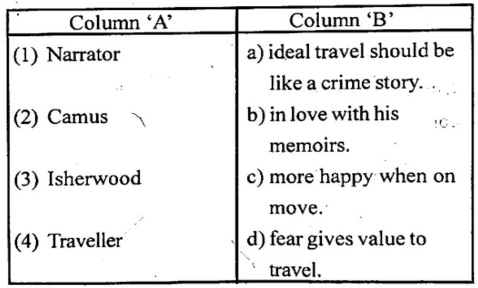
Match the persons given in column 'A' with opinions/characteristics given in column 'B'
I would come back to my apartment in New York.
(Choose the correct option using ‘used to’ for the given sentence and rewrite.)
Choose two correct alternatives which define the theme of the extract:
I like to ask questions of the places I visit.
(Choose the correct tense form of the above sentence from the following options and rewrite.)
Appreciation:
Read the extract and write the appreciation of the poem: The Inchcape Rock (By Robert Southey)
Poem Extract:
They hear no sound, the swell is strong;
Though the wind hath fallen they drift along,
Till the vessel strikes with a shivering shock,-
‘O Christ! it is the Inchcape Rock!’
Sir Ralph the Rover tore his hair;
He curst himself in his despair;
The waves rush in every side,
The ship is sinking beneath the tide.
But even in his dying fear
One dreadful sound could the Rover hear,
A sound as if with the Inchcape Bell,
The Devil below was ringing his knell.
Give reasons:
"We are objects of scrutiny," because _______________
(i) ___________________
(ii) ___________________
Expand the following idea with the help of the points given below (100 to 150 words):
'Manners Maketh Man'
Essential Virtues
- Politeness
- Speech, tone, gestures, and action
- To be courteous and amiable
Complete the following web describing the various aspects of the lady’s beauty. One is done for you at the center place.
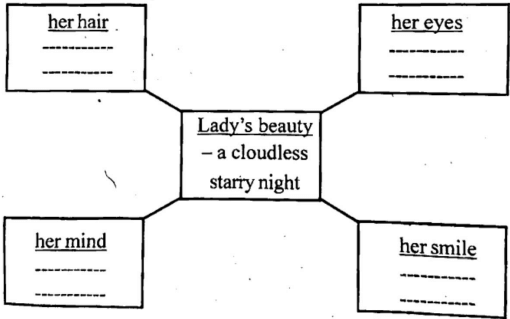
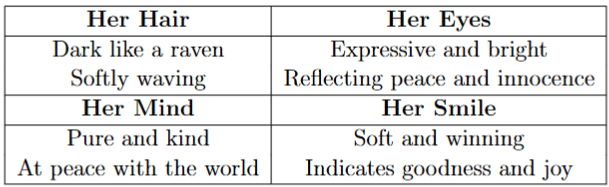
Read the extract and complete the activities given below:
She walks in beauty, like the night
Of cloudless climes and starry skies;
And all that’s best of dark and bright
Meet in her aspect and her eyes;
Thus mellowed to that tender light
Which heaven to gaudy day denies.
One shade the more, one ray the less,
Had half impaired the nameless grace
Which waves in every raven tress,
Or softly lightens o’er her face;
Where thoughts serenely sweet express,
How pure, how dear their dwelling-place.
And on that cheek, and o’er that brow,
So soft, so calm, yet eloquent,
The smiles that win, the tints that glow,
But tell of days in goodness spent,
A mind at peace with all below,
A heart whose love is innocent!
Mind Mapping :
Prepare a mind map on ‘Effects of Music on Human Life’ using your ideas/thoughts/concepts to illustrate.
‘Love and tolerance are the true indicators of a civilized person.’ Justify.
Write how we can build up a civilized society with the help of the extract.
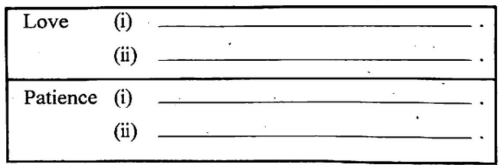
Complete the following table with the help of the extract:
Give one merit and one demerit of ‘Love’ and ‘Patience’.

Read the following extract and complete the activities given below:
Love is a great force in private life; it is indeed the greatest of all things; but love in public affairs does not work. It has been tried again and again; by the people of the Middle Ages, and also by the French Revolution, a secular movement which reasserted the Brotherhood of Man. And it has always failed. The idea that nations should love one another, or that business concerns or marketing boards should love one another or that a man in Portugal should love a man in Peru of whom he has never heard — it is absurd, unreal, dangerous. ‘Love is what is needed,’ we chant, and then sit back and the world goes on as before. The fact is we can only love what we know personally. And we cannot know much. In public affairs, in the rebuilding of civilization, something much less dramatic and emotional is needed, namely tolerance. Tolerance is a very dull virtue. It is boring. It is negative. It merely means putting up with people, being able to stand things. No one has ever written an ode to tolerance, or raised a statue to her. Yet this is the quality which will be most needed after the war. This is the sound state of mind which we are looking for. This is the only force which will enable different races and classes and interests to settle down together to the work of reconstruction.
The world is very full of people— appallingly full; it has never been so full before, and they are all tumbling over each other. Most of these people one doesn’t know and some of them one doesn’t like. Well, what is one to do? If you don’t like people, put up with them as well as you can. Don’t try to love them; you can’t. But try to tolerate them. On the basis of that tolerance a civilized future may be built. Certainly, I can see no other foundation for the post-war world.
Travelling is an interesting teacher." Write your views in 3-4 sentences.
Quest for something may end in more mystery.
One gets inspected as he inspects the world around him.
A traveller may sink in love with his travel memoirs.
Read the extract and complete the activities given below:
This is what Camus meant when he said that “what gives value to travel is fear” — disruption, in other words, (or emancipation) from circumstance, and all the habits behind which we hide. And that is why many of us travel not in search of answers, but of better questions. I, like many people, tend to ask questions of the places I visit, and relish most the ones that ask the most searching questions back of me: “The ideal travel book,” Christopher Isherwood once said, “should be perhaps a little like a crime story in which you’re in search of something.” And it’s the best kind of something, I would add, if it’s one that you can never quite find.
I remember, in fact, after my first trips to Southeast Asia, more than a decade ago, how I would come back to my apartment in New York, and lie in my bed, kept up by something more than jet lag, playing back, in my memory, over and over, all that I had experienced, and paging wistfully through my photographs and reading and re-reading my diaries, as if to extract some mystery from them. Anyone witnessing this strange scene would have drawn the right conclusion: I was in love.
When we go abroad is that we are objects of scrutiny as much as the people we scrutinize, and we are being consumed by the cultures we consume, as much on the road as when we are at home. At the very least, we are objects of speculation (and even desire) who can seem as exotic to the people around us as they do to us.
All, in that sense, believed in “being moved” as one of the points of taking trips, and “being transported” by private as well as public means; all saw that “ecstasy” (“ex-stasis”) tells us that our highest moments come when we’re not stationary, and that epiphany can follow movement as much as it precipitates it.
1. Read and rewrite the following sentences and state whether they are True or False :
(a) A traveller may sink in love with his travel - memoirs.
(b) One gets inspected as he inspects the world around him.
(c) Quest for something may end in more mystery.
(d) Staying in comfort at home gives one more happiness than travelling.
2. Match the persons given in column 'A' with opinions/ characteristics given in column 'B':
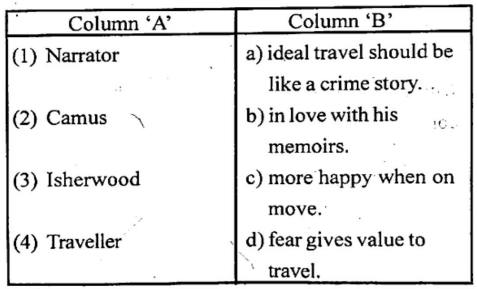
3. Give reasons:
"We are objects of scrutiny," because ___________
(i) _____________________________
(ii) ______________________________
4. "Travelling is an interesting teacher." Write your views in 3-4 sentences.
5. Do as directed :
(i) I like I visit. to ask questions of the places (Choose the correct tense form of the above sentence from the following options and rewrite.)
(a) Simple past tense
(b) Simple present tense
(c) Past perfect tense
(d) Present perfect tense
(ii) I would come back to my apartment in New York. (Choose the correct option using 'used to' for the given sentence and rewrite.)
(a) I use to come back to my apartment in New York.
(b) I have used to come back to my apartment in New York.
(c) I used to come back to my apartment in New York.
(d) I had used to come back to my apartment in New York.
6. Find out the words from passage which mean:
(i) reminiscence
(ii) exhilaration
Read the extract and complete the activities given below :
I spent 32 years in Information Technology out of which I was a Chief Executive Officer or MDorthe software head for 23 years for large global multinational software companies with thousands of software professionals worldwide and 6 offices in the US, 3 in Europe, 1 in Japan and 1 in Australia. I had to travel all over the globe around 150 times for business. During this period, I had also written 4 books with 500-700 pages each on Information Technology published by Tata McGraw-Hill and then translated into Chinese for global distribution.
I learnt a lot of things when I was running these large companies. The first one was the importance of team work. In today’s world, nothing is possible without team work. You cannot be successful if you are a loner and an egoistic person. Secondly, you need to lead from the front by setting a good example in front of your staff. Third was that you need to treat your subordinates and your colleagues as friends. In my career, I made a few mistakes, but learnt a lot about motivation, being a good listener, target setting and the art of delegation which forms such an important part of today’s management.
After working for all these software companies for so many years, I wanted to retire from my line of work and write on various subjects concerning human life and existence. Therefore, I gave up two offers of around 3 crore rupees per annum to become a writer. This is how my second innings as a writer in Marathi began.
After this, I have written about 34 books in Marathi. Most of them have become bestsellers with tens of thousands of copies sold for each. However it is not sales or the money that is important to me as much as the fact that these books have brought about very good changes in the lives of thousands of readers.
Change is the only constant and disruptive technologies are only quickening its pace. “I’ve been an entrepreneur all my life. Never has the pace of change been as high as it is today. Today, we are facing a large number of disruptive forces, especially those caused by technology,” Nilekani said. He shared the example of the iPhone, which is currently celebrating its 10th anniversary. “What we have seen in the past 10 years is a complete change in the balance of technology from serving the enterprise to serving the consumer. Today, when you look at the leading companies in the world by Market Capitalisation, they are all companies that service consumers like Facebook, Google, Amazon, Apple and so on. This is because the balance of power has shifted to consumer technology,” He said. The constant change will require constant learning and relearning. The core message from Nilekani therefore was: Lifetime learning. “The good news is that you have got degree from IIT Madras. The not so good news is that you can’t stop learning. You will have to keep learning for the rest of your life because we are now entering an era of lifelong learning,” he said. And by life-long learning, he didn’t mean “going to a campus and have fun for five years.” It will be learning in short bursts, any time learning, anywhere learning. It’s going to be just in time learning. A lot of it will even be online learning.
This need for constant learning and relearning will come because of our collective inability to predict the kind of jobs that will be done in future or the kind of organisations that people will be working for in future. The high rate of automation in the jobs will have an impact on the way jobs are done. We have seen in the past that technology has made repetitive jobs go away as computers became more and more powerful. In the past 10-15 years, you are seeing the rise of AI (Artificial Intelligence) and Machine Learning. And increasingly, in the last 5-6 years, you are seeing the rise of deep learning, which allows you to use a new kind of technology called neural networks that can make computers smarter and smarter.
Healthy, free, the world before me,
The long brown path before me leading wherever I choose.
Henceforth I ask not good-fortune, I myself am good-fortune,
Henceforth I whimper no more, postpone no more, need nothing,
Done with indoor complaints, libraries, querulous criticisms,
Strong and content I travel the open road.
The earth, that is sufficient,
I do not want the constellations any nearer.
Read the extract and complete the activities given below:
Family can be classified into two types: joint family and nuclear family. In the joint family along with parents and children other members like grandparents, uncles, aunts, cousins, etc. are included. In such family, socialization of children is quicker. Tasks are shared. Responsibilities are shared.
Establishment of emotional bonds are common leading to mental security. Members learn adjustment. But sometimes there are conflicts and misunderstandings among family members. Children do not get complete attention from their parents.
On the contrary nuclear family consists of parents and their children. So we see flexibility in parental roles. Parents share their responsibilities. Parent child relationships are very intimate. Full attention is paid on children’s personality development. But children lack in making adjustments. Children get too much attention from their parents and so they become demanding and selfish.
Parenting styles do influence children’s behaviour. The best known research on parenting style is Diana Baumrind’s early studies of pre-school children and their parents. She proposed three parenting styles : permissive, authoritarian and authoritative.
Permissive parents are inconsistent in their behaviour. So children of such parents become dependent, immature.
Authoritarian parents are rigid and punitive in nature. Children of such parents become unfriendly, unsocial and uninvolved. Parents provide food and shelter to their children but they neglect them and become emotionally detached. That leads to indifferent, rejecting behaviour on the part of the children.
Authoritative parents encourage independence, they set limits and goals, they are firm in their behaviour. This kind of parenting style makes children self-reliable, independent and develop social skills.
Read the extract and complete the activities given below:
At length Soapy reached one of the avenues to the east where the glitter and turmoil was but faint. He dragged himself toward Madison Square, for the homing instinct survives even when the home is a park bench.
But, on an unusually quiet corner, Soapy came to a standstill. Here was an old church, quaint and rambling and gabled. Through one violet-stained window a soft light glowed, where, no doubt, the organist loitered over the keys, making sure of his mastery of the coming Sabbath Anthem. For there drifted out to Soapy’s ears sweet music that caught and held him transfixed against the convolutions of the iron fence.
The moon was above, full and radiant; vehicles and pedestrians were few; sparrows twittered sleepily in the eaves or a little while the scene might have been a country churchyard. And the anthem that the organist played cemented Soapy to the iron fence, for he had known it well in the days when his life contained such things as mothers and roses and ambitions and friends and immaculate thoughts and collars.
The conjunction of Soapy’s receptive state of mind and the influences about the old church brought a sudden and wonderful change in his soul. He viewed with rising horror the pit into which he had tumbled, the degraded days,
unworthy desires, dead hopes, wrecked faculties and base motives that made up his existence. And also in a moment his heart responded thrillingly to this strange mood. A strong impulse moved him to battle with his desperate fate. He would pull himself out of the mire and would make a man of himself again; he would conquer the evil that had enslaved him. There was time; he was young yet; he would resurrect his old eager ambitions and pursue them without faltering. Those solemn but sweet organ notes had set up a revolution in him. Tomorrow he would go into the roaring downtown district and find work. A fur importer had once offered him a place as driver. He would be somebody in the world. He would .....
Soapy felt a hand laid on his arm. He looked quickly around into the impassive face of a policeman.
“What are you doin’ here?” asked the officer.
“Nothin’,” said Soapy.
“Then come along,” said the policeman.
“Three months on the island,” said the Magistrate in the Police Court the next morning.
About Reading Comprehension - MAHARASHTRA-CLASS-XII
Reading Comprehension is a vital chapter for MAHARASHTRA-CLASS-XII aspirants. Mastering the concepts covered in this chapter is essential for securing a top rank.
By rigorously practicing the previous year questions associated with this chapter, you can identify high-yield topics, understand the examiner's perspective, and boost your confidence during the actual exam.
Frequently Asked Questions
Why focus on Reading Comprehension PYQs?
Analyzing PYQs for this specific chapter reveals the most frequently tested concepts and the typical complexity of questions, allowing you to tailor your study plan efficiently.
How to best use this analysis?
Review the topic breakdown to see which sub-topics within Reading Comprehension carry the most weight. Then, tackle the questions iteratively to solidify your understanding.