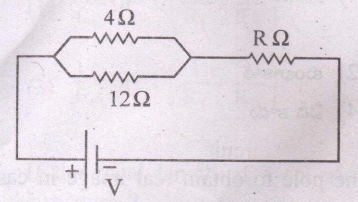
In the circuit given below, if the equivalent resistance is 10 Ω, find the value of R.
1
8 Ω
2
16 Ω
3
7 Ω
4
3 Ω
Official Solution
Correct Option:
(3)
1. Identify the components and their configuration: The circuit consists of:
A resistor ( )
A resistor ( )
A resistor with unknown resistance R
A voltage source V
The and resistors are connected in parallel. This parallel combination is connected in series with the resistor R. The total equivalent resistance of the circuit ( ) is given as .
2. Calculate the equivalent resistance of the parallel combination: Let be the equivalent resistance of the parallel combination of and . The formula for the equivalent resistance of two parallel resistors is: $ ) is connected in series with the resistor R. The total equivalent resistance ( ) is the sum of resistances in series: \) . Substituting the known values into the equation from Step 3: \) from both sides to find R: \) . This corresponds to option (3).
Final Answer:
The final answer is \) {7 \Omega}$
02
PYQ 2022
medium
physicsID: ts-polyc
Usage of fuse in a circuit prevents from
1
Power cut
2
Overload
3
Short circuit
4
None of the above
Official Solution
Correct Option:
(2)
To solve the problem, we need to understand the role of a fuse in a circuit.
1. Function of a Fuse:
A fuse is a safety device used in electrical circuits to protect against overload and short circuits. It contains a wire that melts when the current exceeds a certain limit, breaking the circuit and preventing further damage.
2. Effect of Overload:
In the case of an overload (when the current exceeds the safe limit), the fuse will blow, preventing further damage to the circuit and other components.
Final Answer:
The usage of a fuse in a circuit prevents .
03
PYQ 2025
medium
physicsID: ts-polyc
How many times does a ray of light refract when it passes through a prism?
1
1
2
2
3
3
4
4
Official Solution
Correct Option:
(2)
Step 1: Refraction in Prism. When a ray of light passes through a prism, it is refracted twice. First, as it enters the prism, and then as it exits the prism. Step 2: Explanation. The light ray bends towards the normal at the first surface, and away from the normal at the second surface due to the difference in refractive indices of air and the prism material. Step 3: Conclusion. Thus, a ray of light undergoes two refractions when passing through a prism.
About Electric Circuit - TS-POLYCET
Electric Circuit is a vital chapter for TS-POLYCET aspirants. Mastering the concepts covered in this chapter is essential for securing a top rank.
By rigorously practicing the previous year questions associated with this chapter, you can identify high-yield topics, understand the examiner's perspective, and boost your confidence during the actual exam.
Frequently Asked Questions
Why focus on Electric Circuit PYQs?
Analyzing PYQs for this specific chapter reveals the most frequently tested concepts and the typical complexity of questions, allowing you to tailor your study plan efficiently.
How to best use this analysis?
Review the topic breakdown to see which sub-topics within Electric Circuit carry the most weight. Then, tackle the questions iteratively to solidify your understanding.