In an AC generator direction of current changes because of _____ .
1
external magnet
2
carbon brushes
3
slip rings
4
all the above AC
Official Solution
Correct Option:
(3)
The correct option is (C): slip rings.
02
PYQ 2020
medium
physicsID: ts-polyc
The frequency of direct current is _____ .
1
0
2
50
3
60
4
100
Official Solution
Correct Option:
(1)
The correct option is (A): 0.
03
PYQ 2021
medium
physicsID: ts-polyc
The current in a conductor is directly proportional to the potential difference between its ends. This is called____
1
Faraday's law
2
Kirchoff's law
3
Ohm's law
4
Newton's law
Official Solution
Correct Option:
(3)
To solve the problem, we need to identify the law that states the current in a conductor is directly proportional to the potential difference between its ends.
1. Understanding the Statement: The given statement describes a fundamental relationship in electricity: the current flowing through a conductor is directly proportional to the potential difference (voltage) applied across it, provided the temperature and other physical conditions remain constant.
2. Analyzing the Options:
(A) Faraday's Law: This law deals with electromagnetic induction, specifically the production of an electromotive force (EMF) in a conductor due to a changing magnetic field. It does not describe the relationship between current and voltage.
(B) Kirchhoff's Law: These laws are used to analyze complex circuits and consist of two parts: - Kirchhoff's Current Law (KCL): The sum of currents entering a junction equals the sum of currents leaving the junction. - Kirchhoff's Voltage Law (KVL): The sum of voltages around any closed loop in a circuit is zero. Neither part of Kirchhoff's laws directly relates to the proportionality between current and voltage.
(C) Ohm's Law: This law states that the current through a conductor between two points is directly proportional to the voltage across the two points, and inversely proportional to the resistance of the conductor. Mathematically, it is expressed as:
or equivalently,
This directly matches the statement in the question.
(D) Newton's Law: These laws describe the motion of objects under the influence of forces and do not relate to electrical phenomena.
3. Conclusion: The correct answer is Ohm's Law, as it explicitly states the direct proportionality between current and voltage in a conductor.
Final Answer: (C) Ohm's law.
04
PYQ 2021
medium
physicsID: ts-polyc
Conductivity =
1
Resistance-1
2
Current-1
3
Potential-1
4
Resistivity-1
Official Solution
Correct Option:
(4)
To solve this question, we need to understand the relationship between conductivity and other electrical properties.
1. Definition of Conductivity: Conductivity ( ) is the measure of a material's ability to conduct electric current. It is the reciprocal of resistivity ( ).
2. Clarification of Terms:
Resistance – Property of an object, depends on material and geometry.
Resistivity – Intrinsic property of a material, independent of shape/size.
Conductivity – Reciprocal of resistivity.
3. Evaluating the Options:
(A) – Incorrect; that's conductance.
(B) – Incorrect; unrelated to conductivity definition.
(C) – Incorrect.
(D) – Correct ✔
Final Answer: The correct answer is (D) Resistivity⁻¹.
05
PYQ 2022
medium
physicsID: ts-polyc
Direction of electric current and direction of electrons in a conductor are
1
Same direction
2
Perpendicular to each other
3
Opposite to each other
4
None of the above
Official Solution
Correct Option:
(3)
To solve the problem, we need to understand the relationship between the direction of electric current and the direction of electrons in a conductor.
1. Definition of Electric Current:
Electric current is the flow of positive charge. By convention, the direction of electric current is taken as the direction in which positive charges move. In a conductor, however, the actual charge carriers are electrons, which have a negative charge.
2. Direction of Electrons:
Electrons, being negatively charged, move in the opposite direction to the conventional current. This means if the electric current flows in one direction, the electrons move in the opposite direction.
3. Final Answer:
The direction of electric current and the direction of electrons are opposite to each other.
Thus, the correct answer is .
06
PYQ 2022
medium
physicsID: ts-polyc
Obstruction to the motion of electrons in a conductor is called
1
Conductivity
2
Resistance
3
Resistivity
4
None of the above
Official Solution
Correct Option:
(2)
To solve the problem, we need to identify the term that describes the obstruction to the motion of electrons in a conductor.
1. Understanding the Concepts: - Conductivity refers to the ability of a material to conduct electricity. A high conductivity means the material allows electrons to move freely. - Resistance is the opposition to the flow of electric current. It is the obstruction to the motion of electrons in a conductor. Resistance depends on the material, length, and cross-sectional area of the conductor. - Resistivity is a material property that quantifies how strongly a material opposes the flow of electric current. It is closely related to resistance, but resistivity is independent of the conductor's dimensions.
2. Correct Term: The correct term for the obstruction to the motion of electrons is Resistance.
Final Answer: Obstruction to the motion of electrons in a conductor is called .
07
PYQ 2022
medium
physicsID: ts-polyc
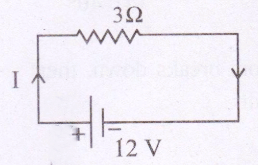
Which of the following is the equation for given circuit as per Kirchoff's loop law?
1
3I+12=0
2
3I×12=1
3
3I×12=0
4
3I-12=0
Official Solution
Correct Option:
(4)
To solve the problem, we need to apply Kirchhoff's loop law for the given circuit.
1. Kirchhoff's Loop Law:
Kirchhoff's loop law states that the sum of the potential differences (voltages) around any closed loop in a circuit must be zero. This is because energy is conserved in a closed loop.
2. Given Circuit Description:
In the given circuit:
- The current flows through a resistor of .
- The voltage of the battery is .
3. Apply Kirchhoff’s Voltage Law:
The potential drop across the resistor is (using Ohm's law: ), and the voltage source provides .
As per Kirchhoff's law, the sum of voltages in a closed loop is zero:
Final Answer:
The equation for the given circuit as per Kirchhoff's loop law is .
08
PYQ 2022
easy
physicsID: ts-polyc
Multimeter can be used to measure
1
current
2
voltage
3
resistance
4
all of the above
Official Solution
Correct Option:
(4)
The correct option is (D): all of the above.
09
PYQ 2023
easy
physicsID: ts-polyc
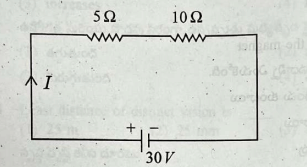
Find the current (I) in the following circuit diagram
1
5A
2
4A
3
3A
4
2 A
Official Solution
Correct Option:
(4)
To solve the problem, we need to find the total current flowing in the circuit using Ohm's Law.
1. Identify the Components:
- Two resistors in series: and
- Voltage source:
2. Calculate the Total Resistance:
Since the resistors are in series, the total resistance is:
3. Apply Ohm's Law:
Ohm's Law:
Substitute the values:
Final Answer:
The current in the circuit is .
10
PYQ 2023
medium
physicsID: ts-polyc
In a circuit two or more resistors are connected in parallel. Then the following quantity is same for all the resistors
1
Potential difference
2
Electric current
3
Resistance
4
Heat
Official Solution
Correct Option:
(1)
To solve the problem, we need to determine which physical quantity remains the same for all resistors connected in a parallel circuit.
1. Understanding Parallel Connection: In a parallel circuit, each resistor is connected directly across the same two points of the circuit. This means that each resistor experiences the same voltage across its terminals.
2. Analyzing the Quantities:
- Potential difference: Same across all resistors in parallel. ✅ - Electric current: Divides inversely according to the resistance values. - Resistance: May vary between resistors. - Heat: Depends on both current and resistance, so it varies.
Final Answer: The quantity that remains the same for all resistors in parallel is
11
PYQ 2023
medium
physicsID: ts-polyc
Algebraic sum of potential differences in a closed loop is
1
one
2
equal
3
zero
4
none
Official Solution
Correct Option:
(3)
To solve the problem, we need to understand the principle that governs the potential differences in a closed loop in an electric circuit.
1. Understanding Kirchhoff's Voltage Law (KVL): According to Kirchhoff's Voltage Law, the algebraic sum of all potential differences (voltages) around any closed loop in a circuit is zero. This includes the sum of emfs and the product of currents and resistances.
2. Application: This law is based on the law of conservation of energy, ensuring that all the energy supplied in a closed loop is used up within the loop, so no net energy gain or loss occurs.
Final Answer: The algebraic sum of potential differences in a closed loop is .
12
PYQ 2024
medium
physicsID: ts-polyc
Which one of the following statements is correct?
1
AC changes its magnitude but not direction
2
DC changes its magnitude and direction
3
DC changes its direction only
4
AC changes both its magnitude and direction
Official Solution
Correct Option:
(4)
Alternating current (AC) changes both its magnitude and direction periodically. In contrast, direct current (DC) maintains a constant magnitude but its direction can change depending on the external factors, such as polarity reversal.
About Electric Current - TS-POLYCET
Electric Current is a vital chapter for TS-POLYCET aspirants. Mastering the concepts covered in this chapter is essential for securing a top rank.
By rigorously practicing the previous year questions associated with this chapter, you can identify high-yield topics, understand the examiner's perspective, and boost your confidence during the actual exam.
Frequently Asked Questions
Why focus on Electric Current PYQs?
Analyzing PYQs for this specific chapter reveals the most frequently tested concepts and the typical complexity of questions, allowing you to tailor your study plan efficiently.
How to best use this analysis?
Review the topic breakdown to see which sub-topics within Electric Current carry the most weight. Then, tackle the questions iteratively to solidify your understanding.