Which of the following materials has high value of specific resistance?
1
Copper
2
Silicon
3
Glass
4
Iron
Official Solution
Correct Option:
(3)
The correct option is (C): Glass.
02
PYQ 2021
medium
physicsID: ts-polyc
Units for specific resistance
1
2
3
4
Official Solution
Correct Option:
(1)
To determine the correct units for specific resistance, let's analyze the concept step by step.
1. Understanding Specific Resistance: Specific resistance (also known as resistivity) is a material property that quantifies how strongly a material opposes the flow of electric current. It is denoted by the symbol (rho).
The formula for resistivity is given by: $ R \Omega A m^2 L m \rho = \frac{R \cdot A}{L} R \Omega A m^2 L m \rho {(A) \, \Omega \cdot m} $
03
PYQ 2021
medium
physicsID: ts-polyc
resistors are connected in series. Resultant resistance is . Then
1
2
3
4
Official Solution
Correct Option:
(4)
To solve the problem, we need to find the unknown resistance when three resistors are connected in series and the total resistance is given.
1. Understanding Series Connection: In a series connection, the total or resultant resistance is the sum of all individual resistances:
2. Substitute the Known Values: Given: , , and Also,
3. Solve for R:
Final Answer: The correct answer is option (D): 8 Ω.
04
PYQ 2022
medium
physicsID: ts-polyc
A bulb is marked 60 W and 240 V. Find the resistance in the bulb.
1
40 Ω
2
180 Ω
3
960 Ω
4
60 Ω
Official Solution
Correct Option:
(3)
To solve the problem, we need to find the resistance of the bulb given its power and voltage.
1. Use the Power Formula:
The power of an electrical device is related to voltage and resistance by the formula:
where is the power in watts, is the voltage in volts, and is the resistance in ohms.
2. Rearranging the Formula to Solve for Resistance:
Rearranging the formula to find resistance:
3. Substituting the Given Values:
Given and , substitute these values into the formula:
Final Answer:
The resistance of the bulb is .
05
PYQ 2023
medium
physicsID: ts-polyc
If area of cross section of a wire increases, while temperature and length are constant, then resistance of the wire
1
decreases
2
depends on material
3
increases
4
none
Official Solution
Correct Option:
(1)
To solve the problem, we need to understand how the resistance of a wire is affected by changes in its cross-sectional area, while keeping its temperature and length constant.
1. Formula for Resistance: The resistance of a wire is given by the formula:
Where: = resistivity of the material (constant for a given material) = length of the wire = area of cross-section
2. Given Conditions: - Temperature is constant - Length is constant - Area increases
3. Analyzing the Relationship: From the formula, resistance is inversely proportional to area :
So, if the area increases, the resistance decreases.
Final Answer: The resistance of the wire when the area of cross-section increases.
06
PYQ 2024
hard
physicsID: ts-polyc
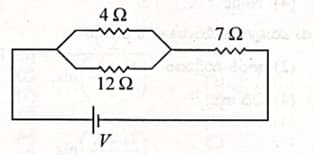
Calculate the resultant resistance in the following circuit.
1
3
2
10
3
13
4
7
Official Solution
Correct Option:
(2)
In this circuit, we have a combination of resistors. The 4 and 7 resistors are in series, so their total resistance is: Now, this combination is in parallel with the 12 resistor. The total resistance for resistors in parallel is given by: Thus, the resultant resistance is 10 .
07
PYQ 2024
medium
physicsID: ts-polyc
Formula for specific resistance is
1
2
3
4
Official Solution
Correct Option:
(1)
Specific resistance (also known as resistivity) is calculated using the formula , where is the resistance, is the cross-sectional area, and is the length of the material. Thus, the correct answer is option (1).
08
PYQ 2024
medium
physicsID: ts-polyc
The S.I. unit of electrical resistance is
1
Ampere
2
Volt
3
Farad
4
Ohm
Official Solution
Correct Option:
(4)
The S.I. unit of electrical resistance is the ohm (symbol: Ω), named after the German physicist Georg Simon Ohm. Thus, the correct answer is option (4).
About Resistance - TS-POLYCET
Resistance is a vital chapter for TS-POLYCET aspirants. Mastering the concepts covered in this chapter is essential for securing a top rank.
By rigorously practicing the previous year questions associated with this chapter, you can identify high-yield topics, understand the examiner's perspective, and boost your confidence during the actual exam.
Frequently Asked Questions
Why focus on Resistance PYQs?
Analyzing PYQs for this specific chapter reveals the most frequently tested concepts and the typical complexity of questions, allowing you to tailor your study plan efficiently.
How to best use this analysis?
Review the topic breakdown to see which sub-topics within Resistance carry the most weight. Then, tackle the questions iteratively to solidify your understanding.