Which of the following catalysts is used in Haber’s process for the manufacture of ammonia ?
1
Al O
2
Fe + Mo
3
CuO
4
Pt
Official Solution
Correct Option:
(2)
Step 1: Understand Haber’s process.
Haber’s process is used to synthesize ammonia from nitrogen and hydrogen gas. The reaction is as follows:
Step 2: Identify the catalyst.
In Haber’s process, the catalyst used is a mixture of iron (Fe) and molybdenum (Mo), which speeds up the reaction without being consumed. Step 3: Analyze the options.
- Fe + Mo (Option B) is the correct catalyst used in the Haber process.
- Al O (Option A) is used in some catalytic reactions but not in the Haber process.
- CuO (Option C) is a catalyst for other reactions, but not for ammonia synthesis.
- Pt (Option D) is a catalyst for hydrogenation reactions but not for ammonia synthesis. Step 4: Apply to the options.
The correct answer is (B) Fe + Mo. Final Answer:
02
PYQ 2025
medium
chemistryID: bihar-bo
The hybridization of S in SO is
1
sp
2
sp
3
sp d
4
sp d
Official Solution
Correct Option:
(1)
Step 1: Understand the structure of SO .
SO (sulfur trioxide) has a trigonal planar structure with sulfur in the center and three oxygen atoms around it. The sulfur atom forms three bonds with oxygen atoms. Step 2: Identify the electron domains around sulfur.
- Sulfur in SO has 3 bonding pairs of electrons and no lone pairs of electrons. Therefore, the number of electron domains around sulfur is 3. Step 3: Determine the hybridization.
- When there are 3 electron domains, the hybridization of the central atom is sp . Step 4: Apply to the options.
The hybridization of sulfur in SO is sp , so option (A) is correct. Final Answer:
03
PYQ 2025
medium
chemistryID: bihar-bo
The maximum covalency of nitrogen is
1
2
2
3
3
4
4
5
Official Solution
Correct Option:
(4)
Step 1: Understand covalency.
Covalency refers to the number of bonds an atom can form with other atoms. For nitrogen, the covalency is determined by the number of valence electrons and the available orbitals for bonding. Step 2: Analyze nitrogen's bonding capacity.
- Nitrogen has 5 valence electrons and can form 3 single bonds (e.g., in NH ) or 4 bonds in some cases (e.g., in NCl ). - However, nitrogen can also form 5 bonds in compounds like nitrogen pentachloride (NCl ), where it utilizes its empty d-orbitals. Step 3: Apply to the options.
The maximum covalency of nitrogen is 5, so option (D) is correct. Final Answer:
04
PYQ 2025
medium
chemistryID: bihar-bo
The most abundant noble gas in atmosphere is
1
He
2
Ar
3
Xe
4
Rn
Official Solution
Correct Option:
(2)
Step 1: Identify the noble gases in the atmosphere.
The noble gases in the atmosphere include helium (He), argon (Ar), xenon (Xe), and radon (Rn). Step 2: Understand the abundance of noble gases.
Argon (Ar) is the most abundant noble gas in the Earth's atmosphere, constituting approximately 0.93% by volume of the atmosphere. Helium, while abundant in the universe, is much less common in the Earth's atmosphere. Step 3: Apply to the options.
Argon (Ar) is the most abundant noble gas in the atmosphere, so the correct answer is (B). Final Answer:
05
PYQ 2025
medium
chemistryID: bihar-bo
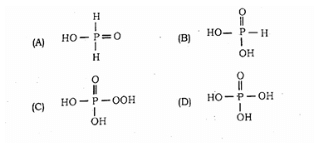
Which of the following is the structural formula of hypophosphorous acid?
1
A
2
B
3
C
4
D
Official Solution
Correct Option:
(3)
Step 1: Understand the structure of hypophosphorous acid. Hypophosphorous acid is a weak acid with the molecular formula H PO . It contains one phosphorus atom bonded to two hydroxyl groups (-OH) and one -OOH group (hydroperoxide group). Step 2: Analyze each option.
- Option (A) is incorrect because it shows a double bond to oxygen, which is not the structure of hypophosphorous acid. - Option (B) is incorrect because it shows two hydrogen atoms attached to phosphorus, which is not typical for this acid. - Option (C) is the correct structure, showing the correct bonding with one hydroxyl group and one hydroperoxide group (-OOH). - Option (D) is incorrect because it shows two hydroxyl groups and no hydroperoxide group. Step 3: Apply to the options. The correct structural formula for hypophosphorous acid is shown in option (C). Final Answer:
06
PYQ 2025
easy
chemistryID: bihar-bo
Ammonia can be dried by
Official Solution
Correct Option:
(1)
07
PYQ 2025
easy
chemistryID: bihar-bo
Which among the following is the strongest base?
Official Solution
Correct Option:
(1)
About The P Block Elements - BIHAR-BOARD-XII
The P Block Elements is a vital chapter for BIHAR-BOARD-XII aspirants. Mastering the concepts covered in this chapter is essential for securing a top rank.
By rigorously practicing the previous year questions associated with this chapter, you can identify high-yield topics, understand the examiner's perspective, and boost your confidence during the actual exam.
Frequently Asked Questions
Why focus on The P Block Elements PYQs?
Analyzing PYQs for this specific chapter reveals the most frequently tested concepts and the typical complexity of questions, allowing you to tailor your study plan efficiently.
How to best use this analysis?
Review the topic breakdown to see which sub-topics within The P Block Elements carry the most weight. Then, tackle the questions iteratively to solidify your understanding.