Therapeutic Approaches
13 previous year questions.
High-Yield Trend
Chapter Questions 13 MCQs
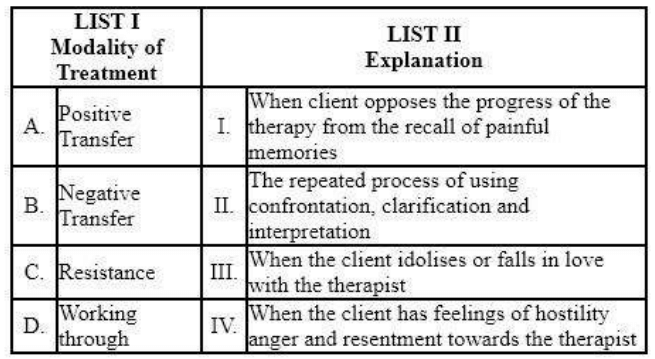
Match List I with List II:
(A) Identification of areas to be targeted for treatment in psychotherapy
(B) Understanding the status of the client
(C) Understanding the problems
(D) To make money
(E) Choice of techniques for treatment
(A) Autism Spectrum Disorder
(B) Intellectual Disability
(C) Specific Learning Disorder
(D) Hallucinations
(E) Conduct Disorder
| List-I | List-II |
|---|---|
| (A) Logotherapy | (I) Freiderick Perls and Laura Perls |
| (B) Client Centred Therapy | (II) Victor Frankl |
| (C) Gestalt Therapy | (III) Albert Ellis |
| (D) Rational Emotive Therapy | (IV) Carl Rogers |
(A) The therapist relaxes the clients and asks him to think about the least anxiety-provoking situation.
(B) The client is interviewed to elicit fear-provoking situations.
(C) The therapist prepares a hierarchy of anxiety-provoking stimuli with the least anxiety-provoking at the bottom.
(D) The client is asked to stop thinking of the fearful situation if the slightest tension is felt.
(E) Over the sessions, the client is able to imagine more severe fear-provoking situations while maintaining relaxation.
(A) Negative emotions and behaviours as consequences of the antecedent event are identified and noted
(B) Client's irrational beliefs which are distorting present reality are identified
(C) Antecedent events which caused psychological distress are noted
(D) The irrational beliefs are refuted by the therapist through non-directive questioning
(E) Eventually, the client is able to replace the irrational beliefs with the rational ones.
Choose the correct answer from the options given below:
About Therapeutic Approaches - CUET-UG
Therapeutic Approaches is a vital chapter for CUET-UG aspirants. Mastering the concepts covered in this chapter is essential for securing a top rank.
By rigorously practicing the previous year questions associated with this chapter, you can identify high-yield topics, understand the examiner's perspective, and boost your confidence during the actual exam.
Frequently Asked Questions
Why focus on Therapeutic Approaches PYQs?
Analyzing PYQs for this specific chapter reveals the most frequently tested concepts and the typical complexity of questions, allowing you to tailor your study plan efficiently.
How to best use this analysis?
Review the topic breakdown to see which sub-topics within Therapeutic Approaches carry the most weight. Then, tackle the questions iteratively to solidify your understanding.