Quantum Mechanics
23 previous year questions.
High-Yield Trend
Chapter Questions 23 MCQs
Consider the potential defined as
where and are real constants of appropriate dimensions. According to the first Born approximation, the elastic scattering amplitude calculated with for a (wave-vector) momentum transfer and , is proportional to
(Useful integral: )
Consider a particle in a one-dimensional infinite potential well with its walls at and . The system is perturbed as shown in the figure. The first order correction to the energy eigenvalue is 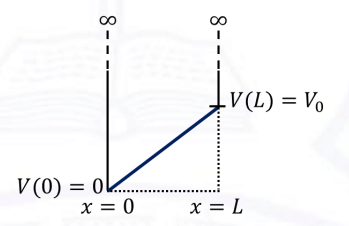
The wavefunction of a particle in one dimension is given by Here and are positive constants. If is the corresponding momentum space wavefunction, which one of the following plots best represents ?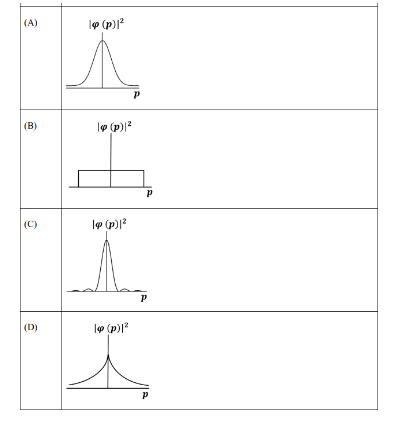
A
B
C
D
Some values of are:
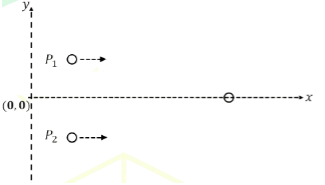
Two projectile protons and , both with spin up (along the -direction), are scattered from another fixed target proton with spin up at rest in the -plane, as shown in the figure. They scatter one at a time. The nuclear interaction potential between both the projectiles and the target proton is , where is the orbital angular momentum of the system with respect to the target, is the spin angular momentum of the system, and is a negative constant in appropriate units. Which one of the following is correct?
where are the spin operators of particles labelled 1, 2, and 3 respectively, and is a constant with appropriate dimensions. The set of possible energy eigenvalues of the system is:
The minimum time after which the electron will be in the spin down state along the -axis, i.e., is:
About Quantum Mechanics - GATE-PH
Quantum Mechanics is a vital chapter for GATE-PH aspirants. Mastering the concepts covered in this chapter is essential for securing a top rank.
By rigorously practicing the previous year questions associated with this chapter, you can identify high-yield topics, understand the examiner's perspective, and boost your confidence during the actual exam.
Frequently Asked Questions
Why focus on Quantum Mechanics PYQs?
Analyzing PYQs for this specific chapter reveals the most frequently tested concepts and the typical complexity of questions, allowing you to tailor your study plan efficiently.
How to best use this analysis?
Review the topic breakdown to see which sub-topics within Quantum Mechanics carry the most weight. Then, tackle the questions iteratively to solidify your understanding.