Thermodynamics
23 previous year questions.
High-Yield Trend
Chapter Questions 23 MCQs
Consider the reaction .
The value of for the reaction at 300 K is -281.8 kJ mol . The value of at same temperature is ......... kJ mol .
[R = 8.3 J K mol ]
For the reaction , the following information is given: The value of for the reaction is ........... J K mol .
The heat of formation of MgO at 300 K and 1 bar pressure is -600.60 kJ mol . The free energy (in kJ mol ) of formation of MgO at 280 K is ......... (Round off to nearest integer)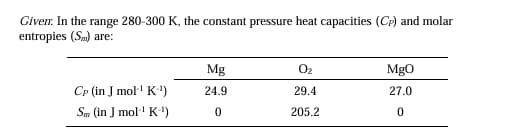
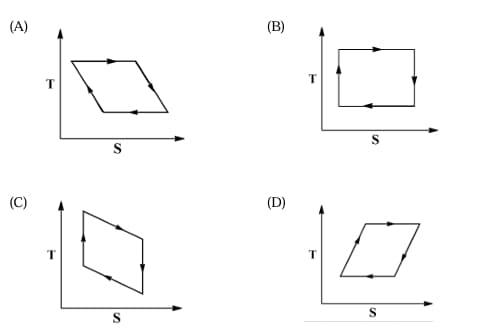
The graph that represents the temperature (T) – entropy (S) variation of a Carnot cycle is
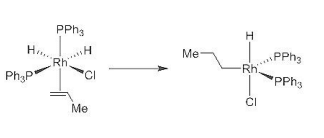
at 2500 K is
The equilibrium constant for the reaction is
[Given: ]




The volume of CO (at STP) required to produce 1 kg of iron is ________liters. (round off to the nearest integer)
[Given: Atomic wt. of Fe = 56; assume STP to be 0 °C and 1 atm]
[Given: R = 8.314 J K-1 mol-1]
2 C6H6+15 O2→12 CO2+6 H2O =−3120 kJ mol−1.
A closed system initially contains 5 moles of benzene and 25 moles of oxygen under standard conditions at 298 K. The reaction was stopped when 17.5 moles of oxygen is left. The amount of heat evolved during the reaction is____kJ.
(round off to the nearest integer)
[Given: Heat of atomization of Cu = +338 kJ/mol,
Ionization energy of Cu = +746 kJ/mol,
Heat of atomization of Cl2 = +121 kJ/mol,
Electron affinity of Cl = −349 kJ/mol, and
Lattice energy of CuCl = −973 kJ/mol]
(round off to the nearest integer)
[Given: R=8.314 J mol-1 K-1 ]
(round off to two decimal places)
C(𝑔) + O2(𝑔)→CO(𝑔) is _______ kJ per mole of CO(𝑔) produced.
(rounded off to one decimal place)
[Given:
C(𝑔)+O2(𝑔) → CO2(𝑔), ΔHrxn = −393.5 kJ per mole of CO2(𝑔) produced
CO2(𝑔) → CO(𝑔) + O2(𝑔), ΔHrxn = 283.0 kJ per mole of CO(𝑔) produced]
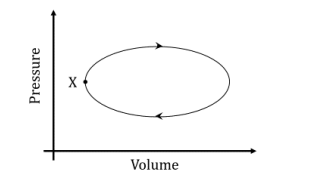
The correct statement about this process is
About Thermodynamics - IIT-JAM-CY
Thermodynamics is a vital chapter for IIT-JAM-CY aspirants. Mastering the concepts covered in this chapter is essential for securing a top rank.
By rigorously practicing the previous year questions associated with this chapter, you can identify high-yield topics, understand the examiner's perspective, and boost your confidence during the actual exam.
Frequently Asked Questions
Why focus on Thermodynamics PYQs?
Analyzing PYQs for this specific chapter reveals the most frequently tested concepts and the typical complexity of questions, allowing you to tailor your study plan efficiently.
How to best use this analysis?
Review the topic breakdown to see which sub-topics within Thermodynamics carry the most weight. Then, tackle the questions iteratively to solidify your understanding.