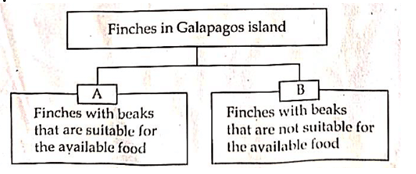
Analyse the illustration and answer the following questions. (a) What happens to finches in A and B categories in terms of survival ? (b) What will happen to the population of finches that survive ? (c) How can these changes in survival lead to the formation of new species of finches ?
Official Solution
Correct Option:
(1)
Step 1: Understanding the illustration.
The diagram shows finches of Galapagos Island divided into two groups. Group A has finches with beaks suitable for the available food, while Group B has finches with beaks not suitable for the available food. This represents natural selection. Step 2: Survival of A and B categories.
Finches in A category will survive better because their beaks are adapted to the available food source. Finches in B category will have less chance of survival because their beaks are not suitable for obtaining food efficiently. Step 3: Effect on the surviving population.
The finches that survive will reproduce and increase in number. As a result, the population will gradually contain more individuals with favourable beak characteristics. Step 4: Role in formation of new species.
Over many generations, these favourable traits are inherited and become more common in the population. Continuous selection, variation, and adaptation to different food habits can make the group more and more distinct from the original population. Step 5: Conclusion.
Thus, natural selection favors finches with suitable beaks, increases their population, and over a long period can lead to the evolution and formation of new species of finches.
02
PYQ 2026
medium
biologyID: kerala-s
A tall round seeded plant (TTRR) is crossed with a dwarf wrinkled seeded plant (ttrr). (a) Write the genotype and phenotype of F plants. (b) If F plants are self-pollinated, write the possible phenotypes in F .
Official Solution
Correct Option:
(1)
Step 1: Identify the dominant and recessive traits.
In this question, T represents the dominant trait for tallness and t represents the recessive trait for dwarfness. Similarly, R represents the dominant trait for round seeds and r represents the recessive trait for wrinkled seeds. Step 2: Write the parental cross.
The given parental cross is:
The first parent can produce only one type of gamete, that is TR, and the second parent can also produce only one type of gamete, that is tr. Step 3: Determine the F genotype and phenotype.
When gametes TR and tr combine, all F offspring will have the genotype:
Since both T and R are dominant, all F plants will show the phenotype tall round seeded. Step 4: Self-pollination of F plants.
Now the F plants are self-pollinated:
This is a typical dihybrid cross. In the F generation, the characters for height and seed shape assort independently, producing different phenotypic combinations. Step 5: Write the possible phenotypes in F .
The possible phenotypes obtained in the F generation are:
Tall round seeded plants
Tall wrinkled seeded plants
Dwarf round seeded plants
Dwarf wrinkled seeded plants
Their phenotypic ratio is:
03
PYQ 2026
medium
biologyID: kerala-s
By giving suitable examples based on the hints, explain there are various situations which differ from Gregor Mendel’s hypothesis. Hints: (a) Incomplete dominance (b) Co-dominance (c) Polygenic inheritance
Official Solution
Correct Option:
(1)
Step 1: Understand Mendel’s hypothesis.
Gregor Mendel proposed that traits are controlled by pairs of factors (genes) where one allele is dominant over the other, leading to clear dominant and recessive phenotypes. However, some inheritance patterns do not follow this simple dominance rule. Step 2: Incomplete dominance.
In incomplete dominance, neither allele is completely dominant over the other, resulting in an intermediate phenotype. Example: When red flowered (RR) and white flowered (rr) plants are crossed, the F generation shows pink flowers (Rr), which is a blend of both traits. Step 3: Co-dominance.
In co-dominance, both alleles express themselves equally in the heterozygous condition. Example: In human blood group system, individuals with genotype AB have both A and B antigens expressed simultaneously. Step 4: Polygenic inheritance.
In polygenic inheritance, a single trait is controlled by multiple genes, leading to continuous variation rather than distinct categories. Example: Human skin colour is determined by multiple genes, resulting in a wide range of shades rather than just two types. Step 5: Conclusion.
These patterns show that inheritance can be more complex than Mendel’s laws, as traits may show blending, equal expression, or continuous variation instead of simple dominant-recessive relationships.
About Heredity And Evolution - KERALA-SSLC-EXAM
Heredity And Evolution is a vital chapter for KERALA-SSLC-EXAM aspirants. Mastering the concepts covered in this chapter is essential for securing a top rank.
By rigorously practicing the previous year questions associated with this chapter, you can identify high-yield topics, understand the examiner's perspective, and boost your confidence during the actual exam.
Frequently Asked Questions
Why focus on Heredity And Evolution PYQs?
Analyzing PYQs for this specific chapter reveals the most frequently tested concepts and the typical complexity of questions, allowing you to tailor your study plan efficiently.
How to best use this analysis?
Review the topic breakdown to see which sub-topics within Heredity And Evolution carry the most weight. Then, tackle the questions iteratively to solidify your understanding.