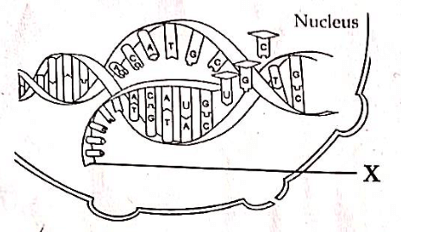
Observe the illustration and answer the following questions. (a) Identify the molecule labelled as ‘X’. (b) Mention its role in protein synthesis.
Official Solution
Correct Option:
(1)
Step 1: Understanding the diagram.
The diagram shows the process of transcription inside the nucleus, where a DNA strand is used as a template to form a complementary RNA strand. The labelled part ‘X’ represents the RNA molecule leaving the nucleus. Step 2: Identification of molecule ‘X’.
The molecule labelled ‘X’ is messenger RNA (mRNA). It is synthesized from DNA during transcription. Step 3: Role of mRNA in protein synthesis.
mRNA carries the genetic information (in the form of codons) from DNA in the nucleus to the ribosomes in the cytoplasm. Step 4: Function during translation.
At the ribosome, mRNA serves as a template for assembling amino acids in the correct sequence to form a protein. Each codon on mRNA corresponds to a specific amino acid. Step 5: Conclusion.
Thus, mRNA acts as a messenger that transfers genetic information from DNA to ribosomes, enabling protein synthesis.
02
PYQ 2026
medium
biologyID: kerala-s
CRISPR is a modern technology used for precise DNA editing. (a) Explain the role of the following in this technology: • Guide RNA • Cas9 enzyme
Official Solution
Correct Option:
(1)
Step 1: Understand CRISPR technology.
CRISPR-Cas9 is a gene-editing tool that allows scientists to cut and modify DNA at specific locations. It works like molecular scissors guided to a target sequence. Step 2: Role of Guide RNA (gRNA).
Guide RNA is responsible for identifying and binding to the specific DNA sequence that needs to be edited. It has a sequence complementary to the target DNA, ensuring high precision in locating the correct site. Step 3: Function of Guide RNA.
Once bound, the guide RNA directs the Cas9 enzyme exactly to the target site on the DNA, acting like a navigator. Step 4: Role of Cas9 enzyme.
Cas9 is an endonuclease enzyme that acts as molecular scissors. It cuts the DNA strands at the specific location identified by the guide RNA. Step 5: Final outcome of the process.
After the DNA is cut, the cell's natural repair mechanisms allow scientists to insert, delete, or modify genes, enabling precise genetic editing.
03
PYQ 2026
medium
biologyID: kerala-s
How does CRISPR gene editing help to change the characteristics of an organism?
Official Solution
Correct Option:
(1)
Step 1: Understanding CRISPR technology.
CRISPR (Clustered Regularly Interspaced Short Palindromic Repeats) is a modern gene-editing tool that allows scientists to precisely modify DNA sequences in an organism. Step 2: Mechanism of action.
It uses a guide RNA (gRNA) to locate a specific DNA sequence and an enzyme called Cas9 to cut the DNA at that exact location. Step 3: Modification of genes.
After the DNA is cut, scientists can add, remove, or replace specific genetic material. This leads to changes in the genetic code of the organism. Step 4: Effect on characteristics.
Since genes control traits (such as color, size, disease resistance), modifying genes results in changes in the organism’s characteristics or phenotype. Step 5: Conclusion.
Thus, CRISPR enables precise and targeted changes in DNA, allowing scientists to alter the characteristics of organisms efficiently.
04
PYQ 2026
medium
biologyID: kerala-s
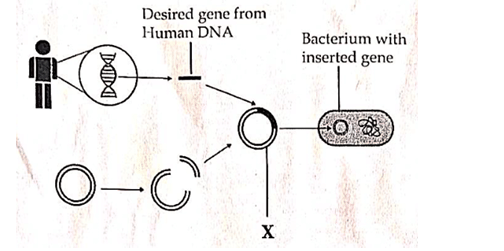
The steps involved in recombinant DNA technology is illustrated below: (a) Identify the DNA into which the cut human gene is ligated. (b) What happens when ‘X’ is inserted into the host cell?
Official Solution
Correct Option:
(1)
Step 1: Understanding recombinant DNA technology.
Recombinant DNA technology involves combining a desired gene (from human DNA) with a vector DNA and then introducing it into a host cell for replication and expression. Step 2: Identify the DNA used for ligation.
The cut human gene is ligated into a plasmid DNA. Plasmids are circular DNA molecules present in bacteria and are commonly used as vectors in genetic engineering. Step 3: Identify ‘X’.
‘X’ represents the recombinant DNA (recombinant plasmid) formed after the insertion of the human gene into the plasmid. Step 4: Explain what happens after insertion into host cell.
When ‘X’ (recombinant plasmid) is inserted into the host bacterial cell, it begins to replicate along with the host DNA. The inserted gene is also expressed, leading to the production of the desired protein. Step 5: Conclusion.
Thus, plasmid acts as the vector for gene insertion, and introduction of recombinant DNA into the host results in cloning and expression of the desired gene.
05
PYQ 2026
medium
biologyID: kerala-s
In gene therapy using stem cells, viruses are mainly used as vectors because they:
1
Help in inserting the active gene into stem cells.
2
Destroy the defective gene in defective cells.
3
Increase the number of stem cells in the body.
4
Convert body cells into stem cells.
Official Solution
Correct Option:
(1)
Step 1: Understanding gene therapy. Gene therapy involves introducing a functional gene into cells to replace or repair a defective gene responsible for a disease. Step 2: Role of vectors. Vectors are carriers that help transfer the desired gene into target cells. Viruses are commonly used as vectors because of their natural ability to enter cells and deliver genetic material. Step 3: Function of viruses in gene therapy. Modified viruses are engineered so that they are harmless but can still carry and insert the required gene into the host cell's DNA. This helps in correcting genetic defects. Step 4: Analysis of options. (a) Correct — Viruses insert the desired gene into stem cells.
(b) Incorrect — Viruses do not directly destroy defective genes.
(c) Incorrect — They do not increase stem cell numbers.
(d) Incorrect — They do not convert body cells into stem cells. Step 5: Conclusion. Thus, viruses are used because they help in inserting the active gene into stem cells.
06
PYQ 2026
medium
biologyID: kerala-s
Which option correctly lists all three components of a single DNA nucleotide?
1
Phosphate, two nitrogen bases and a deoxyribose sugar
2
Deoxyribose sugar, a nitrogen base and a phosphate
3
Deoxyribose sugar, two phosphates and a nitrogen base
4
Deoxyribose sugar, phosphate and an amino acid
Official Solution
Correct Option:
(2)
Step 1: Understand the structure of a nucleotide. A nucleotide is the basic structural unit of DNA. Each nucleotide is composed of three essential components which together form the building block of the DNA molecule. Step 2: Identify the three components. A DNA nucleotide consists of:
A deoxyribose sugar
A nitrogenous base (such as adenine, thymine, cytosine, or guanine)
A phosphate group
Step 3: Analyze the options.
(A) Incorrect. A nucleotide contains only one nitrogen base, not two.
(B) Correct. It correctly lists sugar, base, and phosphate.
(C) Incorrect. A nucleotide has only one phosphate group in its basic unit.
(D) Incorrect. Amino acids are components of proteins, not nucleotides.
Step 4: Conclusion. Thus, the correct components of a DNA nucleotide are deoxyribose sugar, nitrogen base, and phosphate group. Final Answer:} Deoxyribose sugar, a nitrogen base and a phosphate.
About Molecular Genetics - KERALA-SSLC-EXAM
Molecular Genetics is a vital chapter for KERALA-SSLC-EXAM aspirants. Mastering the concepts covered in this chapter is essential for securing a top rank.
By rigorously practicing the previous year questions associated with this chapter, you can identify high-yield topics, understand the examiner's perspective, and boost your confidence during the actual exam.
Frequently Asked Questions
Why focus on Molecular Genetics PYQs?
Analyzing PYQs for this specific chapter reveals the most frequently tested concepts and the typical complexity of questions, allowing you to tailor your study plan efficiently.
How to best use this analysis?
Review the topic breakdown to see which sub-topics within Molecular Genetics carry the most weight. Then, tackle the questions iteratively to solidify your understanding.