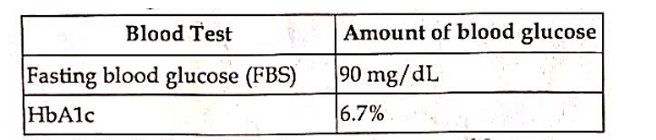
Observe the given blood test result of a person and answer the following questions: (a) Is the fasting blood glucose value normal? (b) Is the given HbA1c value normal? Why? (c) Suggest any two lifestyle habits that people should follow to maintain a normal blood glucose level.
Official Solution
Correct Option: (1)
Step 1: Analyse fasting blood glucose (FBS).
The normal fasting blood glucose level lies between 70β100 mg/dL. The given value is 90 mg/dL, which falls within the normal range. Step 2: Answer part (a).
Yes, the fasting blood glucose value is normal. Step 3: Analyse HbA1c value.
HbA1c represents the average blood glucose level over the past 2β3 months. A normal HbA1c value is usually below 5.7%. Values between 5.7%β6.4% indicate prediabetes, and values 6.5% or above indicate diabetes. The given value is 6.7%. Step 4: Answer part (b).
No, the HbA1c value is not normal because it is above 6.5%, indicating diabetic condition. Step 5: Suggest lifestyle habits.
To maintain normal blood glucose levels, the following habits should be followed:
- Regular physical exercise
- Balanced diet with low sugar and controlled carbohydrate intake Step 6: Answer part (c).
Two lifestyle habits are regular exercise and healthy balanced diet.
02
PYQ 2026
medium
biologyID: kerala-s
A patient shows frequent fatigue and weakness. Blood examination reveals that some red blood cells are sickle-shaped. Based on these observations, answer the following: (a) Identify the reason for this disease. (b) In what other ways does this genetic defect affect the body?
Official Solution
Correct Option: (1)
Step 1: Identify the disease.
The presence of sickle-shaped red blood cells indicates that the patient is suffering from sickle cell anaemia, a genetic blood disorder. Step 2: Cause of the disease.
This disease is caused by a mutation in the gene responsible for haemoglobin formation. The normal haemoglobin (HbA) is replaced by abnormal haemoglobin (HbS), which causes red blood cells to become rigid and sickle-shaped. Step 3: Answer part (a).
Thus, the reason for this disease is a genetic mutation in haemoglobin leading to formation of abnormal HbS. Step 4: Effects of this defect on the body.
Due to the abnormal shape, red blood cells lose their flexibility and may block blood vessels. This leads to:
- Reduced oxygen supply to tissues
- Pain and swelling due to blocked capillaries
- Damage to organs over time
- Shortened lifespan of red blood cells causing anaemia Step 5: Answer part (b).
Therefore, this defect affects the body by causing poor oxygen transport, blockage of blood vessels, organ damage, and anaemia.
03
PYQ 2026
medium
biologyID: kerala-s
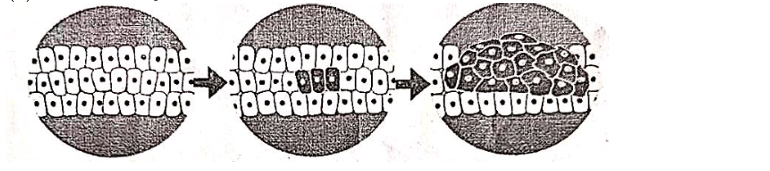
Observe the illustration and answer the following questions. (a) Which defect is shown in the illustration? (b) What are the reasons for the formation of abnormal cells? (c) Mention any two treatment measures of the disease.
Official Solution
Correct Option: (1)
Step 1: Understanding the illustration.
The diagram shows normal cells gradually changing into abnormal cells and then forming a mass of irregular, uncontrolled cells. This indicates uncontrolled cell division. Step 2: Identification of the defect.
The defect shown is cancer. It is characterized by uncontrolled growth and division of cells leading to tumor formation. Step 3: Reasons for abnormal cell formation.
Abnormal cells are formed due to mutations in genes that control cell division. These mutations may be caused by carcinogens such as tobacco, radiation, harmful chemicals, or viral infections. Step 4: Treatment measures.
Two common treatment measures are:
- Chemotherapy: Use of drugs to destroy cancer cells.
- Radiotherapy: Use of high-energy radiation to kill cancer cells. Step 5: Conclusion.
Thus, cancer arises due to uncontrolled cell division, and it can be treated using methods like chemotherapy and radiotherapy.
04
PYQ 2026
medium
biologyID: kerala-s
After a wound occurs, several processes that help in blood clotting are initiated. (a) Which enzyme initiates these reactions? (b) Explain how the activity of this enzyme helps the clotting mechanism.
Official Solution
Correct Option: (1)
Step 1: Identify the initiating enzyme.
When a wound occurs, the clotting process begins with the activation of an enzyme called thrombin. Step 2: Understand the precursor activation.
Thrombin is formed from its inactive precursor prothrombin in the presence of clotting factors such as calcium ions and thromboplastin released from damaged tissues. Step 3: Role of thrombin in clotting.
Thrombin plays a crucial role by converting the soluble plasma protein fibrinogen into insoluble fibrin threads. Step 4: Formation of clot.
These fibrin threads form a mesh-like network that traps blood cells such as red blood cells and platelets, leading to the formation of a blood clot. Step 5: Final outcome.
The clot seals the wound, preventing further blood loss and protecting the body from infection.
05
PYQ 2026
medium
biologyID: kerala-s
A doctor prescribes an antibiotic to a patient and advises continuing the full course even after the symptoms improve. (a) Identify the type of pathogen that can be destroyed using antibiotics. (b) Why is stopping the course too early considered a βmajor concernβ?
Official Solution
Correct Option: (1)
Step 1: Identify the target of antibiotics.
Antibiotics are medicines that specifically act against bacterial infections. They either kill bacteria or inhibit their growth by targeting bacterial cell structures or metabolic pathways. Step 2: Answer part (a).
The type of pathogen that can be destroyed using antibiotics is bacteria. Antibiotics are not effective against viruses or other non-bacterial pathogens. Step 3: Understanding incomplete treatment.
When a patient starts taking antibiotics, the weaker bacteria are killed first, leading to improvement in symptoms. However, some stronger bacteria may still survive in the body. Step 4: Explain the major concern.
If the antibiotic course is stopped too early, the remaining bacteria can multiply again. These surviving bacteria may develop resistance to the antibiotic, making future infections harder to treat. Step 5: Conclusion.
Therefore, completing the full course of antibiotics is essential to completely eliminate the infection and prevent antibiotic resistance.