Aniline on heating with ‘X’ in the presence of KOH gives a product with very bad smell. Which of the following is ‘X’?
1
CH Cl
2
CHCl
3
CH Cl
4
C H Cl
Official Solution
Correct Option: (2)
Step 1: Recall the carbylamine reaction. Primary amines on heating with chloroform (CHCl ) and alcoholic KOH form isocyanides. Step 2: Aniline is a primary aromatic amine. Step 3: When aniline reacts with CHCl and KOH, it forms phenyl isocyanide, which has an extremely foul smell. Step 4: The reaction is:
Step 5: Therefore, the reagent ‘X’ is chloroform (CHCl ).
02
PYQ 2022
medium
chemistryID: lpunest-
Heterolytic fission of an organic covalent bond gives only
1
Free radicals
2
Both cation and anion
3
Only cation
4
Only anion
Official Solution
Correct Option: (2)
Step 1: Recall the meaning of heterolytic fission. In heterolytic bond cleavage, the shared pair of electrons is unequally divided between the two atoms. Step 2: One atom takes both electrons and becomes a negatively charged ion (anion). Step 3: The other atom loses the shared electrons and becomes a positively charged ion (cation). Step 4: Therefore, heterolytic fission always produces one cation and one anion. Step 5: Hence, the correct option is (B).
03
PYQ 2022
medium
chemistryID: lpunest-
Which of the following order is true regarding the acidic nature of phenol?
1
Phenol o-Cresol o-Nitrophenol
2
Phenol o-Cresol o-Nitrophenol
3
Phenol o-Cresol o-Nitrophenol
4
Phenol o-Cresol o-Nitrophenol
Official Solution
Correct Option: (2)
Step 1: Recall that the acidic nature of phenols depends on the stability of the phenoxide ion formed after loss of H . Step 2:Electron-withdrawing groups increase acidity by stabilising the phenoxide ion, while electron-donating groups decrease acidity. Step 3: In o-nitrophenol, the –NO group is a strong electron-withdrawing group, which greatly increases acidity. Step 4: In o-cresol, the –CH group is electron-donating, which decreases acidity compared to phenol. Step 5: Therefore, the relative acidic strength is:
Step 6: This relationship is correctly represented by option (B).
04
PYQ 2022
medium
chemistryID: lpunest-
On ozonolysis 2-methyl-2-butene gives
1
2 moles of CH CHO
2
2 moles of CH COCH
3
CH CHO \& CH COCH
4
CH CHO \& HCHO
Official Solution
Correct Option: (3)
Step 1: Write the structure of 2-methyl-2-butene:
Step 2: Ozonolysis cleaves the C=C double bond and converts each carbon of the double bond into a carbonyl compound. Step 3: The carbon atom attached to two CH groups forms a ketone:
Step 4: The other carbon atom attached to one CH group and one hydrogen forms an aldehyde:
Step 5: Therefore, the products of ozonolysis are CH CHO and CH COCH .
05
PYQ 2022
hard
chemistryID: lpunest-
For the following question, enter the correct numerical value upto TWO decimal places. If the numerical value has more than two decimal places, round-off the value to TWO decimal places. (For example: Numeric value 5 will be written as 5.00 and 2.346 will be written as 2.35) 0.2 g of an organic compound on complete combustion produces 0.44 g of CO2, then the percentage of carbon in it is _____ %.
Official Solution
Correct Option: (1)
Step 1: Determine the mass of carbon in CO . The molar mass of CO is 44 g/mol, and carbon contributes 12 g/mol. Step 2: Use the ratio of masses to find the mass of carbon:
Step 3: Calculate the percentage of carbon in the compound:
Step 4: Correct the mass of compound: given is 0.2 g
Step 5: Check the calculation: mass of carbon in CO2 = g. Percentage = ? Wait, mass of compound = 0.2 g (given), so
06
PYQ 2024
medium
chemistryID: lpunest-
In a reaction involving ring substitution of , the major product is the meta-isomer. The group can be:
1
2
3
4
Official Solution
Correct Option: (2)
Step 1: Recall directing effects in electrophilic aromatic substitution. Substituents on a benzene ring influence the position of incoming electrophiles: Ortho/para directors — donate electron density to the ring.
Meta directors — withdraw electron density from the ring. Step 2: Classify the given substituents. : Strongly electron-donating, ortho/para-directing : Electron-donating (hyperconjugation), ortho/para-directing : Deactivating but donates by resonance, ortho/para-directing : Strongly electron-withdrawing ( and effects), meta-directing Step 3: Identify the meta-directing group. Only the group withdraws electron density from the ring sufficiently to direct substitution predominantly to the meta position. Hence, the correct answer is
07
PYQ 2024
medium
chemistryID: lpunest-
Identify the correct compound formed in the reaction
1
Tetramethylhydrazine and dimethylhydroxylamine
2
Dimethylphenol amine and tetramethylhydrazine
3
Tetramethylhydrazine and tetramethylhydrazine
4
Dimethylhydroxylamine and dimethylhydroxylamine
Official Solution
Correct Option: (1)
Step 1: Secondary amine with strong H SO undergoes oxidation coupling to give hydrazine derivative.
= tetramethylhydrazine → matches first part. Step 2: Primary methyl amine under acidic Hg oxidation forms
= dimethyl hydroxyl amine. Step 3: Option (A) states exactly this pair. Hence → (A).
08
PYQ 2024
medium
chemistryID: lpunest-
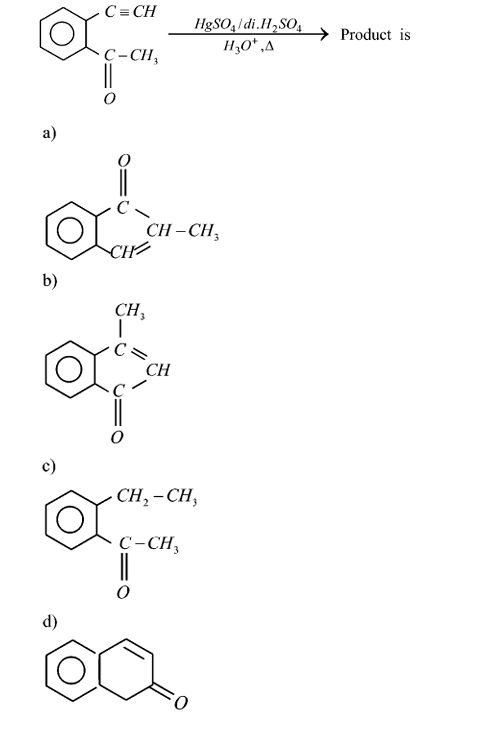
For the reaction shown, the product formed is:
1
Acetophenone type structure
2
Vinyl ketone on benzene
3
Ethyl substituted ketone
4
Cyclohexanone fused to benzene
Official Solution
Correct Option: (4)
Step 1: The reagent set is / dil.\;H SO \) in presence of water and heat. This combination is used for oxymercuration–demercuration of terminal alkynes. Step 2: Terminal alkyne attached to aromatic ring undergoes
via Markovnikov hydration. Step 3: In the given molecule, the side chain is attached to benzene adjacent to a carbonyl group. After hydration the triple bond converts into a methyl ketone ring closure. Step 4: The resulting system behaves as if the alkyne portion forms a six-membered saturated ring with → cyclohexanone fused to benzene. Step 5: Match with options → only (D) represents this transformation.
09
PYQ 2024
medium
chemistryID: lpunest-
How many monochloro derivatives are possible when 3-methylpentane is subjected to free radical chlorination (including isomers)?
1
7
2
5
3
6
4
4
Official Solution
Correct Option: (3)
Step 1: Write the structure of 3-methylpentane: Carbon types: - C and C – equivalent primary (2 sites) - C and C – equivalent secondary (2 sites) - C – tertiary (1 site) - branch methyl – primary (1 site) Step 2: Non-equivalent substitution positions: 1. on terminal primary → 1 product 2. on secondary → 1 product 3. on tertiary → 1 product 4. on branch methyl → 1 product Total constitutionally = 4. Step 3: Secondary carbon substitution creates a chiral centre. Each such gives two enantiomers. There are 2 secondary positions (equivalent) → 2×2 = 4 stereoisomers. Step 4: Add non-chiral others (primary + tertiary + branch = 2). Step 5: Overall monochloro derivatives = 4 + 2 = 6. Hence → (C).
10
PYQ 2024
medium
chemistryID: lpunest-
Hyper conjugation involves overlap of following orbitals
1
σ – π
2
π – π
3
p – p
4
σ – σ
Official Solution
Correct Option: (1)
Step 1: Hyperconjugation is interaction of C–H σ bond with adjacent empty/partially filled π orbital. Step 2: Therefore type = σ–π only. Step 3: π–π is resonance; p–p is covalent sigma. Hence → (A).
11
PYQ 2025
medium
chemistryID: lpunest-
Ammonia evolved from of the soil sample in the Kjeldahl’s method for nitrogen estimation neutralises of . Find the percentage of nitrogen present in the soil.
1
2
3
4
Official Solution
Correct Option: (2)
Step 1: Calculate the moles of sulphuric acid used.
Step 2: Use the reaction between ammonia and sulphuric acid. From the equation:
Step 3: Calculate the mass of nitrogen present. Each mole of contains 1 mole of nitrogen. Step 4: Calculate the percentage of nitrogen in the soil. Final Answer:
12
PYQ 2025
medium
chemistryID: lpunest-
The correct order of increasing chemical reactivity of the following metals is:
1
Zn Fe Mg K
2
Fe Mg Zn K
3
Fe Mg K Zn
4
Fe Zn Mg K
Official Solution
Correct Option: (4)
Step 1: Recall the metal reactivity series. The reactivity series of metals (from most reactive to least reactive) is:
Step 2: Identify the given metals in the series.
Potassium (K) — most reactive
Magnesium (Mg) — highly reactive
Zinc (Zn) — moderately reactive
Iron (Fe) — less reactive
Step 3: Arrange them in increasing order of reactivity (least to most). Step 4: Match with the given options. This order corresponds to option (D).
13
PYQ 2025
medium
chemistryID: lpunest-
Which of the following is liquid at ordinary temperature?
1
Germanium
2
Gallium
3
Gold
4
Galena
Official Solution
Correct Option: (2)
Step 1: Recall the melting points of the given substances.
Germanium: Melting point — solid at ordinary temperature
Gallium: Melting point — melts near room temperature
Gold: Melting point — solid
Galena (PbS): High melting point — solid
Step 2: Identify the substance liquid at ordinary temperature. Since gallium melts slightly above room temperature, it can exist as a liquid at ordinary conditions. Step 3: Final conclusion. The substance that is liquid at ordinary temperature is .
14
PYQ 2025
medium
chemistryID: lpunest-
Which one of the following salts when dissolved in water makes the solution basic?
1
Sodium chloride
2
Copper sulphate
3
Ferric chloride
4
Sodium acetate
Official Solution
Correct Option: (4)
Step 1: Recall the rule for nature of salt solutions.
Salt of strong acid + strong base → neutral solution
Salt of strong acid + weak base → acidic solution
Salt of weak acid + strong base → basic solution
Step 2: Analyze each option.
Sodium chloride (NaCl) Formed from HCl (strong acid) and NaOH (strong base) → neutral solution Copper sulphate (CuSO ) Formed from H SO (strong acid) and Cu(OH) (weak base) → acidic solution Ferric chloride (FeCl ) Formed from HCl (strong acid) and Fe(OH) (weak base) → acidic solution Sodium acetate (CH COONa) Formed from CH COOH (weak acid) and NaOH (strong base) → basic solution ✔
Step 3: Final conclusion. The salt that makes the solution basic when dissolved in water is sodium acetate.