A particle of charge is moving with a velocity m/s in the presence of magnetic and electric fields. If the magnetic field is T and the electric field is NC , then the Lorentz force on the particle is:
1
2
3
4
Official Solution
Correct Option: (3)
The Lorentz force is given by: First, calculate the cross product : Now, adding : Multiplying by : Magnitude:
02
PYQ 2024
medium
physicsID: ts-eamce
A rectangular coil of 400 turns and area, carrying a current of 0.5 A is placed in a uniform magnetic field of 1 T such that the plane of the coil makes an angle of 60° with the direction of the magnetic field. The initial moment of force acting on the coil in Nm is:
1
2
3
1
4
Official Solution
Correct Option: (3)
We are tasked with finding the initial moment of force (torque) acting on a rectangular coil placed in a uniform magnetic field. The given parameters are: Number of turns, ,
Area of the coil, , Current through the coil, , Magnetic field strength, , Angle between the plane of the coil and the magnetic field, . Step 1: Recall the formula for torque on a current-carrying coil The torque ( ) acting on a current-carrying coil in a magnetic field is given by: where: is the number of turns, is the current, is the area of the coil, is the magnetic field strength,
is the angle between the magnetic field and the normal to the plane of the coil. Step 2: Determine the angle The angle is the angle between the plane of the coil and the magnetic field. The angle is the angle between the normal to the plane of the coil and the magnetic field. These two angles are complementary, so: Step 3: Substitute values into the torque formula Substitute the given values into the torque formula: Simplify: Thus, the initial moment of force acting on the coil is 1 Nm.
03
PYQ 2024
medium
physicsID: ts-eamce
The magnetizing field which produces a magnetic flux of in a metal bar of area of cross-section is (susceptibility of the metal = 699):
1
2500 A/m
2
1250 A/m
3
3750 A/m
4
5000 A/m
Official Solution
Correct Option: (2)
Using the magnetic flux and the cross-sectional area , we first calculate the flux density : Given the susceptibility , we find the relative permeability : The absolute permeability is then: Now, solve for :
04
PYQ 2024
medium
physicsID: ts-eamce
If the amplitude of the magnetic field part of a harmonic electromagnetic wave in vacuum is nT, the amplitude of the electric field part of the wave is:
1
2
3
4
Official Solution
Correct Option: (2)
The relation between electric field amplitude and magnetic field amplitude in an electromagnetic wave is: where m/s and T.
05
PYQ 2024
medium
physicsID: ts-eamce
The most exotic diamagnetic materials are:
1
Superconductors
2
Semiconductors
3
Conductors
4
Resistors
Official Solution
Correct Option: (1)
Diamagnetic materials are those which are repelled by a magnetic field. Superconductors exhibit perfect diamagnetism, meaning they expel all magnetic fields when cooled below a certain temperature, which is why they are considered one of the most exotic diamagnetic materials.
06
PYQ 2024
medium
physicsID: ts-eamce
A current flows through a circular loop of radius . The ratio of the magnetic field produced at its centre to the field produced at a point at a distance from its centre on its axis is:
1
2
3
4
Official Solution
Correct Option: (2)
Step 1: The magnetic field at the center of the loop is given by:
where is the current and is the radius of the loop. Step 2: The magnetic field at a distance on the axis of the loop is given by:
Step 3: The ratio of the magnetic fields is:
07
PYQ 2024
medium
physicsID: ts-eamce
Two circular coils of radii and ( ) are placed coaxially with their centers coinciding. The mutual inductance of the arrangement is:
1
2
3
4
Official Solution
Correct Option: (3)
The mutual inductance between two circular coils is given by: where and are the radii of the coils, and implies that the first coil is much smaller than the second coil.
08
PYQ 2024
medium
physicsID: ts-eamce
A magnetic field is applied in y-direction on an -particle traveling along x-direction. The motion of the -particle will be:
1
along x-axis
2
a circle in xz plane
3
a circle in yz plane
4
a circle in xy plane
Official Solution
Correct Option: (2)
Considering the Lorentz force , with along the x-axis and along the y-axis, the force acts in the z-direction, causing circular motion in the xz-plane
09
PYQ 2024
medium
physicsID: ts-eamce
Two particles of charges in the ratio and masses in the ratio moving along a straight line enter a uniform magnetic field at right angles to the direction of the field. If the radii of the circular paths of the particles in the magnetic field are in the ratio , then the ratio of the initial linear momenta of the two particles is:
1
2
3
4
Official Solution
Correct Option: (3)
Step 1: The magnetic force on a charged particle moving in a circular path is given by:
where:
- is the mass of the particle,
- is its velocity,
- is the radius of the circular path. The force experienced by the particle is also equal to the magnetic force:
where:
- is the charge,
- is the magnetic field strength. Equating the two expressions for force gives:
Step 2: Solving for the linear momentum , we get:
Since the velocity is proportional to the radius and the charge, the ratio of linear momenta of the two particles is proportional to the product of the charge and mass ratio. Step 3: Let the charge and mass ratio of the two particles be and . The ratio of the linear momenta is given by:
10
PYQ 2024
medium
physicsID: ts-eamce
The energy stored in a coil of inductance 80 mH carrying a current of 2.5 A is:
1
1.25 J
2
0.75 J
3
0.25 J
4
0.50 J
Official Solution
Correct Option: (3)
The energy stored in an inductor is calculated using the formula: where and . Plugging in the values, we get:
11
PYQ 2024
easy
physicsID: ts-eamce
For the displacement current through the plates of a parallel plate capacitor of capacitance 30 µF to be 150 µA, the potential difference across the plates of the capacitor has to vary at the rate of:
1
10 V/s
2
5 V/s
3
15 V/s
4
20 V/s
Official Solution
Correct Option: (2)
Step 1: Formula for Displacement Current The displacement current in a parallel plate capacitor is given by the equation: Where: - is the displacement current, - is the capacitance of the capacitor, - is the rate of change of the potential difference across the capacitor.
Step 2: Substitute Given Values We are given the following values: - , - . Substitute these values into the formula:
Step 3: Solve for Now, solve for the rate of change of the potential difference: Thus, the rate of change of the potential difference across the plates of the capacitor is:
12
PYQ 2024
medium
physicsID: ts-eamce
A straight wire carrying a current of is making an angle of with the direction of a uniform magnetic field of . The force per unit length on the wire due to the magnetic field is:
1
2
3
4
Official Solution
Correct Option: (3)
Step 1: Magnetic Force Per Unit Length Formula The force per unit length on a current-carrying conductor in a magnetic field is given by: Where: - (magnetic field strength), - (current), - (angle between the current and magnetic field). \vspace{0.5cm}
Step 2: Substitute the Given Values Substitute the values into the formula: Since , we get: Simplifying the expression: Thus, the correct answer is:
13
PYQ 2025
medium
physicsID: ts-eamce
Two long straight parallel wires carry currents of 8 A and 10 A in opposite directions. If the distance of separation between the wires is 9 cm, then the net magnetic field at a point between the two wires, which is at a perpendicular distance of 4 cm from the wire carrying 8 A current is
1
Zero
2
T
3
T
4
T
Official Solution
Correct Option: (3)
The magnetic field (B) at a distance r from a long straight wire carrying current I is given by Ampere's law: . The value of the constant is T·m/A. Let's call the wire with 8 A current wire 1, and the wire with 10 A current wire 2. A, A. The currents are in opposite directions. The point P is between the wires. The distance from wire 1 is . The total separation is 9 cm, so the distance from wire 2 is . At a point between two wires carrying opposite currents, the magnetic fields from both wires point in the same direction (by the right-hand grip rule). Therefore, the net magnetic field is the sum of the individual fields. Magnetic field from wire 1: T. Magnetic field from wire 2: T. The net magnetic field is the sum of and . T.
14
PYQ 2025
medium
physicsID: ts-eamce
The number of turns of two circular coils A and B are 300 and 200 respectively. The magnetic moments of the two coils A and B are in the ratio 1:2. If the two coils carry equal currents, then the ratio of radii of coils A and B is
1
2:
2
2:3
3
1:2
4
1:
Official Solution
Correct Option: (4)
The magnetic moment ( ) of a circular coil is given by the formula , where n is the number of turns, I is the current, and A is the area of the coil. The area of a circular coil with radius r is . So, the magnetic moment is . Let's write down the information given for coil A and coil B. For coil A: , , , . For coil B: , , , . We are given that the currents are equal: . We are given the ratio of their magnetic moments: . Now, let's write the ratio of the magnetic moments using the formula. . Since and is a constant, they cancel out. . We are given this ratio is 1/2. Substitute the known values. . Now, we need to solve for the ratio of the radii, . . Taking the square root of both sides: . The ratio of the radii of coils A and B is .
15
PYQ 2025
medium
physicsID: ts-eamce
A short bar magnet of magnetic moment 2.5 Am is kept in a uniform magnetic field of T. The work done in moving the magnet from its most stable position to most unstable position is
1
J
2
J
3
J
4
J
Official Solution
Correct Option: (4)
The potential energy (U) of a magnetic dipole with moment M in a uniform magnetic field B is given by , where is the angle between the magnetic moment and the magnetic field. The most stable position occurs when the potential energy is minimum. This happens when is maximum, i.e., , which corresponds to . In this position, the magnetic moment is aligned with the field. The potential energy in the most stable position is . The most unstable position occurs when the potential energy is maximum. This happens when is minimum, i.e., , which corresponds to . In this position, the magnetic moment is anti-aligned with the field. The potential energy in the most unstable position is . The work done in moving the magnet from the stable to the unstable position is the change in its potential energy. . . We are given the values: Magnetic moment, Am . Magnetic field, T. Substitute these values to find the work done. . J.
16
PYQ 2025
hard
physicsID: ts-eamce
Two identical wires, carrying equal currents are bent into circular coils A and B with 2 and 3 turns respectively. The ratio of the magnetic fields at the centres of the coils A and B is
1
4:9
2
2:3
3
9:4
4
3:2
Official Solution
Correct Option: (1)
Step 1: Relation between N and r: Let the length of the wire be . For coil A with turns of radius : . For coil B with turns of radius : . Step 2: Magnetic Field Formula: Magnetic field at the center of a coil with turns: . Since is same, . Substituting , we get . Step 3: Calculate Ratio:
17
PYQ 2025
easy
physicsID: ts-eamce
An electron moving along a straight line with a velocity of is subjected to a magnetic field of 3 mT. If the magnetic field is applied perpendicular to the direction of the initial path of the electron, then the radius of the circular path in which the electron moves under the influence of the magnetic field is
(Mass of electron kg and charge of the electron C)
Official Solution
Correct Option: (1)
18
PYQ 2025
medium
physicsID: ts-eamce
A straight wire of length 90 cm carrying a current of 3 A is bent in the form of an equilateral triangular loop and is placed in a uniform magnetic field of T such that the plane of the loop makes an angle of with the direction of the magnetic field. The torque acting on the triangular loop is
1
Nm
2
Nm
3
Nm
4
Nm
Official Solution
Correct Option: (4)
Step 1: Calculate Loop Dimensions:
Total length cm = 0.9 m.
Equilateral triangle side m.
Area of loop . Step 2: Magnetic Moment ( ):
(Here ).
. Step 3: Calculate Torque ( ):
Formula: .
Important: is the angle between the area vector (normal to loop) and the magnetic field.
Given: Plane of loop makes with field.
So, .
The 8 in numerator cancels in denominator.
Step 4: Final Answer:
The torque is Nm.
19
PYQ 2025
medium
physicsID: ts-eamce
As shown in the figure, a uniform straight wire of length cm is bent in the form of an equilateral triangle ABC. A uniform magnetic field 2T is applied parallel to the side BC. If the current through the wire is 2A, the magnitude of the force on the side AC is
1
N
2
N
3
N
4
N
Official Solution
Correct Option: (4)
Step 1: Determine the length of the side of the equilateral triangle.
The total length of the wire is cm.
The triangle has 3 equal sides, so the length of each side ( ) is:
Convert to SI units (meters): .
Step 2: State the formula for the magnetic force on a current-carrying wire.
The magnitude of the magnetic force on a segment of wire of length carrying a current in a uniform magnetic field is given by:
where is the angle between the current direction (along the wire) and the magnetic field .
Step 3: Determine the angle for the side AC.
The magnetic field is applied parallel to the side BC.
The angle between side AC and side BC in an equilateral triangle is (or rad).
The current flows along the sides, and the magnetic field is parallel to BC.
The angle between the current direction on side AC and the magnetic field (parallel to BC) is .
Step 4: Substitute the given values and calculate the force.
Given values: A, m, T, and .
20
PYQ 2025
medium
physicsID: ts-eamce
A proton moving with a velocity of ms enters a uniform magnetic field normal to the direction of the magnetic field. If the radius of the circular path of the proton in the magnetic field is cm, then the magnitude of the magnetic field is (Charge of proton = C and mass of the proton = kg)
1
500 mT
2
100 mT
3
200 mT
4
400 mT
Official Solution
Correct Option: (2)
Step 1: State the formula for the radius of a charged particle's path in a magnetic field.
When a charged particle enters a uniform magnetic field perpendicularly ( ), the magnetic force provides the centripetal force, and the particle moves in a circular path.
The radius of the path is given by:
where is the mass, is the velocity, is the charge, and is the magnetic field magnitude.
Step 2: Solve the formula for the magnetic field .
Rearrange the formula to isolate :
Step 3: Convert the given values to standard units (SI).
Mass of proton: kg.
Velocity: m/s.
Charge of proton: C.
Radius of path: .
Step 4: Substitute the numerical values and calculate B.
Group the numerical and exponential parts:
Simplify the numerical part:
Simplify the exponential part:
Step 5: Convert the result to mT.
Since :
21
PYQ 2025
medium
physicsID: ts-eamce
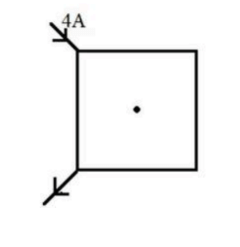
A current of 4 A is passed through a square loop of side 5 cm made of a uniform manganin wire as shown in the figure. The magnetic field at the centre of the loop is
1
T
2
T
3
T
4
Zero
Official Solution
Correct Option: (4)
Step 1: Analyze the Circuit: The figure shows a square loop of uniform wire. Current enters at one corner and leaves at another. Let the side of the square be . The total current is . Let the input terminal be A and the output terminal be B. The current splits into two paths:
1. Short path (one side, length , Resistance ).
2. Long path (three sides, length , Resistance ). Step 2: Current Division: Since the wire is uniform, resistance is proportional to length. Current in short path ( ) and long path ( ) divides inversely to resistance. . . Step 3: Magnetic Field Calculation: The magnetic field at the center of a square side of length carrying current is . Field due to short path (1 side): . (Direction: Out of page, say). Field due to long path (3 sides): . (Direction: Into page). Step 4: Net Field: The magnitudes are equal: . The directions produced by the currents in the two branches at the center are opposite (one clockwise, one counter-clockwise relative to center). Thus, the net magnetic field is . Note: This result holds true for any regular polygon loop of uniform wire where current enters and leaves at any two vertices.
22
PYQ 2025
medium
physicsID: ts-eamce
If and are respectively the vertical and horizontal components of the earth's magnetic field at a place where the angle of dip is , then the total magnetic field at that place is
1
2
3
4
Official Solution
Correct Option: (3)
Step 1: Formulae: Angle of dip . Vertical component . Horizontal component . Total magnetic field . Step 2: Express B in terms of components: From the vertical component equation: . Step 3: Substitute : . (Checking horizontal option: . This is not among the options in that form).
23
PYQ 2025
medium
physicsID: ts-eamce
A coil of resistance , number of turns 250 and area is placed in a uniform magnetic field of 2 T such that the plane of the coil makes an angle of with the direction of the magnetic field. In a time of 100 ms, the coil is rotated until its plane becomes parallel to the direction of the magnetic field. The current induced in the coil is
1
5.25 A
2
3.75 A
3
2.75 A
4
1.25 A
Official Solution
Correct Option: (2)
Step 1: Identify Flux Angles: The magnetic flux is , where is the angle between the normal to the coil and the magnetic field. Initial state: Plane makes with field. So normal makes . Final state: Plane is parallel to field. So normal makes . Step 2: Calculate Flux Change: , T, . Wb. . Change in flux Wb. Step 3: Calculate Induced EMF and Current: Time interval s. Induced EMF V. Induced Current A.
24
PYQ 2025
medium
physicsID: ts-eamce
An inductor and a resistor are connected in series to an ac supply. If the potential differences across the inductor and the resistor are 180 V and 240 V respectively, then the voltage of the ac supply is
1
300 V
2
420 V
3
60 V
4
210 V
Official Solution
Correct Option: (1)
Step 1: AC Circuit Formula: In a series RL circuit connected to an AC source, the voltages across the resistor ( ) and the inductor ( ) are not in phase. leads by . The total supply voltage is the phasor sum: Step 2: Calculation: Given V and V.
25
PYQ 2025
medium
physicsID: ts-eamce
If electromagnetic waves of power 600 W incident on a non-reflecting surface, then the total force acting on the surface is
1
N
2
N
3
N
4
N
Official Solution
Correct Option: (4)
Step 1: Formula for Radiation Pressure Force: When radiation is absorbed (non-reflecting surface), the momentum transfer per unit time is . The force exerted is: where is the speed of light ( m/s). Step 2: Calculation: Power W.
26
PYQ 2025
medium
physicsID: ts-eamce
An alpha particle moving with certain speed towards east enters a uniform magnetic field directed vertically up. The alpha particle will then move in
1
vertical circular path with the same speed
2
horizontal circular path with the same speed
3
vertical circular path with increased speed
4
vertical circular path with decreased speed
Official Solution
Correct Option: (2)
The magnetic force on a charged particle is given by the Lorentz force law: . Here, the particle is an alpha particle, so its charge is positive ( ). The velocity vector is directed towards the east. The magnetic field vector is directed vertically up. The velocity vector and the magnetic field vector are perpendicular to each other. According to the formula for the cross product, the force vector is perpendicular to both and . Using the right-hand rule for a positive charge:
Point fingers in the direction of velocity (East).
Curl fingers in the direction of the magnetic field (Up).
The thumb points in the direction of the force. This direction is South. The force is initially directed towards the South. The velocity is East. Since the force is perpendicular to the velocity, it acts as a centripetal force, causing the particle to move in a circular path. The force vector lies in the East-South direction, which is horizontal. Since the force is always in the horizontal plane (perpendicular to the vertical B-field), the particle's motion will be confined to a horizontal circular path. The magnetic force does no work on the charged particle because the force is always perpendicular to the direction of motion (velocity). Since no work is done, the kinetic energy of the particle remains constant. Therefore, the speed of the particle remains the same. Combining these findings, the alpha particle will move in a horizontal circular path with the same speed.
27
PYQ 2025
medium
physicsID: ts-eamce
The ratios of the voltage sensitivities, resistances and areas of the coils of two moving coil galvanometers A and B are 4:3, 3:4 and 1:2 respectively. If the number of turns of the coil of galvanometer A is 200, then the number of turns of the coil of galvanometer B is (All other quantities remain same in both the cases)
1
100
2
150
3
200
4
400
Official Solution
Correct Option: (1)
The voltage sensitivity ( ) of a moving coil galvanometer is defined as the deflection per unit voltage. , where is the deflection and is the voltage. The deflection is given by , where N is the number of turns, A is the area, B is the magnetic field, k is the torsional constant, and I is the current. Voltage , where R is the resistance of the coil. Substituting these into the sensitivity formula: . We are given that all other quantities (B and k) remain the same. So, we can write the proportionality: . We are given the ratios for galvanometer A and B: . . . We can set up a ratio of the sensitivities using the proportionality: . Now, substitute the given ratios: . The term cancels from both sides: . This gives the relationship between the number of turns: . We are given that the number of turns for galvanometer A is . .
28
PYQ 2025
medium
physicsID: ts-eamce
A square coil of side 10 cm having 200 turns is placed in a uniform magnetic field of 2 T such that the plane of the coil is in the direction of magnetic field. If the current through the coil is 3 mA, then the torque acting on the coil is
1
Nm
2
Nm
3
Nm
4
Zero
Official Solution
Correct Option: (1)
Step 1: Understanding the Concept:
A current-carrying loop placed in a magnetic field experiences a torque. The magnitude of this torque depends on the magnetic moment of the loop, the strength of the magnetic field, and the orientation of the loop with respect to the field. Step 2: Key Formula or Approach:
The torque ( ) on a coil is given by the vector product of its magnetic dipole moment ( ) and the magnetic field ( ):
The magnitude of the torque is:
where:
- is the magnitude of the magnetic moment.
- is the number of turns.
- is the current.
- is the area of the coil.
- is the angle between the magnetic moment vector and the magnetic field vector . Step 3: Detailed Explanation:
First, let's list the given values in SI units:
- Side of the square coil, .
- Area of the coil, .
- Number of turns, .
- Magnetic field strength, .
- Current, . Next, determine the angle . The problem states "the plane of the coil is in the direction of magnetic field". This means the magnetic field lines are parallel to the surface of the coil. The magnetic moment vector is, by definition, perpendicular to the plane of the coil. Therefore, the angle between and is . Now, calculate the magnetic moment :
Finally, calculate the torque :
Since , the torque is at its maximum value. Step 4: Final Answer:
The torque acting on the coil is Nm. Therefore, option (A) is correct.
29
PYQ 2025
medium
physicsID: ts-eamce
The magnetic field due to a current carrying circular coil on its axis at a distance of from the centre of the coil is B. If d is the diameter of the coil, then the magnetic field at the centre of the coil is
1
18B
2
27B
3
3B
4
9B
Official Solution
Correct Option: (2)
Step 1: Understanding the Concept:
This problem involves the formulas for the magnetic field produced by a circular current loop, both at its center and at a point along its axis. We need to establish a relationship between the two. Step 2: Key Formula or Approach:
Let be the radius of the coil.
- The magnetic field at the center of the coil is: .
- The magnetic field at a distance from the center on its axis is: . Step 3: Detailed Explanation:
First, let's relate the given distances to the radius .
- Diameter of the coil = .
- Radius of the coil, .
- The distance from the center, . We are given that the field at this distance is . Let's write the expression for :
Now, simplify the denominator:
So, the expression for B becomes:
We need to find the magnetic field at the center, :
To relate to , we can express from equation (1):
Now substitute this into equation (2): Step 4: Final Answer:
The magnetic field at the centre of the coil is 27B. Therefore, option (B) is correct.
30
PYQ 2025
medium
physicsID: ts-eamce
If the magnetic susceptibility of a substance is 0.6, then the ratio of permeability of the substance and permeability of free space is
1
6:5
2
7:4
3
8:5
4
3:5
Official Solution
Correct Option: (3)
Step 1: Understanding the Concept:
We need to find the relative permeability , which is the ratio of the permeability of the substance to that of free space . Step 2: Key Formula or Approach:
Relative permeability , where is the magnetic susceptibility.
Also . Step 3: Detailed Explanation:
Given .
Convert to fraction:
Thus, the ratio . Step 4: Final Answer:
The ratio is 8:5.
31
PYQ 2025
medium
physicsID: ts-eamce
A solenoid of length 50 cm and radius 10 cm has two closely wound layers of windings 100 turns each. If a current of 2.5 A is passing through the windings, the magnetic field (in T) at a point 5 cm from the axis is
1
2
31.4
3
4
Zero
Official Solution
Correct Option: (3)
Step 1: Understanding the Concept:
The magnetic field inside a long solenoid is uniform and parallel to the axis. The point 5 cm from the axis is inside the solenoid (since radius is 10 cm). The total magnetic field is due to both layers of windings. Step 2: Key Formula or Approach:
Magnetic field inside a solenoid: .
Where is turns per unit length.
For multiple layers, is the total number of turns or simply add the fields if layers are in series. Here, we use total turns density. Step 3: Detailed Explanation:
Given:
Length .
Total turns (two layers of 100 each).
Current .
Permeability . Calculate :
Calculate :
The question asks for the value in .
Value . Step 4: Final Answer:
The magnetic field is T.
32
PYQ 2025
medium
physicsID: ts-eamce
A proton and an alpha particle moving with equal speeds enter normally into a uniform magnetic field. The ratio of times taken by the proton and the alpha particle to make one complete revolution in the magnetic field is
1
2
3
4
Official Solution
Correct Option: (2)
Step 1: Understanding the Concept:
A charged particle moving perpendicular to a magnetic field executes circular motion. The time period of revolution depends on the charge-to-mass ratio but is independent of speed. Step 2: Key Formula or Approach:
Time period of revolution:
Ratio:
Step 3: Detailed Explanation:
For Proton ( ):
Mass , Charge .
For Alpha particle ( ):
Mass (2 protons + 2 neutrons), Charge . Substitute into ratio:
Step 4: Final Answer:
The ratio is 1:2.
33
PYQ 2025
medium
physicsID: ts-eamce
The magnetic field (in T) at the centre of a toroid of mean radius 10 cm with 200 turns and carrying a current of 2.5 A is:
1
2
10
3
5
4
Zero
Official Solution
Correct Option: (1)
• Magnetic field inside toroid: . • m, , A, T·m/A. • T. • Hence correct answer: in T units}.
34
PYQ 2025
medium
physicsID: ts-eamce
Two charged particles enter a uniform magnetic field normally. If the ratio of the specific charges of the two particles is 2:3, then the ratio of the times taken by the two particles to complete one revolution is:
1
1:1
2
3:2
3
9:4
4
3:2
Official Solution
Correct Option: (2)
• Cyclotron motion period . • Given . • Period ratio . • Hence correct answer: 3:2.
35
PYQ 2025
medium
physicsID: ts-eamce
If the time period of an alpha particle rotating in a circular path of radius 2 fermi is 3.14 s, then the magnetic field induced at the centre of the circle is nearly
1
48 T
2
16 T
3
32 T
4
64 T
Official Solution
Correct Option: (1)
1. Magnetic field at the center of circular current loop: . 2. Current where = charge of alpha particle, = time period. 3. Given: s, fermi = m, C.
4.
36
PYQ 2025
medium
physicsID: ts-eamce
A galvanometer of resistance 8 gives full scale deflection for a current of 4 mA. The resistance to be connected in series to the galvanometer to convert it into a voltmeter to measure a maximum potential difference of 20 V is
1
4992
2
5008
3
3992
4
4008
Official Solution
Correct Option: (1)
1. To convert a galvanometer into a voltmeter: , where = full scale deflection current, = galvanometer resistance, = series resistance. 2. Given: V, mA = 0.004 A, . 3. Series resistance required: