UPSC Mains Economics
Distinguish Between The Human Development Index H
Low Priority
Consistency: 7%
Weightage: 1 / 15 Yrs
High-Yield Trend
1
2025 Questions 1 MCQs
01
PYQ 2025
mains
medium
economics ID: upsc-202
Distinguish between the Human Development Index (HDI) and Inequality-adjusted Human Development Index (IHDI) with special reference to India. Why is the IHDI considered a better indicator of inclusive growth?
Official Solution
Correct Option:
The HDI measures average achievements in **health, education and income**, but ignores inequalities within society. The IHDI adjusts HDI by accounting for distributional inequalities, thereby reflecti
The HDI measures average achievements in **health, education and income**, but ignores inequalities within society. The IHDI adjusts HDI by accounting for distributional inequalities, thereby reflecting the actual level of human development experienced by people. India's IHDI reveals a stark **30.7% loss in human development potential** due to inequality, highlighting the critical gap between average progress and inclusive growth. ## Distinguishing HDI and IHDI | Aspect | HDI | IHDI |
|--------|-----|------|
| **Methodology** | Average achievements in health, education, living standards | HDI adjusted for inequality using Atkinson index |
| **Data Approach** | Country-level aggregated data | Distribution-sensitive analysis |
| **Focus** | Overall development level | Inclusive development outcomes | ### HDI Framework
- Measures **life expectancy at birth**, **mean years of schooling**, and **GNI per capita**
- Provides snapshot of average human development
- India ranks **130th globally** with HDI of 0.685 (2023) 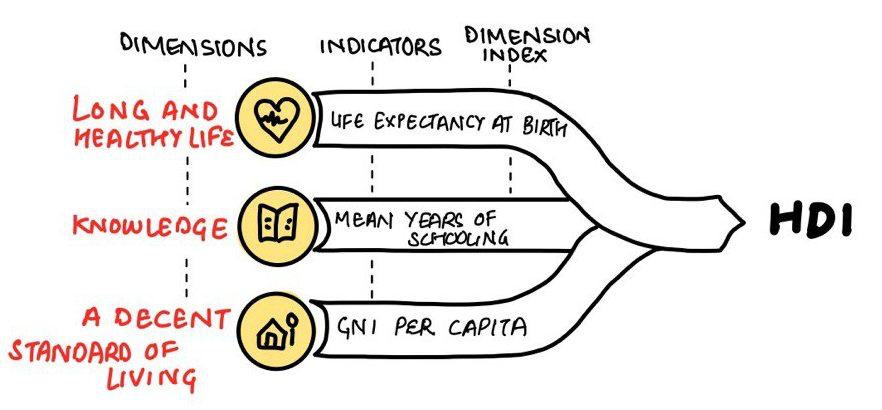 ### IHDI Enhancement
- Incorporates **inequality penalties** across all three dimensions
- Reveals actual development distribution among population
- India's Inequality-Adjusted Human Development Index (IHDI) dropped to **0.475, reflecting a significant loss due to disparities in health, education, and income**, despite its overall HDI improving to **0.685 in the 2023-2024 Human Development Report**. 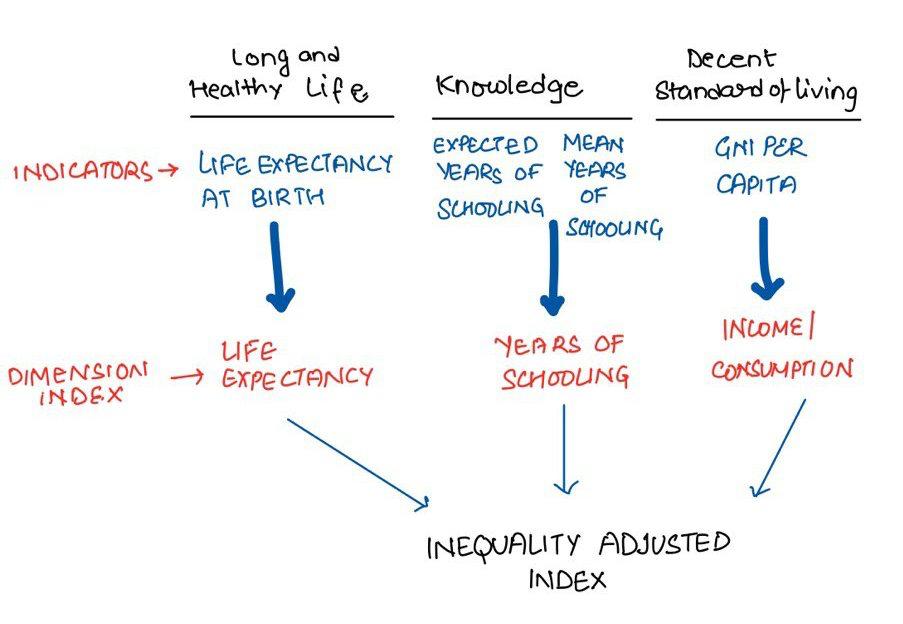 ## India's Performance Analysis ### Regional Disparities
- **Kerala** leads with highest HDI while **Bihar** lags.
- **Gender inequality** contributes significantly to IHDI reduction
- **Caste-based disparities** further widen development gaps ### Sectoral Variations
- **Health inequalities**: Rural-urban divide in maternal mortality
- **Educational gaps**: Digital divide affecting online learning access
- **Income distribution**: Top 1% holds 22% of national wealth ## IHDI as Superior Indicator of Inclusive Growth ### Comprehensive Assessment
- Captures **"leave no one behind"** principle of SDGs
- Reflects impact of schemes like **PM-JAY** and **Samagra Shiksha**
- Identifies beneficiaries left out of development process ### Policy Relevance
- Guides targeted interventions through **Aspirational Districts Programme**
- Supports **National Education Policy 2020** implementation
- Informs **Ayushman Bharat** coverage expansion strategies ### Development Planning
- Enables monitoring of **SDG 10** (Reduced Inequalities)
- Facilitates evidence-based resource allocation
- Supports **PM Gati Shakti** infrastructure planning IHDI's inequality-adjusted approach makes it indispensable for India's pursuit of **inclusive growth**, ensuring development benefits reach every citizen across socio-economic strata.