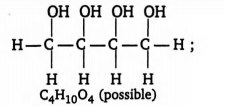
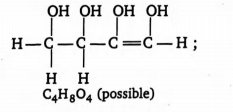
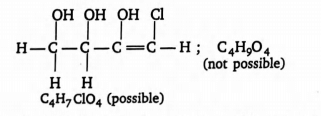
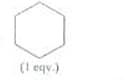
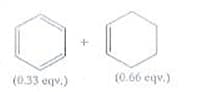
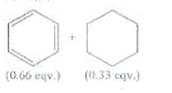
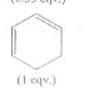
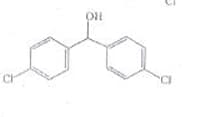
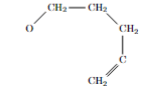
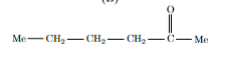
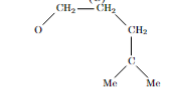
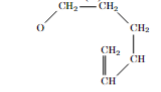
Which one of the following formulae does not represent an organic compound?
1
2
3
4
Official Solution
Correct Option: (4)
is type compound, ie with unsaturation factor and are (unsaturated) type compound, ie, have unsaturation factor 1 while is type compound with unsaturation factor 0.5. Hence, does not represent an organic compound.
undefinedundefined
02
PYQ 2009
medium
chemistryID: wbjee-20
Which of the following carbocations will be most stable ?
1
2
3
4
Official Solution
Correct Option: (1)
The order of stability of given carbocations is
03
PYQ 2011
medium
chemistryID: wbjee-20
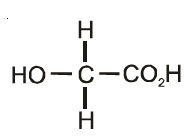
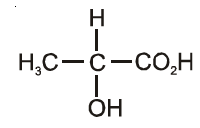
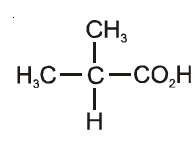
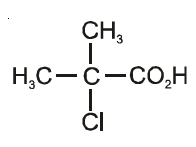
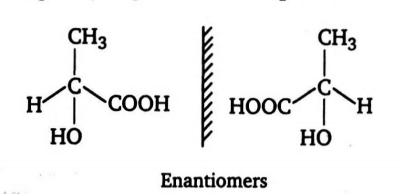
Which one of the following will show optical isomerism?
1
2
3
4
Official Solution
Correct Option: (2)
-hydroxypropanoic acid has a central carbon atom, which is linked to four different groups. This carbon atom is called chiral carbon atom and the molecule is called chiral molecule. Hence, -hydroxy propanoic acid shows optical isomerism.
04
PYQ 2011
medium
chemistryID: wbjee-20
Hybridization of and of are
1
2
3
4
Official Solution
Correct Option: (2)
N/A
05
PYQ 2018
medium
chemistryID: wbjee-20
Ferric ion forms a Prussian blue precipitate due to the formation of
1
2
3
4
Official Solution
Correct Option: (4)
Ferric ion forms a prussian blue precipitate due to the formation of . This complex is formed during the determine action of presence of nitrogen in the given sample. In this method, to portion of sodium fusion extract, freshly prepared ferrous sulphate, solution is added and warmed. Then about 2 to 3 drops of solution are added and acidified with conc. HCl. The appearance of a prussian blue colour indicate the presence of nitrogen.
06
PYQ 2022
medium
chemistryID: wbjee-20
What is the correct order of acidity of salicylic acid, 4-hydroxybenzoic acid, and 2,6-dihydroxybenzoic acid?
To determine the acidity order, we need to consider the effects of the hydroxyl groups on the acidity of the benzoic acid.
Step 1: Draw the Structures
Let's draw the structures of the three compounds:
Salicylic acid (2-hydroxybenzoic acid): The hydroxyl group is in the ortho position.
4-hydroxybenzoic acid: The hydroxyl group is in the para position.
2,6-dihydroxybenzoic acid: There are two hydroxyl groups in the ortho positions.
Step 2: Factors Affecting Acidity
Several factors influence the acidity of organic acids:
Inductive effect: Electron-withdrawing groups increase acidity, while electron-donating groups decrease acidity.
Resonance effect: Groups that stabilize the conjugate base increase acidity.
Ortho effect: Substituents in the ortho position can have a significant effect on acidity due to steric and electronic interactions. This is complex and not predictable just by looking at inductive and resonance effect.
Intramolecular hydrogen bonding: Can stabilize the conjugate base (increase acidity) or the acid itself (decrease acidity).
Step 3: Acidity Analysis of the Given Compounds
4-hydroxybenzoic acid:
The hydroxyl group in the para position has a weaker effect on acidity because it is farther from the carboxyl group. The -OH group exhibits both +R (resonance) and -I (inductive) effects. Usually, the +R effects counteract each other, and the -I effect slightly decreases the acidity of the compound relative to benzoic acid.
Salicylic acid (2-hydroxybenzoic acid):
The hydroxyl group in the ortho position has a stronger effect than in the para position. The ortho effect and intramolecular hydrogen bonding influence acidity. Salicylic acid benefits from intramolecular hydrogen bonding which stabilises the conjugate base, increasing its acidity.
2,6-dihydroxybenzoic acid:
The presence of two hydroxyl groups in the ortho positions further increases the acidity. The effect of one hydroxyl group in ortho is stabilising the conjugate base through hydrogen bonding. With two OH groups, more hydrogen bonding is possible, stabilising the anion more than in salicylic acid.
Step 4: Putting It All Together
Based on the analysis, we can conclude the following acidity order:
The correct order of acidity is: 2, 6-dihydroxybenzoic acid > salicylic acid > 4- hydroxybenzoic acid.
07
PYQ 2022
medium
chemistryID: wbjee-20
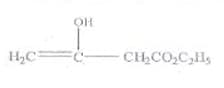
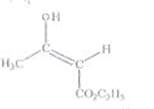
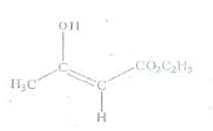
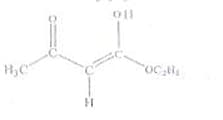
The enol form in which ethyl-3-oxobutanoate exists is
1
2
3
4
Official Solution
Correct Option: (3)
To determine the correct enol form of ethyl-3-oxobutanoate, we analyze the compound's tendency to undergo keto-enol tautomerism.
Step-by-step Analysis:
1. Structure of Ethyl-3-oxobutanoate: This is a β-keto ester with a ketone at the 3-position and an ester at the 1-position. Such compounds readily exhibit keto-enol tautomerism.
2. Enol Formation: The hydrogen at the alpha carbon (between the ester and ketone groups) is acidic and can be removed to form a double bond with the carbon adjacent to the ketone. The carbonyl oxygen of the ketone becomes an OH group.
3. Stability of Enol: The most stable enol is typically the one where the OH group is hydrogen bonded to the ester oxygen, forming a six-membered ring. Additionally, conjugation between the C=C bond and the ester group enhances stability.
4. Evaluating the Options: Among the given images, the correct enol form is the one where: - A C=C bond is formed between the alpha and carbonyl carbon - The ketone oxygen is converted into an OH group - Intramolecular hydrogen bonding and conjugation are possible
Conclusion: The correct enol form is shown in the third image.
08
PYQ 2022
medium
chemistryID: wbjee-20
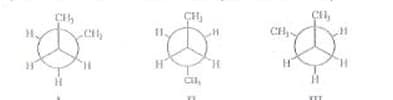
The correct order of relative stability of the given conformers of n-butane is
1
II>I = III
2
II>III>I
3
II>I>III
4
I = III>II
Official Solution
Correct Option: (1)
To determine the relative stability of the given conformers of n-butane, we analyze the Newman projections about the central C–C bond.
Conformer II: This is the anti-conformation where the two methyl groups (CH₃) are 180° apart. It is the most stable due to minimal steric hindrance.
Conformer I and III: Both are gauche conformations, where the methyl groups are 60° apart. These are less stable than anti due to gauche interactions (steric repulsion between bulky groups), but they are equally stable with respect to each other.
Hence, the correct order of relative stability is:
II > I = III
09
PYQ 2022
medium
chemistryID: wbjee-20
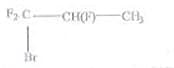
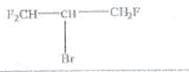
The major product of the following reaction is
1
F3C-----CH2----CH2Br
2
F3C------CH(Br)------CH3
3
4
Official Solution
Correct Option: (1)
The reaction is the addition of HBr to an alkene:
This follows the electrophilic addition mechanism. Since there is no peroxide present, the addition follows Markovnikov’s rule.
According to Markovnikov’s rule, the hydrogen (H) adds to the carbon of the double bond that already has more hydrogens, and the bromine (Br) adds to the other carbon.
In the given compound: - The terminal carbon ( ) gets the H - The middle carbon (adjacent to ) gets the Br
However, the group is strongly electron-withdrawing, making the formation of a carbocation at the adjacent carbon (near CF₃) highly unstable. Therefore, instead of a Markovnikov product, the reaction favors anti-Markovnikov addition due to the destabilization of the carbocation by the electron-withdrawing group.
Thus, the H⁺ adds to the middle carbon and Br⁻ adds to the terminal one, forming:
Answer:F₃C–CH₂–CH₂Br
10
PYQ 2022
medium
chemistryID: wbjee-20
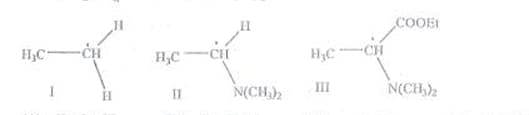
The correct order of relative stability for the given free radical is:
1
II>I>III
2
II>III>I
3
III>I>II
4
III>II>I
Official Solution
Correct Option: (1)
The correct order of stability is II > I > III.
Here's why:
Free Radical Stability: Free radical stability is primarily determined by the degree of substitution. More substituted free radicals are more stable. This is due to hyperconjugation (overlap of the singly occupied p-orbital with sigma bonds on adjacent carbon atoms) and inductive effects (electron donation from alkyl groups).
Radical I: Radical I is a secondary allylic free radical. The allylic stabilization from the adjacent double bond makes it more stable than simple secondary radicals.
Radical II: Radical II is a tertiary free radical. It is more stable than secondary or primary radicals due to hyperconjugation. Since it's also benzylic, with the unpaired electron delocalized across the benzene ring, it has greater stability. Benzyl radicals are more stable than allyl radicals. Hence this is most stable.
Radical III: Radical III is a primary free radical. The primary radicals are the least stable because there are fewer alkyl groups that can stabilize the carbon atom with the unpaired electron through hyperconjugation or inductive effects.
Because radical II benefits from tertiary and benzylic stabilization, is most stable; radical I is only stabilized through allylic and secondary carbons, and radical III is only stabilized through a primary carbon, it follows that the order of stability is II > I > III.
Correct Answer: II > I > III
11
PYQ 2022
medium
chemistryID: wbjee-20
The product of the following hydrogenation reaction is:
1
2
3
4
Official Solution
Correct Option: (3)
The correct product is Option 3.
Here's why:
Hydrogenation: Hydrogenation is the addition of hydrogen (H2) to a molecule, typically in the presence of a metal catalyst (like Pt, Pd, or Ni). It's commonly used to reduce multiple bonds (alkenes and alkynes) to single bonds (alkanes).
Catalytic Hydrogenation and Stereochemistry: In catalytic hydrogenation with a metal catalyst, hydrogen adds to the *same face* of the double bond (syn addition). This is because both hydrogen atoms are adsorbed onto the surface of the metal catalyst, and the alkene approaches the catalyst surface from one side.
Analyzing the Reactant and Products: The reactant contains a double bond in a cyclic system. Option 3 shows the addition of two hydrogen atoms on the *same side* of the ring (syn addition). Therefore, only **Option 3** corresponds to this stereochemical outcome. Other products show anti addition that doesn't match the process.
Therefore, the product of the hydrogenation reaction is the isomer in which both hydrogen atoms have been added to the *same face* of the original double bond, corresponding to the structure in Option 3.
Correct Answer: Option 3
12
PYQ 2022
medium
chemistryID: wbjee-20
The product of the following reaction is:
1
2
3
4
Official Solution
Correct Option: (1)
The Reaction: The reaction is an intramolecular aldol condensation. The starting material is a dialdehyde. Under basic conditions, one aldehyde can act as a nucleophile and attack the other aldehyde in the same molecule, forming a cyclic aldol product. Heat then causes dehydration, leading to the formation of a cyclic , -unsaturated aldehyde.
Mechanism: The base removes a proton from an -carbon of one of the aldehyde groups, creating an enolate. This enolate then attacks the other aldehyde group intramolecularly. After protonation, this is followed by dehydration (loss of water) to form a stable , -unsaturated carbonyl compound.
Product Formation: The specific structure of the starting material dictates the ring size of the cyclic product. In this case, a six-membered ring is formed, with the double bond in conjugation with the carbonyl group.
Therefore, the aldol condensation reaction leads to the formation of the cyclic enone product shown in Option 1.
Correct Answer: Option 1
13
PYQ 2022
medium
chemistryID: wbjee-20
Which of the following would produce enantiomeric products when reacted with methyl magnesium iodide?
1
Benzaldehyde
2
Propiophenone
3
Acetone
4
Acetaldehyde
Official Solution
Correct Option: (1)
Grignard Reaction: Methyl magnesium iodide (CH3MgI) is a Grignard reagent, which is a strong nucleophile. It reacts with carbonyl compounds (aldehydes and ketones) to form alcohols.
Chirality: A molecule is chiral if it is non-superimposable on its mirror image (i.e., it has a stereocenter with four different substituents).
Benzaldehyde (C6H5CHO): Reaction with CH3MgI followed by protonation gives 1-phenylethanol (C6H5CH(OH)CH3). The carbon atom bonded to the OH group is attached to a phenyl group, a methyl group, a hydrogen atom, and an OH group. These are four different groups, so it is a chiral center, creating a pair of enantiomers.
Propiophenone (C6H5C(=O)CH2CH3): Reaction with CH3MgI followed by protonation gives 2-phenylbutan-2-ol (C6H5C(OH)(CH3)CH2CH3). The carbon atom bonded to the OH group is attached to a phenyl group, a methyl group, an ethyl group, and an OH group. These are four different groups, so it is a chiral center, creating a pair of enantiomers.
Acetone (CH3C(=O)CH3): Reaction with CH3MgI followed by protonation gives 2-methylpropan-2-ol ((CH3)3COH). The carbon bonded to the OH group is attached to three methyl groups and an OH group. It has two or more identical groups attached to it, so it is *not* chiral.
Acetaldehyde (CH3CHO): Reaction with CH3MgI followed by protonation gives propan-2-ol (CH3CH(OH)CH3). The carbon bonded to the OH group is attached to two methyl groups, a hydrogen, and an OH group. It has two or more identical groups attached to it, so it is *not* chiral.
Therefore, only benzaldehyde and propiophenone produce chiral alcohols (and thus enantiomers) upon reaction with methyl magnesium iodide.
Correct Answer: Benzaldehyde, Propiophenone
14
PYQ 2023
easy
chemistryID: wbjee-20
The correct stability order of the following carbocations is : (I)H2C⨁-CH=CH-CH3, (II)⨁CH2-CH=CH-BMe2, (III)H2C⨁-CH=CH-NMe2, (IV)H2C⨁-CH=CH-OMe
1
II>I>III>IV
2
III>I>II>IV
3
III>IV>I>II
4
IV>III>II>I
Official Solution
Correct Option: (3)
Stability Order of the Given Carbocations:
The stability of a carbocation depends on:
Resonance effects: Delocalization of the positive charge increases stability.
Inductive effects: Electron-donating groups stabilize the carbocation, while electron-withdrawing groups destabilize it.
⁺CH2–CH=CH–BMe2: Allylic, but boron is an electron-withdrawing group → destabilizes.
H2C⁺–CH=CH–NMe2: Allylic, NMe2 is an electron-donating group via resonance → highly stabilized.
H2C⁺–CH=CH–OMe: Allylic, OMe is also electron-donating → stabilizes, but not as strongly as NMe2.
Stability order:III > IV > I > II
Correct option: (C)
15
PYQ 2024
medium
chemistryID: wbjee-20
The correct acidity order of phenol (I), 4-hydroxybenzaldehyde (II), and 3-hydroxybenzaldehyde (III) is:
1
I
2
I
3
II
4
III
Official Solution
Correct Option: (2)
Phenol is acidic due to the resonance stabilization of the phenoxide ion. The introduction of an electron-withdrawing group such as -CHO increases acidity by stabilizing the negative charge on the oxygen atom.
4-Hydroxybenzaldehyde (II): The -CHO group at the para position exerts the maximum electron-withdrawing effect due to resonance and inductive effects, making II the most acidic.
3-Hydroxybenzaldehyde (III): The -CHO group at the meta position provides a lesser electron-withdrawing effect compared to the para position, making III less acidic than II but more acidic than I.
Phenol (I): Without any substituents, phenol has the lowest acidity among the three compounds.
Therefore, the acidity order is I.
16
PYQ 2025
medium
chemistryID: wbjee-20
Which of the following statement(s) is/are correct about the given compound?
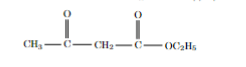
1
It exhibits tautomerism.
2
It does not react with metallic sodium.
3
It gives reddish-violet coloration with FeCl solution.
4
It gives precipitate with 2,4-dinitrophenyl hydrazine solution.
Official Solution
Correct Option: (1)
The given compound is ethyl 3-oxobutanoate, commonly known as ethyl acetoacetate. It is a β-keto ester. Let's analyze each statement:
(A) It exhibits tautomerism: This compound has α-hydrogens located on the CH2 group between the two carbonyl groups (ketone and ester). These hydrogens are relatively acidic, allowing the compound to exist in equilibrium between its keto form and its enol form (keto-enol tautomerism). Therefore, this statement is correct.
(B) It does not react with metallic sodium: The α-hydrogens of ethyl acetoacetate are significantly acidic (pKa ≈ 11) due to the electron-withdrawing effect of both adjacent carbonyl groups, which stabilize the resulting enolate anion. Active metals like sodium react with acidic hydrogens to liberate H2 gas. Thus, ethyl acetoacetate does react with metallic sodium. The statement is incorrect.
(C) It gives reddish-violet coloration with FeCl3 solution: The ferric chloride (FeCl3) test is typically positive for phenols and enols. Since ethyl acetoacetate exists in equilibrium with its enol tautomer, it usually gives a positive FeCl3 test, often resulting in a reddish or violet color due to complex formation between Fe3+ and the enol form. This statement is generally considered correct in qualitative analysis. (Note: While likely correct, it was not specified as correct by the user.)
(D) It gives precipitate with 2,4-dinitrophenyl hydrazine solution: 2,4-Dinitrophenylhydrazine (2,4-DNPH, Brady's reagent) reacts with the carbonyl group of aldehydes and ketones to form 2,4-dinitrophenylhydrazones, which are typically solid precipitates, often yellow, orange, or red. Ethyl acetoacetate contains a ketone group (-C(=O)CH3), which will react with 2,4-DNPH. Therefore, this statement is correct.
Based on the analysis and the user-provided correct options, statements (A) and (D) are correct.
17
PYQ 2025
medium
chemistryID: wbjee-20
Arrange the following compounds in order of their increasing acid strength

1
I II III IV
2
IV III II I
3
I IV II III
4
II I III IV
Official Solution
Correct Option: (3)
The acid strength of dicarboxylic acids (considering the first ionization, pKa1) depends mainly on the stability of the conjugate base formed after losing the first proton. The primary factor influencing this stability is the inductive electron-withdrawing effect (-I effect) of the second carboxyl group (-COOH) on the first one.
The -COOH group is electron-withdrawing. When one proton is lost, the resulting carboxylate ion (-COO-) is stabilized by the -I effect of the remaining -COOH group.
The strength of the inductive effect decreases rapidly with distance. Therefore, the closer the two -COOH groups are, the stronger the stabilization of the conjugate base, and the stronger the acid (lower pKa1).
Let's compare the distance between the -COOH groups in the given acids:
III (Oxalic acid): The two -COOH groups are directly attached (separated by 0 carbons). This allows for the strongest -I effect. It is the strongest acid.
II (Malonic acid): The two -COOH groups are separated by one CH2 group. The -I effect is weaker than in oxalic acid but significant. It is the second strongest acid.
IV (Succinic acid): The two -COOH groups are separated by two CH2 groups. The -I effect is weaker than in malonic acid. It is the third strongest acid.
I (Adipic acid): The two -COOH groups are separated by four CH2 groups. The -I effect is the weakest among the four acids because the groups are farthest apart. It is the weakest acid.
Therefore, the order of decreasing acid strength is: III>II>IV>I. The order of increasing acid strength (weakest to strongest) is: I This corresponds to option (C).
18
PYQ 2025
medium
chemistryID: wbjee-20
In the following reaction, the major product (H) is

1
2
3
4
Official Solution
Correct Option: (3)
The reaction proceeds in two main steps: (A) Grignard Reaction: The nucleophilic methyl group from MeMgBr attacks the electrophilic carbonyl carbon of the ketone (5-chloro-2-pentanone). This forms a tertiary alkoxide intermediate after the C=O -bond breaks.
Cl-CH2-CH2-CH2-C(=O)-Me + MeMgBr → Cl-CH2-CH2-CH2-C(O-MgBr+)(Me)-Me (Intermediate Alkoxide)
(B) Intramolecular SN2 Cyclization: The negatively charged oxygen (alkoxide) acts as an internal nucleophile and attacks the carbon atom bonded to the chlorine (an electrophilic site). Chlorine acts as the leaving group. This forms a stable five-membered ring (tetrahydrofuran derivative). This intramolecular reaction is faster than intermolecular reactions or protonation by trace protic sources before workup, especially for forming 5- or 6-membered rings.
Intramolecular attack leading to ring closure: O--CH2-CH2-CH2-C(Me)(Me)-Cl → O-CH2-CH2-CH2-C(Me)(Me) + Cl-
(C) Workup: The acidic workup (H3O+) neutralizes any remaining reagents and byproducts but doesn't change the already formed cyclic ether product (H). The final major product (H) is 2,2-dimethyltetrahydrofuran, which corresponds to option (C).
19
PYQ 2025
medium
chemistryID: wbjee-20
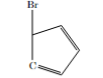
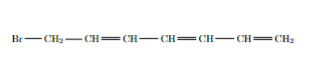
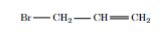
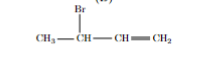
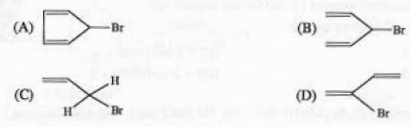
Which of the following compounds is most reactive in S 1 reaction?
1
2
3
4
Official Solution
Correct Option: (2)
The reactivity in SN1 reactions depends primarily on the stability of the carbocation intermediate formed after the leaving group (Br-) departs. The more stable the carbocation, the faster the SN1 reaction. Let's examine the carbocation formed from each compound:
(A) 5-Bromocyclopenta-1,3-diene: Loss of Br- gives the cyclopentadienyl cation. This cation has 4 electrons in a cyclic conjugated system, making it antiaromatic according to Hückel's rule (4n electrons). Antiaromatic systems are highly unstable. Therefore, this compound is very unreactive in SN1.
(B) 7-Bromohepta-1,3,5-triene: Loss of Br- gives the heptatrienyl cation (CH2=CH-CH=CH-CH=CH-CH2+). This is a primary allylic carbocation, but the positive charge is extensively delocalized via resonance over the entire conjugated system of three double bonds (7 carbon atoms). This extensive resonance stabilization makes the carbocation very stable.
(C) 3-Bromoprop-1-ene (Allyl bromide): Loss of Br- gives the allyl cation (CH2=CH-CH2+). This is a primary allylic carbocation stabilized by resonance over three carbon atoms. It is relatively stable.
(D) 3-Bromobut-1-ene: Loss of Br- gives the 1-methylallyl cation (CH2=CH-CH+-CH3). This is a secondary allylic carbocation, also stabilized by resonance over three carbon atoms. Secondary allylic cations are generally more stable than primary allylic cations due to the additional inductive effect of the methyl group.
Comparing the stability of the carbocations:
The stability generally follows the order: Extended conjugation>Secondary allylic>Primary allylic >> Antiaromatic / Vinylic.
Carbocation from (B) is highly stabilized by extended resonance over 7 carbons.
Carbocation from (D) is secondary allylic (resonance over 3 carbons + inductive effect).
Carbocation from (C) is primary allylic (resonance over 3 carbons).
Carbocation from (A) is antiaromatic (highly unstable).
The most stable carbocation is formed from compound (B) due to the most extensive resonance delocalization. Therefore, compound (B) is the most reactive in SN1 reaction.
20
PYQ 2025
medium
chemistryID: wbjee-20
Which one among the following compounds will most readily be dehydrated under acidic condition?
(A)
(B)
(C)
(D)
CH3-CH2-CH2-OH
CH3-CH(CH3)-CH2-OH
CH3-CH2-CH(CH3)-OH
C(CH3)(CH3)-CH2-OH
(1° alcohol)
(2° alcohol)
(2° alcohol)
(3° alcohol)
1
A
2
B
3
C
4
D
Official Solution
Correct Option: (4)
Dehydration under acidic conditions follows the carbocation stability trend:
(A) Primary alcohol (slowest)
(B) Secondary alcohol
(C) Secondary alcohol
(D) Tertiary alcohol (fastest)
The tertiary alcohol in (D) forms the most stable carbocation intermediate, making it dehydrate most readily.
21
PYQ 2026
medium
chemistryID: wbjee-20
Arrange the following compounds in order of their increasing acid strength.
1
I II III IV
2
IV III II I
3
I IV II III
4
II I III IV
Official Solution
Correct Option: (3)
Concept: Acid strength in dicarboxylic acids depends on:
Electron withdrawing effect of second COOH group
Distance between the two COOH groups
Closer COOH groups ⇒ stronger -I effect ⇒ stronger acid.
Step 1: Identify structures
I = Longest chain between COOH groups ⇒ weakest
IV = Slightly shorter chain
II = Even closer COOH groups
III = Two COOH directly attached (oxalic-type) ⇒ strongest
Step 2: Apply inductive effect rule
Greater proximity of COOH groups increases acidity. Thus:
22
PYQ 2026
medium
chemistryID: wbjee-20
Compound given below will produce effervescence when mixed with aqueous sodium bicarbonate solution
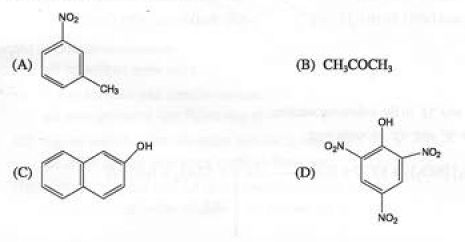
1
Option a
2
Option b
3
Option c
4
Option d
Official Solution
Correct Option: (4)
Concept:
Effervescence with NaHCO indicates evolution of CO gas, which occurs only if compound is acidic enough to react with bicarbonate.
Only strong acids (carboxylic acids, highly acidic phenols) react. Step 1: Analyze options
Nitro toluene: not acidic
Acetone: not acidic
Naphthol: weak phenol, does not react with NaHCO
Picric acid: strongly acidic phenol (three –NO groups) Step 2: Reason
Nitro groups strongly withdraw electrons, increasing acidity of phenolic OH.
Thus picric acid behaves like a strong acid and reacts with NaHCO . Conclusion:
Effervescence observed only with picric acid.