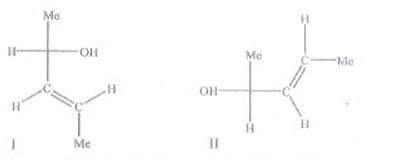
The correct relationship between molecule I and II is:
1
Enantiomer
2
Homomer
3
Diasteromer
4
Constitutional isomer
Official Solution
Correct Option:
(2)
The correct relationship between Molecule I and Molecule II is Homomer.
Here's why:
Stereoisomers: Stereoisomers are molecules with the same molecular formula and the same connectivity, but different spatial arrangements of atoms.
Homomers (Identical): Homomers are identical molecules. Rotating the molecule around a bond or in space will superimpose one molecule onto the other.
Enantiomers: Enantiomers are stereoisomers that are non-superimposable mirror images of each other. This requires a chiral center, and the stereochemistry at that center must be inverted.
Diastereomers: Diastereomers are stereoisomers that are not mirror images of each other. This typically involves having multiple stereocenters, and only some of them change configuration.
Constitutional Isomers: These isomers have the same molecular formula but different connectivity. This means that the atoms are bonded together in a different order.
Analysis of the Structures: Molecule I and Molecule II are the same molecule. You can mentally rotate Molecule II by 180 degrees around a vertical axis in the plane of the page. When you do this, it will perfectly superimpose on Molecule I. Since there is no chiral center, the relationship cannot be enantiomers or diastereomers. Also, since the connectivity is identical, the molecules are not constitutional isomers.
Therefore, Molecule I and Molecule II are identical; thus, they are homomers.
Correct Answer: Homomer
About Stereochemistry - WBJEE
Stereochemistry is a vital chapter for WBJEE aspirants. Mastering the concepts covered in this chapter is essential for securing a top rank.
By rigorously practicing the previous year questions associated with this chapter, you can identify high-yield topics, understand the examiner's perspective, and boost your confidence during the actual exam.
Frequently Asked Questions
Why focus on Stereochemistry PYQs?
Analyzing PYQs for this specific chapter reveals the most frequently tested concepts and the typical complexity of questions, allowing you to tailor your study plan efficiently.
How to best use this analysis?
Review the topic breakdown to see which sub-topics within Stereochemistry carry the most weight. Then, tackle the questions iteratively to solidify your understanding.