Under what condition will the magnifying power of a microscope be maximum?
Official Solution
Correct Option: (1)
Step 1: Understanding the Concept:
The magnifying power (or angular magnification) of a microscope is a measure of how much larger the image appears compared to the object when viewed through the instrument. This power depends on the focal lengths of the lenses and the position of the final image. Step 2: Key Formula or Approach:
The magnifying power ( ) of a compound microscope is the product of the magnification of the objective lens ( ) and the eyepiece ( ):
The magnification of the eyepiece is given by:
where is the least distance of distinct vision and is the focal length of the eyepiece. Step 3: Detailed Explanation:
From the formulas above, it is clear that the value of is greater when the final image is formed at the near point compared to when it is formed at infinity.
Since the overall magnifying power is directly proportional to , the microscope achieves its maximum magnifying power when the eyepiece is adjusted to form the final virtual image at the least distance of distinct vision, .
This condition, however, causes the most strain on the observer's eye, as the eye muscles are fully tensed to focus at the near point. The alternative setting, where the final image is at infinity, is called "normal adjustment" because it allows for more relaxed viewing. Step 4: Final Answer:
The condition for maximum magnifying power is that the eyepiece must be positioned such that the final virtual image is formed at the near point ( ) of the eye.
02
PYQ 2023
medium
physicsID: bihar-bo
The final image formed by a terrestrial telescope is
1
virtual and inverted compared to the object
2
virtual and erect compared to the object
3
real and erect compared to the object
4
none of these
Official Solution
Correct Option: (2)
Step 1: Understanding the Concept:
A terrestrial telescope is designed for viewing objects on Earth. A key requirement for this purpose is that the final image must be upright (erect) relative to the object. This distinguishes it from an astronomical telescope, where an inverted image is acceptable. Step 2: Detailed Explanation:
A terrestrial telescope typically consists of three main components:
1. Objective Lens: This is a convex lens that gathers light from a distant object and forms a real, inverted, and diminished image at its focal plane.
2. Erecting System: To make the final image upright, an additional lens or prism system is placed between the objective and the eyepiece. A common method uses a single convex lens called the erecting lens. This lens takes the real, inverted image from the objective and forms a second image that is real, and now erect.
3. Eyepiece: This is another convex lens that acts as a simple magnifier. The observer looks through the eyepiece at the real, erect image formed by the erecting system. The eyepiece forms a final, magnified image that is virtual and remains erect. Therefore, the final image seen by the observer is magnified, virtual, and erect with respect to the original object. Step 3: Final Answer:
The final image formed by a terrestrial telescope is virtual and erect. Hence, option (B) is the correct answer.
03
PYQ 2023
medium
physicsID: bihar-bo
With neat diagram describe the construction and working of an astronomical telescope. Find its magnifying power.
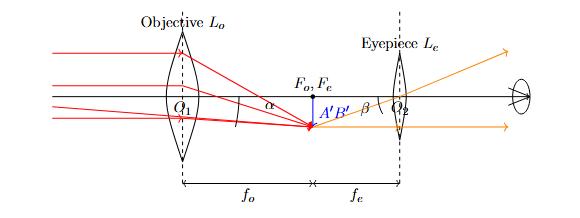
Official Solution
Correct Option: (1)
Step 1: Construction:
An astronomical telescope is an optical instrument used to see magnified images of distant heavenly bodies like stars and planets. It consists of two convex lenses mounted coaxially at the ends of a tube. 1. Objective Lens: It is a convex lens of large focal length ( ) and large aperture. Its function is to gather as much light as possible from the distant object and form a bright, real image. 2. Eyepiece (or Ocular): It is a convex lens of short focal length ( ) and small aperture. It acts as a simple magnifier to view the intermediate image formed by the objective.
The distance between the lenses can be adjusted using a rack and pinion arrangement. Step 2: Diagram and Working (Normal Adjustment):
In normal adjustment, the final image is formed at infinity for relaxed viewing. Working:
1. Parallel rays of light from a distant object (at infinity) enter the objective lens.
2. The objective lens converges these rays to form a real, inverted, and highly diminished image ( ) at its second focal point ( ).
3. For normal adjustment, the eyepiece is positioned such that this intermediate image lies at its first focal point ( ).
4. Therefore, the intermediate image acts as an object for the eyepiece. Since the object is at the focal point of the eyepiece, the final rays emerge parallel from the eyepiece.
5. These parallel rays enter the observer's eye, which perceives them as coming from a highly magnified, virtual, and inverted image at infinity. The length of the telescope tube in this case is . Step 3: Magnifying Power:
The magnifying power ( ) of a telescope is defined as the ratio of the angle ( ) subtended at the eye by the final image to the angle ( ) subtended at the eye by the object directly.
Since the angles are small, we can approximate and .
From the diagram, with the intermediate image of height :
The angle subtended by the object at the objective is . From triangle (where is the optical center of the objective):
The angle subtended by the final image at the eyepiece is . From triangle (where is the optical center of the eyepiece):
Now, we can find the magnifying power:
This is the expression for magnifying power in normal adjustment. Condition for Maximum Magnification:
For maximum magnification, the final image is formed at the least distance of distinct vision ( ). In this case, the magnifying power is: