Differentiate between primary and secondary rainbows.
Official Solution
Correct Option:
(1)
Step 1: Understanding the Concept: Rainbows are optical phenomena caused by the dispersion and internal reflection of sunlight by water droplets (like rain or mist) in the atmosphere. The differences between primary and secondary rainbows arise from the number of internal reflections the light undergoes within each droplet.
Step 2: Detailed Explanation of Differences:
Feature
Primary Rainbow
Secondary Rainbow
Formation
Caused by sunlight undergoing one total internal reflection inside a water droplet.
Caused by sunlight undergoing two total internal reflections inside a water droplet.
Color Sequence
The sequence of colors is Violet on the inner edge and Red on the outer edge (VIBGYOR from bottom to top).
The sequence of colors is reversed due to the extra reflection. Red is on the inner edge and Violet on the outer edge.
Brightness
It is brighter because less light is lost. Light emerges after only one internal reflection.
It is fainter because light energy is lost at each internal reflection.
Angular Position
Forms at an angle of approximately 40 -42 with respect to the observer-sun line. It appears lower in the sky.
Forms at a higher angle of approximately 50 -53 with respect to the observer-sun line. It appears above the primary rainbow.
Step 3: Final Answer: The primary rainbow is brighter, lower, and has red on top, resulting from a single internal reflection. The secondary rainbow is fainter, higher, and has violet on top, resulting from two internal reflections.
02
PYQ 2023
medium
physicsID: bihar-bo
A convex lens of refractive index 1.5 is kept in a liquid medium having same refractive index. What is the focal length of the lens in this medium?
Official Solution
Correct Option:
(1)
Step 1: Understanding the Concept:
A lens works by refracting light. Refraction, or the bending of light, occurs only when light passes from one medium to another with a different refractive index. The focal length of a lens is determined by its curvature and the difference in refractive index between the lens material and the surrounding medium. Step 2: Key Formula or Approach:
The focal length ( ) of a lens is given by the Lens Maker's Formula:
where:
- is the refractive index of the lens material.
- is the refractive index of the surrounding medium.
- and are the radii of curvature of the lens surfaces. Step 3: Detailed Explanation:
According to the problem statement:
- Refractive index of the lens, .
- Refractive index of the medium, . Now, let's substitute these values into the Lens Maker's Formula:
If the reciprocal of the focal length is zero, the focal length itself must be infinite:
A lens with an infinite focal length has zero power ( ). This means it does not bend light at all and acts as a transparent, parallel-sided plate of glass. The light rays will pass through it undeviated. Step 4: Final Answer:
The focal length of the lens will be infinite, and it will lose its converging property, effectively becoming invisible in the liquid.
03
PYQ 2023
medium
physicsID: bihar-bo
The critical angle for total internal reflection of a ray from any medium to vacuum is 30 . Then velocity of light in the medium will be
1
3 x 10 m/s
2
1.5 x 10 m/s
3
6 x 10 m/s
4
4.5 x 10 m/s
Official Solution
Correct Option:
(2)
Step 1: Understanding the Concept:
The critical angle is related to the refractive index of the medium. The refractive index, in turn, relates the speed of light in a vacuum to the speed of light in the medium. Step 2: Key Formula or Approach:
1. The relationship between the refractive index ( ) of a medium and the critical angle ( ) for light going into a vacuum is:
2. The definition of refractive index is: Step 3: Detailed Explanation: Part 1: Calculate the refractive index (n)
Given the critical angle .
We know that or .
The refractive index of the medium is 2. Part 2: Calculate the velocity of light in the medium (v)
We use the formula , where is the speed of light in vacuum, m/s.
Rearranging the formula to solve for :
Substituting the values: Part 3: Compare with options
The calculated velocity is m/s.
Looking at the options:
(A) 3 x 10 m/s (This is the speed in vacuum)
(B) 1.5 x 10 m/s (The numerical value is correct, but the power of 10 is wrong, likely a typo)
(C) 6 x 10 m/s (Faster than light in vacuum, impossible)
(D) 4.5 x 10 m/s (Faster than light in vacuum, impossible) The value m/s is the correct answer. Step 4: Final Answer:
The calculated velocity of light in the medium is m/s. Option (B) is the intended answer, despite the typo.
04
PYQ 2023
medium
physicsID: bihar-bo
The coefficient of reflection for total internal reflection will be
1
0.5
2
1
3
0
4
Official Solution
Correct Option:
(2)
Step 1: Understanding the Concept:
Total Internal Reflection (TIR) is an optical phenomenon that occurs when a ray of light traveling from a denser medium to a less dense medium strikes the boundary at an angle of incidence greater than the critical angle.
The coefficient of reflection (or reflectivity) is the ratio of the reflected power (or intensity) to the incident power (or intensity). Step 2: Detailed Explanation:
When TIR occurs, the boundary between the two media acts like a perfect mirror. No light is transmitted or refracted into the rarer medium; instead, the entire incident light is reflected back into the denser medium.
Let be the intensity of the incident light and be the intensity of the reflected light.
The coefficient of reflection, , is defined as:
In the case of Total Internal Reflection, all the incident energy is reflected, so .
Therefore, the coefficient of reflection is:
This means 100% of the light is reflected. Step 3: Final Answer:
For total internal reflection, the coefficient of reflection is 1. Therefore, option (B) is correct.
05
PYQ 2023
medium
physicsID: bihar-bo
A spherical mirror is immersed in water. Its focal length will
1
decrease
2
increase
3
remain same
4
none of these
Official Solution
Correct Option:
(3)
Step 1: Understanding the Concept:
The focal length of a spherical mirror is determined by the laws of reflection and the geometry of the mirror's surface. Step 2: Key Formula or Approach:
The focal length ( ) of a spherical mirror is related to its radius of curvature ( ) by the formula: Step 3: Detailed Explanation:
The laws of reflection state that the angle of incidence is equal to the angle of reflection, and these angles are measured with respect to the normal at the point of incidence. These laws are independent of the medium in which the reflection occurs.
The formula shows that the focal length of a mirror depends only on its radius of curvature ( ), which is a physical property of the mirror's shape.
Unlike a lens, whose focal length depends on the refractive index of its material and the surrounding medium (as described by the Lens Maker's Formula), a mirror's focal length is purely a geometric property.
Therefore, immersing a spherical mirror in water (or any other transparent medium) does not change its radius of curvature, and consequently, its focal length remains the same. Step 4: Final Answer:
Since the focal length of a spherical mirror depends only on its radius of curvature and not on the surrounding medium, it will remain the same when immersed in water. Option (C) is correct.
06
PYQ 2023
medium
physicsID: bihar-bo
A convex lens of focal length 40 cm and a concave lens of focal length 20 cm are in contact. The power of their combination in dioptre is
1
2.5
2
-2.5
3
7.5
4
-7.5
Official Solution
Correct Option:
(2)
Step 1: Understanding the Concept:
When thin lenses are placed in contact, the power of the combination is the algebraic sum of the powers of the individual lenses. The power of a lens is defined as the reciprocal of its focal length in meters. Step 2: Key Formula or Approach:
Power of a lens, . The unit of power is the dioptre (D).
For a combination of lenses in contact: .
Sign Convention: The focal length of a convex lens is positive, and the focal length of a concave lens is negative. Step 3: Detailed Explanation: Lens 1 (Convex):
Focal length, cm = m.
Power, D. Lens 2 (Concave):
Focal length, cm = m.
Power, D. Power of the Combination:
Now, add the individual powers algebraically:
Step 4: Final Answer:
The power of the combination is -2.5 dioptres. The negative sign indicates that the combination acts as a concave (diverging) lens. Option (B) is correct.
07
PYQ 2023
medium
physicsID: bihar-bo
The dispersive power of a prism depends on
1
Angle of incidence
2
Nature of material of prism
3
Refracting angle of prism
4
Angle of prism
Official Solution
Correct Option:
(2)
Step 1: Understanding the Concept:
Dispersive power ( ) is a property of the material of a prism that quantifies its ability to separate white light into its constituent colors (dispersion). It is defined as the ratio of the angular dispersion (the difference in deviation angles for two extreme colors, typically violet and red) to the deviation of a mean color (typically yellow). Step 2: Key Formula or Approach:
The formula for dispersive power ( ) is:
For a prism with a small angle , the angle of deviation is given by , where is the refractive index of the material.
Substituting this into the formula for :
The prism angle cancels out from the numerator and the denominator:
Step 3: Detailed Explanation:
The final expression, , shows that the dispersive power depends only on the refractive indices of the prism's material for different wavelengths of light ( ). The refractive index is an intrinsic property of the material itself.
Therefore, the dispersive power depends on the nature of the material of the prism. It does not depend on the geometric properties of the prism, such as its angle ( ), nor on how the light enters it, such as the angle of incidence. Step 4: Final Answer:
Since dispersive power is determined solely by the refractive indices of the medium, it is a characteristic property of the material of the prism. Therefore, option (B) is correct.
08
PYQ 2023
medium
physicsID: bihar-bo
The radius of curvature of each surface of a biconvex lens is 20 cm and the refractive index of the material of the lens is 1.5. The focal length of the lens is
1
20 m
2
1/20 m
3
20 cm
4
1/20 cm
Official Solution
Correct Option:
(3)
Step 1: Understanding the Concept:
The problem requires finding the focal length of a biconvex lens given its radii of curvature and refractive index. This can be solved using the Lens Maker's Formula. Step 2: Key Formula or Approach:
The Lens Maker's Formula is:
where:
= focal length of the lens
= refractive index of the lens material with respect to the surrounding medium (air, in this case)
= radius of curvature of the first surface (where light enters)
= radius of curvature of the second surface Step 3: Detailed Explanation:
Given data:
- Type of lens: Biconvex
- Refractive index,
- Radius of curvature of each surface = 20 cm. We must apply the Cartesian sign convention. Assume light travels from left to right.
- For the first surface (left), it is convex towards the incident light. Its center of curvature is on the right side. Thus, cm.
- For the second surface (right), it is also convex, but its center of curvature is on the left side. Thus, cm. Now, substitute these values into the Lens Maker's Formula:
Therefore, the focal length is:
Step 4: Final Answer:
The focal length of the lens is 20 cm. This corresponds to option (C).
09
PYQ 2023
medium
physicsID: bihar-bo
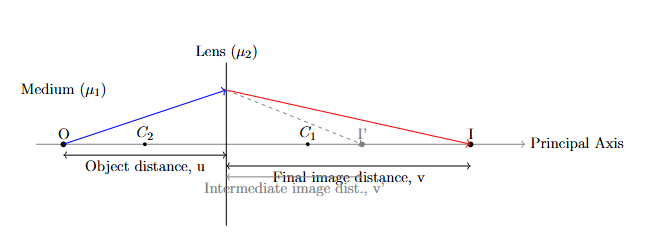
For a thin lens find the formula , where the meaning of symbols is general.
Official Solution
Correct Option:
(1)
This formula is known as the Lens Maker's Formula. It relates the focal length of a lens to the refractive index of its material and the radii of curvature of its two surfaces. Step 1: Assumptions:
1. The lens is thin, meaning its thickness is negligible compared to the radii of curvature.
2. The aperture of the lens is small.
3. The object is a point object placed on the principal axis.
4. The incident and refracted rays make small angles with the principal axis. Step 2: Derivation using Refraction at Spherical Surfaces:
Let's consider a thin convex lens of refractive index placed in a medium of refractive index . Let and be the radii of curvature of the first and second surfaces, respectively.
The general formula for refraction at a single spherical surface is: Refraction at the First Surface (surface 1 with radius ):
- An object O is placed in the medium ( ) at a distance from the lens.
- Light travels from the medium ( ) to the lens material ( ).
- A real image would be formed at a distance if the second surface were absent.
Applying the formula: Refraction at the Second Surface (surface 2 with radius ):
- The image formed by the first surface acts as a virtual object for the second surface, at a distance .
- Light travels from the lens material ( ) back to the medium ( ).
- The final image is formed at a distance .
Applying the formula (note the swapping of and ): Step 3: Combining the Equations:
Now, add equation (1) and equation (2):
The term cancels out.
Divide the entire equation by : Step 4: Final Formula:
From the thin lens equation, we know that , where is the focal length of the lens.
Let be the refractive index of the lens material with respect to the surrounding medium.
Substituting these into the equation, we get the Lens Maker's Formula: Meaning of Symbols:
- : Focal length of the thin lens.
- : Refractive index of the material of the lens relative to the surrounding medium.
- : Radius of curvature of the first surface where light enters.
- : Radius of curvature of the second surface where light exits.
(Note: A proper sign convention must be used for .)
10
PYQ 2025
medium
physicsID: bihar-bo
What type of wave is used in fibre optic communication?
1
Sound waves
2
Electromagnetic waves
3
Seismic waves
4
Mechanical waves
Official Solution
Correct Option:
(2)
Step 1: Understanding fibre optic communication. Fibre optic communication relies on light signals transmitted through optical fibres. The medium used for transmitting data is electromagnetic waves, particularly light waves. These waves travel through the fibre core via total internal reflection. Step 2: Conclusion. Hence, the type of wave used in fibre optic communication is electromagnetic waves.
About Ray Optics And Optical Instruments - BIHAR-BOARD-XII
Ray Optics And Optical Instruments is a vital chapter for BIHAR-BOARD-XII aspirants. Mastering the concepts covered in this chapter is essential for securing a top rank.
By rigorously practicing the previous year questions associated with this chapter, you can identify high-yield topics, understand the examiner's perspective, and boost your confidence during the actual exam.
Frequently Asked Questions
Why focus on Ray Optics And Optical Instruments PYQs?
Analyzing PYQs for this specific chapter reveals the most frequently tested concepts and the typical complexity of questions, allowing you to tailor your study plan efficiently.
How to best use this analysis?
Review the topic breakdown to see which sub-topics within Ray Optics And Optical Instruments carry the most weight. Then, tackle the questions iteratively to solidify your understanding.