Optics
29 previous year questions.
High-Yield Trend
Chapter Questions 29 MCQs
Official Solution
Step 1: Understanding the Concept:
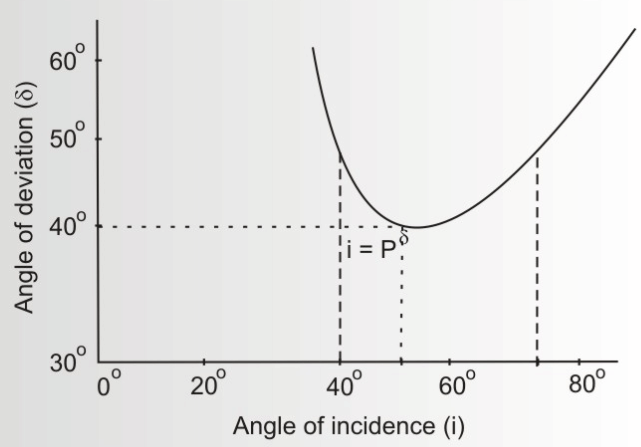
When a ray of light passes through a prism, it undergoes refraction at two surfaces and deviates from its path. The angle of deviation ( ) is the angle between the extended incident ray and the emergent ray. The value of depends on the angle of incidence (i). As 'i' increases, first decreases, attains a minimum value ( ) at a specific angle of incidence, and then increases again. The plot of versus i is a characteristic U-shaped curve.
Step 2: Apparatus:
Apparatus Required:
A glass prism, a drawing board, white sheets of paper, drawing pins or tape, a protractor, a sharp pencil, and several all-pins.
Step 3: Detailed Procedure:
1. Setup: Fix a sheet of white paper on the drawing board. Place the prism on it and trace its triangular outline, label it ABC.
2. Drawing Rays: - Draw a normal NN' to the face AB at a point P.
- Draw an incident ray QP making an angle of incidence i (e.g., 35°) with the normal.
- Fix two pins vertically on this incident ray.
3. Locating Emergent Ray: Look for the images of these two pins through the other face AC. Fix two more pins, R and S, such that they appear to be in a straight line with the images of the first two pins.
4. Measuring Deviation: - Remove the prism and pins. Join the points R and S to draw the emergent ray.
- Extend the incident ray QP forward and the emergent ray RS backward. They meet at a point, and the angle between them is the angle of deviation . Measure this angle using a protractor.
5. Repeating: Repeat the experiment for different values of the angle of incidence, such as 40°, 45°, 50°, 55°, and 60°, and measure the corresponding angle of deviation for each case.
Step 4: Graph and Result:
1. Plotting: Plot a graph with the angle of incidence (i) on the X-axis and the angle of deviation ( ) on the Y-axis.
2. Finding : The plotted points will form a smooth U-shaped curve. The lowest point on this curve corresponds to the angle of minimum deviation.
3. Determining : Draw a horizontal tangent at the bottom of the curve. The point where this tangent touches the curve gives the value of on the Y-axis.
The result is stated as: "The angle of minimum deviation ( ) from the graph is ..... degrees." 
Official Solution
Step 1: Understanding the Concept:
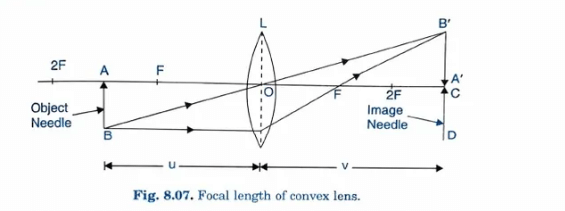
For a convex lens forming a real image, the object distance (u), image distance (v), and focal length (f) are related by the lens formula. A graph plotted between u and v is a rectangular hyperbola. From this graph, the focal length can be determined because, for a convex lens, when the object is placed at a distance of 2f from the optical center, a real image of the same size is formed at a distance of 2f on the other side. Therefore, the point on the graph where u = v corresponds to u = v = 2f.
Step 2: Key Formula and Apparatus:
Apparatus Required:
An optical bench, a convex lens, a lens holder, two optical needles (one for the object, one for the image), and a meter scale.
Key Formula:
Lens formula:
From the u-v graph, at the point of intersection P with the line u=v, we have: Therefore, .
Step 3: Detailed Procedure:
1. Rough Focal Length: Find the approximate focal length of the lens by focusing the image of a distant object (like a window) on a screen.
2. Setup: Mount the lens on the holder on the optical bench. Place the object needle at a distance greater than 2f from the lens.
3. Data Collection: - Adjust the position of the image needle on the other side of the lens until parallax between the tip of the image needle and the real, inverted image of the object needle is removed.
- Record the positions of the object needle, lens, and image needle.
- Calculate the object distance u (distance between object needle and lens) and image distance v (distance between image needle and lens).
- Repeat the process for 5-6 different values of u, moving the object needle away from the lens.
Step 4: Graph and Calculation:
1. Plotting: Plot a graph with u on the X-axis and v on the Y-axis. The graph will be a curve (a rectangular hyperbola).
2. Finding 2f: Draw a line that passes through the origin at an angle of 45° to the axes (the line u = v). This line will intersect the u-v curve at a point P.
3. Reading Coordinates: Read the coordinates of the point P from the graph. Let them be . At this point, .
4. Calculating Focal Length: Calculate the focal length using the relation: The average of these gives the focal length of the lens. 
Official Solution
Step 1: Understanding the Concept:
This experiment is a graphical method to determine the focal length of a concave mirror. It uses the data of object distance (u) and image distance (v) obtained from the two-pin method. By plotting against , we can use the intercepts of the resulting straight-line graph to calculate the focal length, which often provides a more accurate result than averaging individual calculations.
Step 2: Key Formula and Apparatus:
Apparatus Required:
The same as for the two-pin method: an optical bench, a concave mirror, a mirror holder, two optical needles (pins), and a meter scale. Also, a graph paper is needed.
Key Formula:
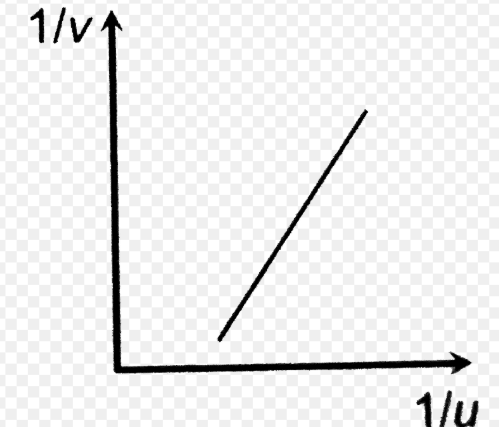
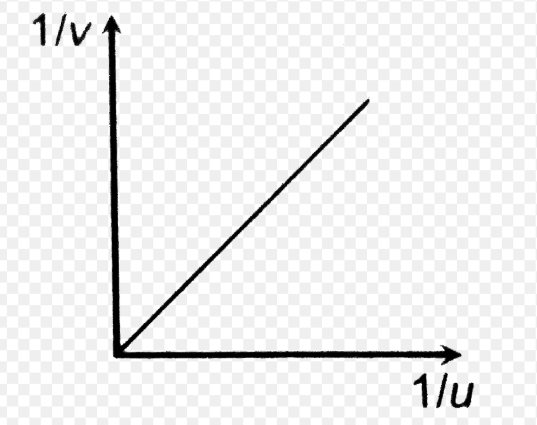
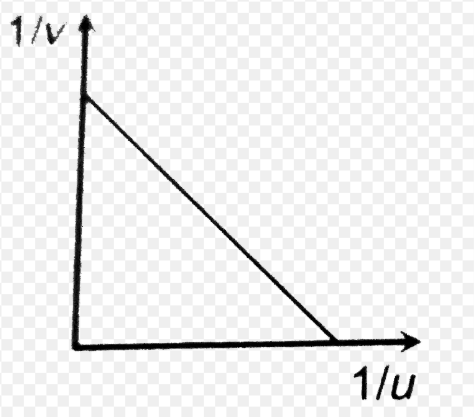
The mirror formula is: This can be rearranged into the form of a straight-line equation : Comparing this with , we have: - - - Slope - Y-intercept
When , we get the X-intercept as .
Step 3: Detailed Procedure:
1. Data Collection:
- Perform the experiment to find the focal length of the concave mirror using the two-pin method (as in Question 1).
- Obtain at least 5-6 sets of readings for object distance (u) and the corresponding image distance (v).
2. Data Processing:
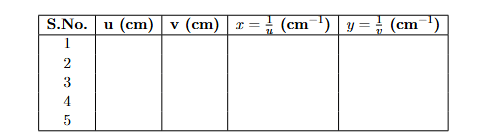
- For each pair of (u, v), calculate their reciprocals: and .
- Tabulate the results.

3. Plotting the Graph:
- Choose a suitable scale for both axes on the graph paper.
- Plot the graph with along the X-axis and along the Y-axis.
- The plotted points should lie on a straight line. Draw the best-fit straight line passing through these points.
- The line will have a negative slope and will intersect both the positive X and Y axes. 


Step 4: Calculation from Graph and Final Answer:
1. Finding Intercepts:
- Find the Y-intercept (OA) where the line cuts the Y-axis ( ).
- Find the X-intercept (OB) where the line cuts the X-axis ( ).
2. Calculating Focal Length:
- From the Y-intercept: .
- From the X-intercept: .
- The focal length of the mirror is the mean of these two values: The result is stated as: "The focal length of the concave mirror as determined from the graph is f cm."
Official Solution
This question might be slightly misstated, as a single thin slit is primarily known for causing \textit{diffraction}, not significant polarization. Polarization is the phenomenon where light waves are restricted to oscillate in a single plane. While diffraction through a very narrow slit (comparable to the wavelength of light) can have minor polarization effects, the standard and most observable method to demonstrate polarization is by using polarizing filters (Polaroids). We will describe the observation using two polarizers, which is the standard demonstration.
Step 2: Apparatus Required:
- A source of unpolarized light (like a lamp or a torch). - Two polarizing filters (often called Polaroids). These can be obtained from a physics kit or by using lenses from 3D movie glasses or some types of sunglasses.
Step 3: Detailed Procedure:
1. Setup: Hold one polarizing filter (let's call it the Polarizer, P1) in front of the light source. Look at the light source through this filter. You will see that the light passes through, but its intensity is reduced by about half. The light emerging from P1 is now plane-polarized.
2. Using the Second Filter: Now, take the second filter (let's call it the Analyzer, P2) and place it in front of the first one, between your eye and P1.
3. Observation 1 (Parallel Axes): Initially, align P2 such that it allows the maximum amount of light to pass through. In this position, the transmission axes of the two polarizers are parallel.
4. Observation 2 (Rotating the Analyzer): Slowly rotate the Analyzer (P2) while keeping the Polarizer (P1) fixed. As you rotate P2, you will observe that the intensity of the transmitted light gradually decreases.
5. Observation 3 (Crossed Axes): When the Analyzer has been rotated by 90 degrees from the initial position, the intensity of the light becomes zero (or very close to it), and you will see darkness. In this position, the axes of the two polarizers are perpendicular, and they are said to be "crossed".
6. Further Rotation: If you continue to rotate P2, the light intensity will start to increase again, becoming maximum at 180 degrees.
Step 4: Conclusion:
This experiment demonstrates the polarization of light. The first filter polarizes the unpolarized light. The second filter (Analyzer) is used to observe this polarization by controlling the amount of polarized light that passes through it, according to Malus's Law ( ). The fact that the light can be blocked completely by the second filter proves that it is a transverse wave and has been polarized.
Official Solution
When two thin lenses are placed in contact, they behave as a single lens with an equivalent focal length (F) that depends on the individual focal lengths ( and ) of the two lenses. By choosing the right combination of lenses, a combination with a desired focal length can be created.
Step 2: Key Formula and Apparatus:
Apparatus Required:
- A collection of lenses (at least two, e.g., two convex lenses or one convex and one concave). - An optical bench with lens holders. - An object (like an illuminated screen or an optical needle). - A screen to view the image.
Key Formula:
The formula for the equivalent focal length (F) of two thin lenses in contact is: The power of the combination is .
Step 3: Detailed Procedure:
1. Measure Individual Focal Lengths: - First, determine the focal length of each of the two given lenses ( and ) individually. This can be done by finding the approximate focal length (focusing a distant object) or more accurately using the u-v method on an optical bench. Remember that focal length is positive for a convex lens and negative for a concave lens.
2. Calculate Theoretical Combined Focal Length: - Let's say you have two convex lenses with cm and cm. - The theoretical focal length of the combination would be: - If one lens is convex ( cm) and one is concave ( cm): 3. Verify Experimental Combined Focal Length: - Place the two lenses in contact with each other in a single holder on the optical bench. Treat this combination as a single lens. - Place an object pin at a known distance 'u' from the combination. - Locate the position of the real image formed on the other side using a screen or another needle (by removing parallax). Measure the image distance 'v'. - Use the lens formula to calculate the experimental focal length of the combination.
Step 4: Result:
Compare the experimentally determined focal length ( ) with the theoretically calculated focal length (F). They should be approximately equal. This demonstrates how to obtain a lens combination with a specific, predictable focal length.
Official Solution
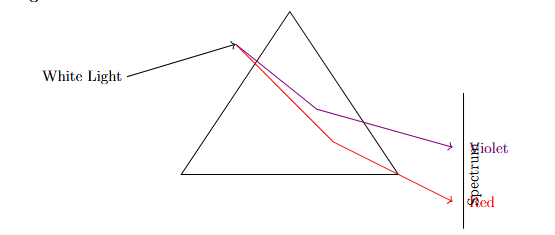
Dispersion is the phenomenon of splitting of white light into its constituent colors when it passes through a transparent medium like a glass prism. This happens because the refractive index of the prism material is different for different wavelengths (colors) of light. According to Cauchy's relation, the refractive index is greater for shorter wavelengths (like violet) and smaller for longer wavelengths (like red). Therefore, violet light bends the most, and red light bends the least, separating the colors into a spectrum.
Step 2: Apparatus Required:
- A glass prism. - A source of white light (a ray box with a narrow slit is ideal, but sunlight from a window or a torch can also be used). - A white screen.
Step 3: Ray Diagram and Procedure:
Ray Diagram:

1. Setup: Perform the experiment in a dark room for the best visibility. Place the prism on a table.
2. Directing Light: Arrange the source of white light so that a narrow beam of light is incident on one of the refracting faces of the prism.
3. Positioning the Screen: Place a white screen on the other side of the prism, where the light emerges.
4. Observation: Adjust the angle of the incident beam and the position of the screen until a clear band of colors is observed on the screen. This band of colors is called a spectrum.
5. Identifying Colors: Observe the colors in the spectrum. You will see a continuous band starting from Red at the top (least deviated) and ending with Violet at the bottom (most deviated). The order of colors is Violet, Indigo, Blue, Green, Yellow, Orange, Red (VIBGYOR).
Step 4: Conclusion:
The experiment demonstrates that white light is a mixture of several colors. When it passes through a prism, the different colors travel at different speeds and are refracted at slightly different angles, causing them to separate and form a spectrum. This phenomenon is called dispersion.
Official Solution
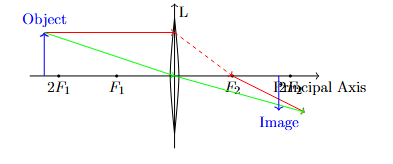
A convex lens is a converging lens. When an object (like a candle flame) is placed in front of it, the lens can form a real, inverted image on a screen placed on the other side, provided the object is placed outside the focal length. The size and position of the image depend on the object's distance from the lens.
Step 2: Apparatus Required:
- A convex lens with a lens holder
- A candle
- A white screen (a piece of white cardboard or a wall)
- A meter scale or optical bench
Step 3: Ray Diagram and Procedure:
Ray Diagram (for object beyond 2F):

1. Setup: Place the convex lens in its holder on a table. Light the candle and place it in front of the lens. Place the screen on the other side of the lens.
2. Case 1: Object far away (beyond 2F): Place the candle at a distance significantly greater than twice the focal length of the lens. Move the screen back and forth until a sharp, clear image of the candle flame is formed on it.
3. Case 2: Object at 2F: Place the candle at a distance equal to twice the focal length. Adjust the screen to get a sharp image.
4. Case 3: Object between F and 2F: Move the candle closer to the lens, to a position between F and 2F. Again, adjust the screen to get a sharp image.
Step 4: Observation:
- Case 1 (Object beyond 2F): The image formed is real (can be captured on a screen), inverted (upside down), and diminished (smaller than the object).
- Case 2 (Object at 2F): The image formed is real, inverted, and of the same size as the object.
- Case 3 (Object between F and 2F): The image formed is real, inverted, and magnified (larger than the object).
This demonstrates how the nature and size of the image change with the object's position.
Official Solution
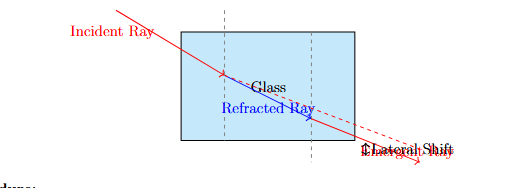
When a ray of light passes obliquely through a rectangular glass slab with parallel faces, it emerges parallel to its original path. However, the emergent ray is shifted sideways. This perpendicular distance between the direction of the incident ray and the emergent ray is called lateral deviation or lateral shift. This phenomenon occurs due to refraction at the two parallel surfaces of the slab.
Step 2: Apparatus Required:
- A rectangular glass slab
- A drawing board and a sheet of white paper
- Drawing pins or tape
- Several all-pins
- A protractor and a ruler
Step 3: Ray Diagram and Procedure:
Ray Diagram:

1. Setup: Fix the sheet of paper on the drawing board. Place the glass slab in the middle and trace its outline, labeling it ABCD.
2. Incident Ray: Remove the slab. Draw a line PQ that meets the face AB at an angle (the incident ray). Fix two pins, P1 and P2, vertically on this line.
3. Locating Emergent Ray: Place the slab back on its outline. Look through the opposite face CD and place two more pins, P3 and P4, such that they appear to be in a straight line with the images of pins P1 and P2.
4. Tracing the Path: Remove the slab and the pins. Join the points P3 and P4 to form the line RS, which is the emergent ray. Join the point Q on face AB to the point R on face CD. The path P-Q-R-S is the path of the light ray.
5. Observing Deviation: Extend the incident ray PQ forward with a dashed line. You will observe that the emergent ray RS is parallel to the extended incident ray. The perpendicular distance between these two parallel lines is the lateral deviation.
Step 4: Result:
The experiment demonstrates that a ray of light incident obliquely on a glass slab emerges parallel to its original path but is displaced laterally.
Official Solution
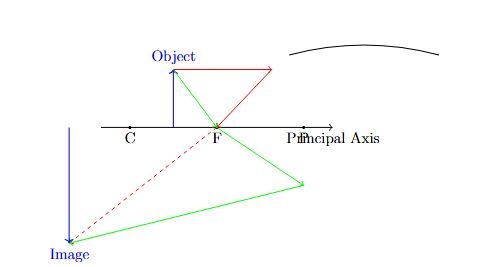
A concave mirror is a converging mirror. It can form a real, inverted image of an object placed in front of it, provided the object is placed beyond the focal point (F). This real image can be projected onto a screen. The size and location of the image depend on the object's distance from the mirror.
Step 2: Apparatus Required:
- A concave mirror with a holder
- A candle (as the object)
- A white screen
- A meter scale or optical bench
Step 3: Ray Diagram and Procedure:
Ray Diagram (Object between C and F):

1. Find Rough Focal Length: First, find the approximate focal length (f) of the mirror by focusing the image of a distant object (like a window) onto the screen. The distance from the mirror to the screen is roughly f. The center of curvature (C) is at 2f.
2. Setup: Place the concave mirror in its holder. Place the lit candle in front of it.
3. Case 1 (Object beyond C): Place the candle at a distance greater than 2f from the mirror. Place the screen between C and F and move it to get a sharp image.
4. Case 2 (Object at C): Place the candle at 2f. Move the screen to get a sharp image.
5. Case 3 (Object between C and F): Place the candle between f and 2f. Move the screen beyond C to get a sharp image.
Step 4: Observation:
- Case 1 (Object beyond C): A real, inverted, and diminished (smaller) image is formed on the screen between C and F.
- Case 2 (Object at C): A real, inverted image of the same size is formed at C.
- Case 3 (Object between C and F): A real, inverted, and magnified (larger) image is formed beyond C.
This demonstrates the different types of real images formed by a concave mirror.
Official Solution
The refractive index of a prism material can be determined accurately using a spectrometer. This method involves measuring two key angles: the angle of the prism (A), which is the angle between the two refracting faces, and the angle of minimum deviation ( ), which is the smallest possible angle of deviation for light passing through the prism. These quantities are related by the prism formula.
Step 2: Key Formula and Apparatus:
Apparatus Required:
A spectrometer, a glass prism, a source of monochromatic light (e.g., a sodium vapour lamp), and a reading lens.
Key Formula:
The prism formula for refractive index is: Step 3: Detailed Procedure:
Part A: Measuring the Angle of the Prism (A)
1. Perform the initial adjustments of the spectrometer (leveling, focusing telescope and collimator).
2. Place the prism on the prism table with its refracting edge facing the collimator.
3. Turn the telescope to one side to receive the light reflected from one refracting face. Center the slit image on the vertical cross-wire. Record the reading from the vernier scale.
4. Turn the telescope to the other side to receive light reflected from the second refracting face. Again, center the slit and record the reading.
5. The difference between these two readings is equal to 2A. Thus, A can be calculated.
Part B: Measuring the Angle of Minimum Deviation ( )
1. Place the prism on the table so that light from the collimator falls on one face and emerges from the other.
2. Locate the refracted image of the slit with the telescope.
3. Rotate the prism table slowly while observing the image. The image will move, reverse its direction, and move back. The position where it reverses direction is the position of minimum deviation.
4. Set the telescope cross-wire on the slit image at this turning point. Record the reading.
5. Remove the prism and move the telescope to view the direct image of the slit from the collimator. Record this reading.
6. The difference between the reading for the deviated ray and the direct ray gives the angle of minimum deviation, .
Step 4: Calculation:
Substitute the measured values of A and into the prism formula to calculate the refractive index .
Official Solution
A convex mirror always forms a virtual image, which cannot be located directly. This experiment uses a convex lens to first form a real image. This real image then acts as a virtual object for the convex mirror. By adjusting the convex mirror's position, the rays are made to reflect back along their incident path, forming a final image at the same location as the original object. This occurs when the rays incident on the convex mirror are directed towards its center of curvature.
Step 2: Key Formula and Apparatus:
Apparatus Required:
An optical bench, a convex mirror, a convex lens, a mirror holder, a lens holder, an optical needle (object pin), and a meter scale.
Key Formula:
The focal length (f) of a spherical mirror is half its radius of curvature (R). Step 3: Detailed Procedure:
1. Setup without Mirror: Mount the convex lens on the optical bench. Place an object pin (O) in front of the lens. Adjust its position to form a clear, real, and inverted image (I) on the other side. Note the position of the image I by using another needle and removing parallax.
2. Introducing the Mirror: Place the convex mirror on a holder and position it between the convex lens and the image position I. The reflecting surface of the mirror should face the lens.
3. Retracing Path: Adjust the position of the convex mirror along the optical bench until the light rays, after reflecting from the mirror, retrace their path back through the lens and form a final image at the same position as the original object pin O. This is confirmed by removing the parallax between the object pin and its image.
4. Locating Center of Curvature: In this adjusted position, the light rays from the lens are incident normally on the convex mirror. This means they are converging towards the center of curvature (C) of the mirror. Thus, the position of the image I (found in step 1) is the location of the center of curvature C of the mirror.
5. Measurement: Record the position of the convex mirror. The distance between the pole of the convex mirror and the position of image I is the radius of curvature (R).
Step 4: Calculation:
Calculate the focal length of the convex mirror using the measured radius of curvature R. Repeat the experiment two to three times for different object positions and find the mean focal length.
Official Solution
The refractive index ( ) of a medium is defined as the ratio of the speed of light in vacuum to the speed of light in the medium. It can also be expressed as the ratio of the real depth to the apparent depth of an object viewed through the medium. A travelling microscope is a precision instrument used for measuring small distances, making it ideal for measuring the real and apparent depths of a glass slab.
Step 2: Key Formula and Apparatus:
Apparatus Required:
A travelling microscope, a rectangular glass slab, and a fine marker or lycopodium powder.
Key Formula:
Refractive Index
In terms of microscope readings: where,
= Microscope reading when focused on a mark without the slab.
= Microscope reading when focused on the image of the mark seen through the slab.
= Microscope reading when focused on the top surface of the slab.
Step 3: Detailed Procedure:
1. Reading R1: Place a mark (e.g., an ink cross) on a piece of paper on the base of the microscope. Adjust the microscope to focus sharply on this mark. Record the reading on the vertical vernier scale. This is .
2. Reading R2: Carefully place the glass slab over the ink mark without disturbing the setup. The mark will appear to be raised. Raise the microscope tube until the image of the mark is in sharp focus again. Record this new reading. This is .
3. Reading R3: Sprinkle a small amount of lycopodium powder or chalk dust on the top surface of the glass slab. Raise the microscope further to bring the powder particles into sharp focus. Record this reading. This is .
Step 4: Calculation:
1. Calculate the real depth of the glass slab: .
2. Calculate the apparent depth of the mark: This is given by the shift, which is , but the depth itself in terms of readings is .
3. Calculate the refractive index using the formula: Repeat the procedure two or three times to find the mean value of .
Official Solution
This experiment aims to determine the focal length of a concave mirror by measuring the object distance (u) and the corresponding image distance (v). The relationship between u, v, and the focal length (f) is given by the mirror formula. The "two-pin method" refers to using one pin as the object and another pin to locate the position of its real, inverted image by eliminating parallax.
Step 2: Key Formula and Apparatus:
Apparatus Required:
An optical bench, a concave mirror, a mirror holder, two optical needles (pins), and a meter scale.
Key Formula:
The mirror formula is given by: According to sign convention for a concave mirror forming a real image:
Object distance (u) is negative.
Image distance (v) is negative.
Focal length (f) is negative.
So, the formula becomes: From this, the focal length can be calculated as: Step 3: Detailed Procedure:
1. Preliminary Setup:
- First, find the approximate focal length (f) of the concave mirror by focusing the image of a distant object (like a tree) on a screen. The distance between the mirror and the screen gives a rough estimate of f.
- Mount the concave mirror on the holder and place it on the optical bench.
- Place one pin (the object pin, O) in front of the mirror at a distance approximately 1.5f from the mirror.
2. Locating the Image:
- Place the second pin (the image pin, I) on the other side of the object pin.
- Adjust the position of the image pin until there is no parallax between the tip of the image pin and the tip of the inverted image of the object pin. Parallax is removed when the image pin and the image of the object pin do not separate when you move your eye side-to-side.
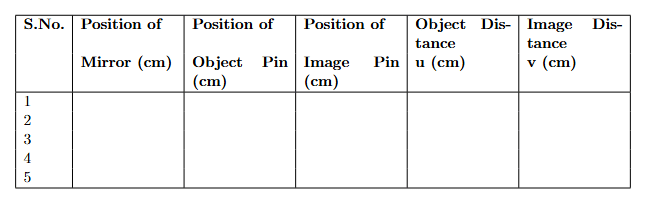
3. Taking Measurements:
- Record the position of the mirror, the object pin (O), and the image pin (I) on the optical bench scale.
- Calculate the object distance, .
- Calculate the image distance, .
4. Repeating the Experiment:
- Repeat the experiment for at least 4-5 different values of u, by moving the object pin further away from the mirror. For each position of u, locate the corresponding image position v.
5. Observation Table:

For each set of u and v, calculate the focal length f using the formula .
Finally, calculate the mean value of the focal length from all the readings.
The mean value is the focal length of the given concave mirror.
Official Solution
Official Solution
Official Solution
Official Solution
Official Solution
Official Solution
Official Solution
Official Solution
Official Solution
An equivalent lens is formed when two or more lenses are placed in contact with each other or at a finite distance. The focal length of the equivalent lens is determined by the combination of the focal lengths of the individual lenses.
Expression for Equivalent Focal Length:
For two lenses of focal lengths and kept at a distance , the formula for the equivalent focal length can be derived using the lens formula for each lens and the condition for combined focal length. The combined power of two lenses is the sum of their individual powers: Where: Thus: For lenses kept at a distance , the additional term due to the separation distance between the lenses must be included. The effective focal length is given by the relation: Therefore, the equivalent focal length of the two lenses placed at a distance is:
Official Solution
The critical angle ( ) is related to the refractive indices of the two media by the formula: where is the refractive index of the medium and is the refractive index of vacuum ( ). The refractive index is related to the velocity of light in the medium by: where is the speed of light in vacuum and is the velocity of light in the medium.
Step 2: Using given information.
We know the critical angle is , so Conclusion: The velocity of light in the medium is .
Official Solution
The photoelectric effect is the phenomenon in which electrons are ejected from a material (usually metal) when light of sufficient frequency (or energy) strikes its surface. The emitted electrons are called photoelectrons. This effect was first observed by Heinrich Hertz in 1887, but it was Albert Einstein who provided the theoretical explanation in 1905, for which he was awarded the Nobel Prize in Physics.
Laws of Photoelectric Effect:
1. Emission of Electrons: When light of suitable frequency (above a certain threshold frequency) is incident on a metal surface, it causes the emission of electrons from the surface. The emitted electrons are called photoelectrons.
2. Threshold Frequency: There exists a minimum frequency of light, called the threshold frequency ( ), below which no electrons are emitted, regardless of the intensity of light.
3. Effect of Light Intensity: The number of emitted photoelectrons depends on the intensity of the light. A higher intensity of light leads to more photoelectrons being emitted, but the kinetic energy of the photoelectrons remains unchanged.
4. Effect of Light Frequency: The kinetic energy of the emitted electrons depends on the frequency of the incident light. If the frequency is higher than the threshold frequency, the kinetic energy of the photoelectrons increases with the increase in frequency of the light.
Einstein's Explanation of the Photoelectric Effect:
Einstein proposed that light behaves as a stream of particles called photons, and each photon has energy given by: Where:
- is the energy of the photon,
- is Planck’s constant,
- is the frequency of the light.
When a photon strikes the metal surface, it transfers its energy to an electron. If the photon has energy greater than the work function ( ) of the metal, the electron absorbs this energy and is ejected from the surface. The kinetic energy of the emitted photoelectron is given by: Where is the work function, or the minimum energy required to eject an electron from the metal surface. Thus, Einstein’s equation explains the photoelectric effect by treating light as quantized packets of energy.
Official Solution
1. The light must travel from a denser medium to a rarer medium: For total internal reflection to occur, the light must be traveling from a medium with a higher refractive index (denser medium) to a medium with a lower refractive index (rarer medium). A typical example is light moving from water (denser) to air (rarer).
2. The angle of incidence must be greater than the critical angle: The critical angle ( ) is the minimum angle of incidence at which total internal reflection occurs. When the angle of incidence exceeds this critical angle, the light is entirely reflected within the denser medium and does not refract into the rarer medium. The critical angle is given by the formula: Where is the refractive index of the denser medium and is the refractive index of the rarer medium.
3. The refractive index of the denser medium must be greater than the refractive index of the rarer medium: For total internal reflection to occur, the refractive index of the first medium (denser medium) must be greater than that of the second medium (rarer medium). This ensures that light is not refracted out but instead is entirely reflected back into the denser medium.
In summary, for total internal reflection to take place, light must travel from a denser to a rarer medium, the angle of incidence must be greater than the critical angle, and the refractive index of the denser medium must be greater than that of the rarer medium.
Official Solution
The relationship between refractive index and wavelength can be described as follows: - For shorter wavelengths (like blue or violet light), the refractive index is higher. This is because the interaction between light and the particles in the medium causes more bending of shorter wavelengths. - For longer wavelengths (like red light), the refractive index is lower, and the light bends less.
Thus, the refractive index ( ) is inversely related to the wavelength of light ( ) in most materials. This is summarized in the equation for dispersion: Where is the refractive index at a reference wavelength, and is a constant that depends on the material.
In summary, as the wavelength of light increases, the refractive index generally decreases, which results in less bending of longer wavelengths in the medium.
Official Solution
The focal length of a lens is related to its refractive index and the refractive index of the surrounding medium. When a lens is immersed in a liquid with the same refractive index as the lens, the refraction at the surfaces of the lens becomes nullified. This leads to the lens losing its focusing ability.
Step 2: Conclusion.
When the refractive index of the surrounding medium matches that of the lens material, the focal length of the lens becomes infinity.
Official Solution
When light falls on a soap bubble, it undergoes interference due to the thin film of the bubble. The light waves reflecting off the two surfaces of the thin film interfere with each other, resulting in the appearance of bright and dark bands of color.
Step 2: Explanation of interference.
Interference occurs when two light waves of the same frequency superimpose, leading to constructive and destructive interference. This is the reason why soap bubbles show colors depending on the thickness of the bubble film.
Step 3: Conclusion.
Therefore, the soap bubble appears coloured due to the phenomenon of interference.
Official Solution
The power of a lens is given by the formula: where is the focal length of the lens. A positive lens (convex lens) is used to correct hypermetropia (farsightedness), where the image focuses behind the retina, requiring a converging lens to bring the focus to the retina.
Step 2: Identifying the defect.
- (A) Myopia: Myopia (nearsightedness) is corrected with a diverging (concave) lens, not a convex lens.
- (B) Hypermetropia: Hypermetropia is corrected with a positive (convex) lens, as the person cannot focus on nearby objects.
- (C) Presbyopia: Presbyopia is a condition related to aging, where the eye loses the ability to focus on nearby objects, often requiring reading glasses.
- (D) Astigmatism: Astigmatism requires cylindrical lenses to correct the distortion of images caused by the uneven curvature of the eye's surface.
Conclusion: The defect is hypermetropia, corrected with a +2D convex lens.