Choose the correct answer from the options given below:
1
(A) - (I), (B) - (II), (C) - (III), (D) - (IV)
2
(A) - (I), (B) - (III), (C) - (II), (D) - (I)
3
(A) - (I), (B) - (II), (C) - (IV), (D) - (III)
4
(A) - (III), (B) - (IV), (C) - (I), (D) - (II)
Official Solution
Correct Option:
(3)
1. Cytochrome oxidase is the terminal enzyme in the electron transport chain that facilitates the transfer of electrons to oxygen, forming water and aiding ATP synthesis. 2. Topoisomerases are enzymes that regulate DNA topology by changing the linking number, enabling processes like unwinding during replication and transcription. 3. Cohesins are protein complexes critical for DNA replication, ensuring that sister chromatids remain bound together until segregation. 4. PCNA (Proliferating Cell Nuclear Antigen) is a DNA clamp essential for DNA replication and repair and is closely associated with cell cycle progression.
02
PYQ 2024
medium
life-scienceID: cuet-pg-
Which of the following enzyme is inhibited by citrate in Kreb's cycle?
1
Phospho-fructo kinase II (PFKII)
2
Aldolase
3
Pyruvate kinase
4
Phosphoglycerate mutase (PGM)
Official Solution
Correct Option:
(1)
Citrate, an intermediate in the Kreb's cycle, acts as a feedback inhibitor for Phospho-fructo kinase II (PFKII). This enzyme is a key regulatory point in glycolysis, controlling the rate at which glucose is metabolized. By inhibiting PFKII, citrate helps balance energy production between glycolysis and the Kreb's cycle, ensuring efficient energy use.
03
PYQ 2024
medium
life-scienceID: cuet-pg-
Why does the presence of proline destabilize α-helix? (A) Proline residue introduces a destabilizing kink in the α-helix (B) In proline, the nitrogen atom is a part of a rigid ring, and rotation about N-C bond is not possible (C) The nitrogen atom of a proline residue in a peptide linkage has no substituent hydrogen to participate in hydrogen bonds with other residues (D) Proline residue works as a helix linker Choose the correct answer from the options given below:
1
(A), (B), and (D) only
2
(A), (B), and (C) only
3
(A), (B), (C), and (D)
4
(B), (C) and (D) only
Official Solution
Correct Option:
(2)
Proline is unique due to its cyclic structure, which introduces a sharp kink in the α-helix, disrupting its regular helical conformation. The nitrogen atom in proline is part of a rigid ring, making rotation around the N-C bond impossible. Additionally, proline lacks a hydrogen atom on its nitrogen to participate in backbone hydrogen bonding, which is essential for α-helix stability.
04
PYQ 2024
medium
life-scienceID: cuet-pg-
Which of the following are components of lipid rafts in plasma membrane? (A) Cholesterol (B) Sphingolipids (C) Glycolipids (D) Phospholipids Choose the correct answer from the options given below:
1
(A) and (B) only
2
(A) and (C) only
3
(B) and (C) only
4
(C) and (D) only
Official Solution
Correct Option:
(1)
Lipid rafts are specialized microdomains within the plasma membrane that are rich in cholesterol and sphingolipids. These regions play critical roles in cellular signaling, protein sorting, and trafficking. They are more ordered and tightly packed than the surrounding membrane but still maintain fluidity.
05
PYQ 2024
medium
life-scienceID: cuet-pg-
Match List I with List II:
List I (Vitamin)
List II (Disorder)
(A) Vitamin-A
(I) Night blindness
(B) Vitamin-D
(II) Scurvy
(C) Vitamin-C
(III) Fat-soluble vitamin
(D) Vitamin-K
(IV) Blood clotting
Choose the correct answer from the options given below:
1
(A) - (I), (B) - (III), (C) - (II), (D) - (IV)
2
(A) - (I), (B) - (III), (C) - (II), (D) - (IV)
3
(A) - (III), (B) - (IV), (C) - (I), (D) - (II)
4
(A) - (III), (B) - (IV), (C) - (II), (D) - (I)
Official Solution
Correct Option:
(2)
1. Vitamin-A: Essential for vision; its deficiency causes night blindness. 2. Vitamin-D: A fat-soluble vitamin crucial for calcium absorption and bone health. 3. Vitamin-C: Deficiency leads to scurvy, characterized by poor collagen synthesis. 4. Vitamin-K: Necessary for blood clotting and hemostasis.
06
PYQ 2024
medium
life-scienceID: cuet-pg-
Identify the correct sequence of the given intermediates formed during glycolysis: (A) Fructose 1,6-biphosphate (B) Fructose 6 phosphate (C) Lactate (D) Phosphoenolpyruvate Choose the correct answer from the options given below:
1
(A), (B), (C), (D)
2
(A), (B), (D), (C)
3
(B), (A), (D), (C)
4
(B), (A), (C), (D)
Official Solution
Correct Option:
(3)
The correct sequence in glycolysis is as follows: 1. Glucose is converted into Fructose 6-phosphate. 2. Fructose 6-phosphate is phosphorylated to form Fructose 1,6-bisphosphate. 3. The pathway proceeds to produce Phosphoenolpyruvate, which is eventually converted to Lactate under anaerobic conditions.
07
PYQ 2024
medium
life-scienceID: cuet-pg-
Identify the correct sequence of the given enzymes involved in the TCA cycle: (A) Aconitase (B) Fumarase (C) Malate dehydrogenase (D) α-ketoglutarate dehydrogenase Choose the correct answer from the options given below:
1
(A), (B), (C), (D)
2
(A), (D), (B), (C)
3
(B), (A), (D), (C)
4
(C), (B), (D), (A)
Official Solution
Correct Option:
(2)
The correct sequence is: 1. Aconitase converts citrate to isocitrate. 2. α-ketoglutarate dehydrogenase catalyzes the conversion of α-ketoglutarate to succinyl-CoA. 3. Fumarase catalyzes the hydration of fumarate to malate. 4. Malate dehydrogenase converts malate to oxaloacetate, completing the cycle.
08
PYQ 2024
hard
life-scienceID: cuet-pg-
Match List I with List II:
List I (Enzyme)
List II (Reaction)
(A) DNase I
(I) Produces single-stranded nicks in DNA
(B) RNase A
(II) Degrades single-stranded RNA
(C) S1 nuclease
(III) Degrades single-stranded DNA
(D) RNase H
(IV) Cleaves the RNA strand of RNA-DNA hybrids
Choose the correct answer from the options given below:
The complete proteins produced by an organism at any one time is called:
1
Transcriptome
2
Proteome
3
Lipidome
4
Metagenome
Official Solution
Correct Option:
(2)
The proteome refers to the entire set of proteins expressed by a cell, tissue, or organism at a specific time. Unlike the transcriptome (which covers RNA molecules), the proteome provides insights into the functional molecules driving biological processes.
10
PYQ 2024
medium
life-scienceID: cuet-pg-
Amino acid that serves as a precursor for formation of the pigment responsible for human skin color is-
1
Tryptophan
2
Cholesterol
3
Tyrosine
4
Indoleamine
Official Solution
Correct Option:
(3)
The amino acid Tyrosine is the primary precursor for melanin production, the pigment responsible for the color of skin, hair, and eyes. Through the enzymatic action of tyrosinase, tyrosine is converted into DOPA and then into melanin. This pathway plays a protective role by shielding skin cells from UV-induced DNA damage. Other compounds listed, such as tryptophan and cholesterol, are involved in unrelated biochemical pathways.
11
PYQ 2024
medium
life-scienceID: cuet-pg-
The peptidyl transferase enzyme activity is located in the
1
Variable loop of tRNA
2
Large ribosomal subunit
3
Acceptor arm of tRNA
4
Small ribosomal subunit
Official Solution
Correct Option:
(2)
Peptidyl transferase is the enzyme responsible for catalyzing the peptide bond formation during protein synthesis. This activity is intrinsic to the rRNA component of the large ribosomal subunit (50S in prokaryotes and 60S in eukaryotes). The small ribosomal subunit is mainly involved in decoding mRNA, while tRNA components (variable loop and acceptor arm) are critical for amino acid recognition and attachment but do not possess enzymatic activity.
12
PYQ 2025
medium
life-scienceID: cuet-pg-
Tryptophan, tyrosine and phenylalanine, absorb ultraviolet light. Therefore, the protein rich in these amino acids strongly absorbs the light of wavelength ___________ due to aromatic side chain of these amino acids.
1
90 nm
2
420 nm
3
550 nm
4
280 nm
Official Solution
Correct Option:
(4)
Step 1: Understanding the Concept:
Spectrophotometry measures light absorption by substances. The amount of absorption depends on the substance's chemical structure and the wavelength of light.
Proteins absorb light primarily in the ultraviolet (UV) range due to specific amino acids. Step 2: Detailed Explanation:
The absorption of UV light by proteins is due to the aromatic side chains of three amino acids: Tryptophan (Trp), Tyrosine (Tyr), and Phenylalanine (Phe).
These aromatic rings have delocalized electrons that absorb UV radiation.
Tryptophan and Tyrosine have absorption maxima around 280 nm. Phenylalanine's maximum is at a lower wavelength (~260 nm), and its contribution is minor.
Because most proteins contain Trp and Tyr, the overall absorbance spectrum of a protein solution shows a characteristic peak at approximately 280 nm.
The other wavelengths are incorrect: 90 nm is in the far-UV, while 420 nm and 550 nm are in the visible spectrum.
Step 3: Final Answer:
The strong absorption of light by proteins rich in aromatic amino acids occurs at a wavelength of 280 nm.
13
PYQ 2025
easy
life-scienceID: cuet-pg-
Which of the following molecule/ion is not transported/buffered by hemoglobin?
1
O
2
CO
3
Na
4
H
Official Solution
Correct Option:
(3)
Step 1: Understanding the Concept:
Hemoglobin (Hb) is a protein in red blood cells that has several crucial roles in respiratory gas transport and blood pH regulation. We need to identify which of the given options is not involved in these functions. Step 2: Detailed Explanation:
Let's examine the interaction of hemoglobin with each molecule/ion:
O : This is the primary function of hemoglobin. It binds reversibly to the heme iron in Hb to transport oxygen from the lungs to the tissues.
CO : Hemoglobin transports a fraction (about 20-25\%) of carbon dioxide directly. CO binds to the amino groups of the globin chains to form carbaminohemoglobin.
H : Hemoglobin is a major blood buffer. Deoxyhemoglobin has a higher affinity for protons (H ) than oxyhemoglobin. It binds H ions produced from the dissociation of carbonic acid, thus helping to maintain blood pH. This is part of the Bohr effect.
Na : Sodium ions (Na ) are crucial for maintaining osmotic balance and membrane potential in cells, including red blood cells. However, their transport and concentration are regulated by pumps (like Na /K -ATPase) and channels, not by binding to hemoglobin.
Step 3: Final Answer:
Hemoglobin transports O and CO , and buffers H . It does not transport or buffer Na ions.
14
PYQ 2025
medium
life-scienceID: cuet-pg-
Which of the following are the types of column chromatography?
A. Paper chromatography
B. Affinity chromatography
C. Size exclusion chromatography
D. Ion-exchange chromatography Choose the correct answer from the options given below:
1
A, B and D only
2
A, B and C only
3
A, B, C and D
4
B, C and D only
Official Solution
Correct Option:
(4)
Step 1: Understanding the Concept:
Chromatography is a technique to separate mixtures. It is classified based on the physical setup of the stationary phase.
Column Chromatography: The stationary phase is packed inside a column.
Planar Chromatography: The stationary phase is on a flat surface.
Step 2: Detailed Explanation:
Let's classify the given techniques:
A. Paper chromatography: The stationary phase is a sheet of paper. This is planar chromatography.
B. Affinity chromatography: This technique uses a stationary phase packed in a column. This is column chromatography.
C. Size exclusion chromatography: This method uses a column packed with porous beads. This is column chromatography.
D. Ion-exchange chromatography: This technique uses a column packed with a charged resin. This is column chromatography.
Step 3: Final Answer:
Therefore, B, C, and D are types of column chromatography, while A is not. The correct option is (D).
15
PYQ 2025
medium
life-scienceID: cuet-pg-
A scientist wants to separate three protein molecules by ion-exchange chromatography. The pH of the mobile phase of the column is maintained in such a way that the protein molecule (A) has a net charge of -2, protein molecule (B) has a net charge of +2 and protein molecule (C) has a net charge of +1. Which one of the molecule/s will elute first from a cation-exchange resin?
1
Protein molecule A
2
Protein molecule B
3
Protein molecule C
4
All protein molecules elute simultaneously
Official Solution
Correct Option:
(1)
Step 1: Understanding the Concept:
Ion-exchange chromatography separates molecules based on their net charge.
Cation-exchange resin: The resin is negatively charged and binds positively charged molecules (cations).
Anion-exchange resin: The resin is positively charged and binds negatively charged molecules (anions).
Molecules with the same charge as the resin are repelled and elute first. Step 2: Detailed Explanation:
The resin is a cation-exchange resin, meaning its stationary phase is negatively charged.
The protein charges are: A (-2), B (+2), and C (+1).
Protein A (-2): Having a negative charge, it will be repelled by the negative resin. It will not bind and will pass through the column immediately, thus eluting first.
Proteins B (+2) and C (+1): Having positive charges, they will bind to the negative resin. They will be eluted later, typically by increasing the salt concentration of the mobile phase. Protein B (+2) will bind more tightly than Protein C (+1).
Step 3: Final Answer:
Protein molecule A, with a net negative charge, will be repelled by the cation-exchange resin and will elute first.
16
PYQ 2025
medium
life-scienceID: cuet-pg-
Which of the following amino acids are essential amino acids in humans:
A. Leucine
B. Lysine
C. Isoleucine
D. Serine Choose the correct answer from the options given below:
1
A, B, and C Only
2
B, C, and D Only
3
A, B, C and D
4
A, C, and D Only
Official Solution
Correct Option:
(1)
Step 1: Understanding the Concept:
Essential amino acids are those that the human body cannot synthesize on its own in sufficient quantities. Therefore, they must be obtained from the diet. Non-essential amino acids can be synthesized by the body. Step 2: Detailed Explanation:
There are nine essential amino acids for adult humans: Histidine, Isoleucine, Leucine, Lysine, Methionine, Phenylalanine, Threonine, Tryptophan, and Valine.
Let's classify the amino acids given in the question:
A. Leucine: This is an essential amino acid.
B. Lysine: This is an essential amino acid.
C. Isoleucine: This is an essential amino acid.
D. Serine: This is a non-essential amino acid, as it can be synthesized in the body from other molecules, such as glycine or 3-phosphoglycerate.
Step 3: Final Answer:
Leucine, Lysine, and Isoleucine (A, B, and C) are essential amino acids, while Serine is not. Therefore, the correct option includes A, B, and C only.
17
PYQ 2025
medium
life-scienceID: cuet-pg-
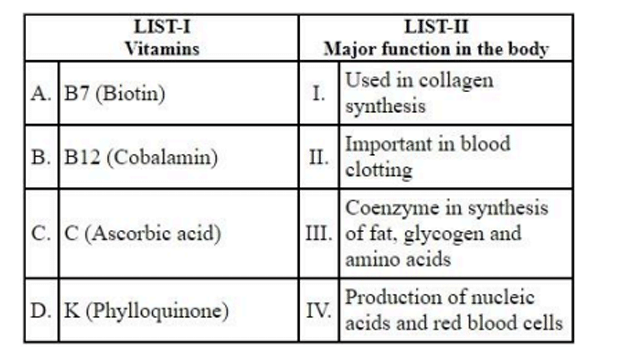
Match LIST-I with LIST-IIChoose the correct answer from the options given below:
1
A-I, B-III, C - IV, D - II
2
A - III, B - II, C - IV, D - I
3
A-I, B-II, C - IV, D - III
4
A-III, B - IV, C - I, D - II
Official Solution
Correct Option:
(4)
Step 1: Understanding the Concept:
This question requires matching common vitamins (LIST-I) with their major functions in the human body (LIST-II). Step 2: Detailed Explanation:
Let's determine the primary function for each vitamin listed:
A. B7 (Biotin): Biotin is a crucial coenzyme for carboxylase enzymes, which are involved in synthesizing fatty acids, synthesizing isoleucine and valine, and in gluconeogenesis. This broadly fits with III. Coenzyme in synthesis of fat, glycogen and amino acids.
B. B12 (Cobalamin): Vitamin B12 is essential for DNA synthesis, and thus for the maturation of red blood cells in the bone marrow and the production of nucleic acids. This matches with IV. Production of nucleic acids and red blood cells.
C. C (Ascorbic acid): Vitamin C is a required cofactor for enzymes that hydroxylate proline and lysine residues during the synthesis of collagen, the main structural protein in connective tissues. This matches with I. Used in collagen synthesis.
D. K (Phylloquinone): Vitamin K is essential for the synthesis of several proteins required for blood coagulation (clotting factors) in the liver. This matches with II. Important in blood clotting.
Step 3: Final Answer:
The correct matching is A-III, B-IV, C-I, D-II. This corresponds to option (D).
18
PYQ 2025
medium
life-scienceID: cuet-pg-
The glycosidic bond between the monomers of sucrose is-
1
Gal(1 4)Glc
2
Fru(4 1)Glc
3
Fru(4 2)Glc
4
Fru(2 1)Glc
Official Solution
Correct Option:
(4)
Step 1: Understanding the Concept:
Sucrose is a non-reducing disaccharide composed of two monosaccharides: glucose and fructose. A glycosidic bond links these two monomers. We need to identify the specific nature of this bond. Step 2: Detailed Explanation:
The monomers of sucrose are -D-glucose and -D-fructose.
The glycosidic bond is formed between the anomeric carbon of glucose (C1) and the anomeric carbon of fructose (C2).
Specifically, the linkage is from the C1 of -glucose to the C2 of -fructose.
The systematic name is -D-glucopyranosyl-(1 2)- -D-fructofuranoside.
Let's analyze the options:
(A) describes the bond in lactose (Galactose + Glucose).
(B) and (C) show incorrect linkages and carbons.
(D) Fru(2 1)Glc correctly represents the bond between the C1 of -glucose and the C2 of -fructose. The double arrow ( ) is often used to indicate a bond between two anomeric carbons, which is why sucrose is a non-reducing sugar.
Step 3: Final Answer:
The glycosidic bond in sucrose is an -1, -2 linkage between glucose and fructose, correctly represented by option (D).
19
PYQ 2025
medium
life-scienceID: cuet-pg-
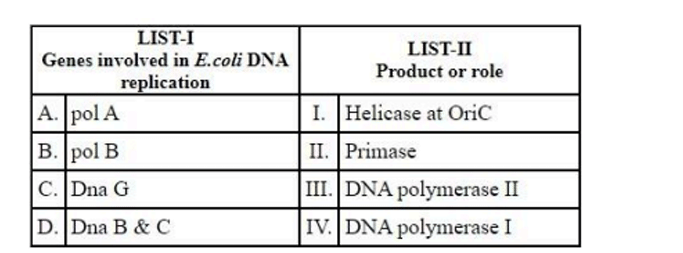
Match LIST-I with LIST-IIChoose the correct answer from the options given below:
1
A - IV, B - III, C - I, D - II
2
A - IV, B - III, C - II, D - I
3
A - I, B - II, C - IV, D - III
4
A - III, B - IV, C - I, D - II
Official Solution
Correct Option:
(2)
Step 1: Understanding the Concept:
This question requires matching the genes involved in E. coli DNA replication (LIST-I) with their corresponding protein products or roles (LIST-II). Step 2: Detailed Explanation:
Let's match each gene with its product/role:
A. polA: This gene codes for DNA polymerase I, an enzyme known for its role in DNA repair and removing RNA primers. This matches IV. DNA polymerase I.
B. polB: This gene codes for DNA polymerase II, an enzyme primarily involved in DNA repair. This matches III. DNA polymerase II.
C. DnaG: This gene codes for the enzyme Primase, which synthesizes short RNA primers to initiate DNA synthesis. This matches II. Primase.
D. DnaB \& C: DnaB is the main replicative Helicase in E. coli, which unwinds the DNA double helix. DnaC is the helicase loader, which helps place DnaB at the origin of replication (OriC). This complex is therefore responsible for the helicase activity at the origin. This matches I. Helicase at OriC.
Step 3: Final Answer:
The correct matching is: A-IV, B-III, C-II, D-I. This corresponds to option (B).
20
PYQ 2025
medium
life-scienceID: cuet-pg-
The cationic antimicrobial peptide, histatin is found in human's_____________.
1
Synovial fluid
2
Cerebrospinal fluid
3
Bile juice
4
Saliva
Official Solution
Correct Option:
(4)
Step 1: Understanding the Concept:
Antimicrobial peptides (AMPs) are a component of the innate immune system found in a wide range of organisms. They provide a rapid, non-specific defense against pathogens. Histatins are a specific family of AMPs, and the question asks for their primary location in the human body. Step 2: Detailed Explanation:
Histatins are a family of small, cationic, histidine-rich peptides.
They are secreted exclusively by the parotid and submandibular salivary glands.
Consequently, they are a major protein component of human saliva.
Their primary functions in the oral cavity include potent antifungal activity (especially against Candida albicans), antibacterial activity, and a role in wound healing.
They are not characteristically found in synovial fluid, cerebrospinal fluid, or bile.
Step 3: Final Answer:
The antimicrobial peptide histatin is found in human saliva.
21
PYQ 2025
medium
life-scienceID: cuet-pg-
Which one of the following acid is hydrophobic with non polar side chain?
1
Tyrosine
2
Proline
3
Glutamine
4
Serine
Official Solution
Correct Option:
(2)
Step 1: Understanding the Concept:
Amino acids are classified based on the chemical properties of their side chains (R-groups). A hydrophobic amino acid has a nonpolar side chain that is repelled by water. Step 2: Detailed Explanation:
Let's analyze the side chain of each amino acid:
Tyrosine: The side chain contains a large aromatic ring (hydrophobic part) but also a hydroxyl (-OH) group, which is polar. Due to the hydroxyl group, tyrosine is classified as a polar amino acid.
Proline: The side chain is an aliphatic hydrocarbon group that loops back and bonds to the main-chain nitrogen atom, forming a rigid ring. This side chain is nonpolar and makes proline a hydrophobic amino acid.
Glutamine: The side chain contains an amide group (-CONH ), which is highly polar. Glutamine is a polar amino acid.
Serine: The side chain contains a hydroxyl (-OH) group, which is polar. Serine is a polar amino acid.
Step 3: Final Answer:
Among the given options, only proline has a side chain that is entirely nonpolar, making it a hydrophobic amino acid.
22
PYQ 2025
medium
life-scienceID: cuet-pg-
More recently discovered plant hormone, Jasmonates, play an important role both in plant defense and development, is derived from which fatty acid?
1
Palmitic acid
2
Oleic acid
3
Linoleic acid
4
Linolenic acid
Official Solution
Correct Option:
(4)
Step 1: Understanding the Concept:
Jasmonates (like jasmonic acid) are a class of plant hormones that regulate a wide range of processes, most notably responses to stress and insect/pathogen attack. The question asks for the precursor molecule from which they are synthesized. Step 2: Detailed Explanation:
The biosynthesis of jasmonic acid (JA) is known as the octadecanoid pathway.
This pathway begins with a polyunsaturated fatty acid that is released from the plant cell membrane.
The specific precursor fatty acid is -linolenic acid (an 18-carbon fatty acid with three double bonds, C18:3).
Linolenic acid is then converted through a series of enzymatic steps (involving lipoxygenase, allene oxide synthase, and others) into jasmonic acid.
Palmitic acid is a saturated fatty acid. Oleic and Linoleic acids are unsaturated but have fewer double bonds than linolenic acid and are not the direct precursors.
Step 3: Final Answer:
Jasmonates are derived from the fatty acid linolenic acid.
23
PYQ 2025
medium
life-scienceID: cuet-pg-
Which one of the following amino acids is involved in synthesis of hormone epinephrine in humans?
1
Threonine
2
Tryptophan
3
Tyrosine
4
Phenylalanine
Official Solution
Correct Option:
(3)
Step 1: Understanding the Concept:
Epinephrine (also known as adrenaline) is a catecholamine hormone and neurotransmitter. Like many biologically active molecules, it is synthesized from a specific amino acid precursor. Step 2: Detailed Explanation:
The biosynthetic pathway for catecholamines proceeds as follows:
The starting amino acid is Tyrosine.
Tyrosine is converted to L-DOPA by the enzyme tyrosine hydroxylase.
L-DOPA is then converted to Dopamine.
Dopamine is converted to Norepinephrine (noradrenaline).
Finally, Norepinephrine is converted to Epinephrine (adrenaline).
So, the entire pathway starts with Tyrosine. While Phenylalanine (D) can be converted to Tyrosine in the body by the enzyme phenylalanine hydroxylase, Tyrosine itself is the direct precursor that enters the catecholamine synthesis pathway. Tryptophan (B) is the precursor for serotonin and melatonin. Threonine is not a precursor for these hormones. Step 3: Final Answer:
Tyrosine is the amino acid directly involved in the synthesis of epinephrine.
24
PYQ 2025
medium
life-scienceID: cuet-pg-
What is the function of Histatin?
1
Growth hormone
2
Antimicrobial peptide
3
Enzyme
4
Neurotransmitter
Official Solution
Correct Option:
(2)
Histatins are antimicrobial peptides found in human saliva. They aid in wound healing, inhibit fungal growth (especially Candida albicans), and contribute to oral health maintenance.
25
PYQ 2025
medium
life-scienceID: cuet-pg-
Match the following: A. Polymers – DNA, RNA; B. Polymerase – DNA polymerase, RNA polymerase.
1
DNA Polymerase → RNA synthesis, RNA Polymerase → DNA synthesis
2
c
3
DNA Polymerase → Transcription, RNA Polymerase → Replication
4
DNA Polymerase → Ribosome assembly, RNA Polymerase → Protein folding
Official Solution
Correct Option:
(2)
DNA polymerase is responsible for replicating DNA, while RNA polymerase synthesizes RNA from the DNA template in transcription. These enzymes are essential for genetic material processing.
About Biochemistry - CUET-PG
Biochemistry is a vital chapter for CUET-PG aspirants. Mastering the concepts covered in this chapter is essential for securing a top rank.
By rigorously practicing the previous year questions associated with this chapter, you can identify high-yield topics, understand the examiner's perspective, and boost your confidence during the actual exam.
Frequently Asked Questions
Why focus on Biochemistry PYQs?
Analyzing PYQs for this specific chapter reveals the most frequently tested concepts and the typical complexity of questions, allowing you to tailor your study plan efficiently.
How to best use this analysis?
Review the topic breakdown to see which sub-topics within Biochemistry carry the most weight. Then, tackle the questions iteratively to solidify your understanding.