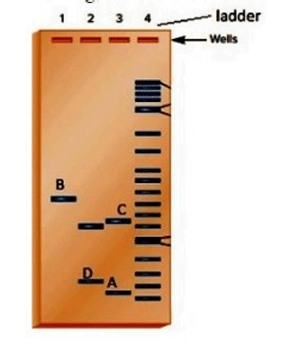
Arrange the following DNA fragments A, B, C, D separated after Gel Electrophoresis in increasing order of number of their base pairs
1
A, B, C, D
2
A, D, C, B
3
B, C, D, A
4
C, B, D, A
Official Solution
Correct Option:
(2)
Step 1: Understanding the Concept:
Agarose gel electrophoresis is a technique used to separate macromolecules like DNA based on their size.
DNA has a uniformly negative charge, so when an electric field is applied, it migrates from the negative electrode (at the top, by the wells) towards the positive electrode (at the bottom).
The agarose gel acts as a sieve. Smaller DNA fragments move faster and farther through the gel than larger fragments. Step 2: Detailed Explanation:
The starting points are the "Wells" at the top.
The distance traveled is inversely proportional to the size of the DNA fragment.
Observing the positions on the gel:
Fragment A has traveled the farthest distance, making it the smallest.
Fragment D has traveled the next farthest distance.
Fragment C has traveled less distance than D.
Fragment B has traveled the shortest distance, making it the largest.
The question asks for the order of increasing number of base pairs, which means from smallest to largest.
Step 3: Final Answer:
The correct order from smallest to largest is A, D, C, B.
02
PYQ 2025
easy
life-scienceID: cuet-pg-
Telomerase acts as a cellular reverse transcriptase that provides the active site for:
1
RNA-dependent DNA synthesis
2
DNA-dependent RNA synthesis
3
RNA-dependent RNA synthesis
4
DNA-dependent DNA synthesis
Official Solution
Correct Option:
(1)
Step 1: Understanding the Concept:
Telomerase is a ribonucleoprotein enzyme responsible for maintaining the length of telomeres, which are the protective caps at the ends of eukaryotic chromosomes. It prevents the progressive shortening of chromosomes that occurs during standard DNA replication. The term "reverse transcriptase" refers to an enzyme that synthesizes DNA from an RNA template. Step 2: Detailed Explanation:
Let's break down the function of telomerase:
Telomerase contains its own built-in RNA molecule that serves as a template.
It uses this RNA template to synthesize DNA, adding repetitive nucleotide sequences to the 3' end of the DNA strand.
The process of synthesizing DNA using an RNA template is called RNA-dependent DNA synthesis.
Let's analyze the other options:
DNA-dependent RNA synthesis is transcription, carried out by RNA polymerase.
RNA-dependent RNA synthesis is carried out by RNA replicase, found in some RNA viruses.
DNA-dependent DNA synthesis is standard DNA replication, carried out by DNA polymerase.
Step 3: Final Answer:
Since telomerase is a reverse transcriptase that uses an RNA template to synthesize DNA, its activity is RNA-dependent DNA synthesis.
03
PYQ 2025
medium
life-scienceID: cuet-pg-
A technique for transferring denatured DNA molecules that have been separated electrophoretically from a gel to a matrix (such as a nitrocellulose or nylon membrane) on which a hybridization assay can be performed is called
1
Northern blotting
2
Southern blotting
3
Eastern blotting
4
Western blotting
Official Solution
Correct Option:
(2)
Step 1: Understanding the Concept:
Blotting techniques transfer macromolecules (DNA, RNA, proteins) from an electrophoresis gel to a solid membrane for detection. Step 2: Detailed Explanation:
The specific names of the blotting techniques correspond to the type of molecule being detected:
Southern blotting: Used to detect specific DNA sequences. The process described in the question—separating DNA on a gel and transferring it to a membrane for hybridization—is the definition of a Southern blot.
Northern blotting: Used to detect specific RNA sequences.
Western blotting: Used to detect specific proteins using antibodies.
Eastern blotting: A less common technique for detecting post-translational modifications.
Step 3: Final Answer:
The technique for transferring separated DNA from a gel to a membrane is called Southern blotting.
04
PYQ 2025
medium
life-scienceID: cuet-pg-
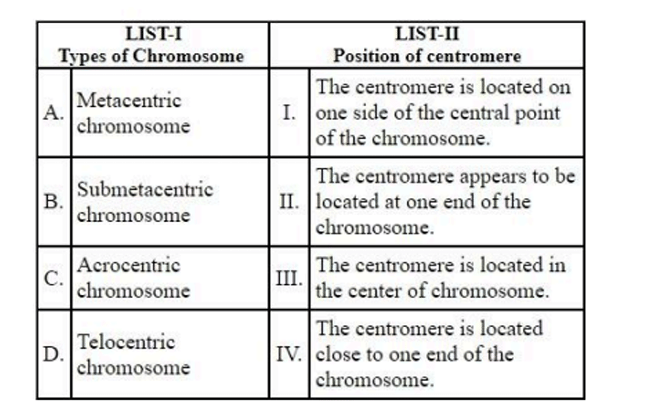
Match the LIST-I with LIST-IIChoose the correct answer from the options given below:
1
A-I, B - II, C - III, D - IV
2
A-I, B - III, C - II, D - IV
3
A-III, B - I, C - IV, D - II
4
A-III, B - IV, C - I, D - II
Official Solution
Correct Option:
(3)
Step 1: Understanding the Concept:
Chromosomes are classified into four types based on the position of the centromere, which divides the chromosome into two arms (a short 'p' arm and a long 'q' arm). Step 2: Detailed Explanation:
Let's match each chromosome type in LIST-I with its corresponding centromere position in LIST-II:
A. Metacentric chromosome: The centromere is located exactly in the center, creating two arms of equal length. This matches with III. The centromere is located in the center of chromosome.
B. Submetacentric chromosome: The centromere is located slightly off-center, resulting in one arm being slightly shorter than the other. This matches with I. The centromere is located on one side of the central point of the chromosome.
C. Acrocentric chromosome: The centromere is located very close to one end, resulting in one very short arm (often with satellites) and one very long arm. This matches with IV. The centromere is located close to one end of the chromosome.
D. Telocentric chromosome: The centromere is located at the very end (telomere) of the chromosome, so there is only one arm. This matches with II. The centromere appears to be located at one end of the chromosome.
Step 3: Final Answer:
The correct matching is: A-III, B-I, C-IV, D-II. This corresponds to option (C).
05
PYQ 2025
medium
life-scienceID: cuet-pg-
Arrange the steps of recombinant DNA-cloning procedure in correct sequence of their occurance:
A. Joining the target DNA with cloning vector DNA by ligase enzyme.
B. Targeted DNA from a source organism is cleaved and cloning vector DNA is also cleaved by the same restriction endonuclease.
C. Selection of transformants from non-transformants through antibiotic resistance and color indicators
D. Introduction of recombinant DNA into host cell. Choose the correct answer from the options given below:
1
A, B, C, D
2
A, C, B, D
3
B, A, D, C
4
C, B, D, A
Official Solution
Correct Option:
(3)
Step 1: Understanding the Concept:
Recombinant DNA technology involves creating a new DNA molecule by combining genetic material from different sources. The question asks for the logical sequence of steps in a standard gene cloning experiment. Step 2: Detailed Explanation:
Let's arrange the steps logically:
Step B: First, you must prepare the DNA fragments. This involves cutting both the target DNA (gene of interest) and the cloning vector (e.g., a plasmid) with the same restriction enzyme to generate compatible ends.
Step A: Next, the prepared target DNA fragment is joined with the cleaved vector DNA. The enzyme DNA ligase is used to form phosphodiester bonds, creating the recombinant DNA molecule.
Step D: The newly created recombinant DNA must be introduced into a host organism, usually a bacterium like E. coli. This process is called transformation.
Step C: Transformation is an inefficient process, so you need to select the few cells that successfully took up the recombinant DNA (transformants) from the vast majority that did not. This is done using selectable markers like antibiotic resistance or color indicators (e.g., blue-white screening).
Step 3: Final Answer:
The correct sequence of occurrence is B A D C.
06
PYQ 2025
medium
life-scienceID: cuet-pg-
Choose the correct answer regarding the translation of mRNA to proteins when AUG is the start codon and codes for methionine.
1
All proteins have methionine as the first amino acids.
2
Methionine never added at the beginning of protein synthesis.
3
An enzyme can cleave the methionine amino acid from the polypeptide after synthesis.
4
Methionine fall off automatically from the polypeptide just after termination step of the protein synthesis.
Official Solution
Correct Option:
(3)
Step 1: Understanding the Concept:
The process of translation is initiated at the start codon AUG, which codes for the amino acid methionine (or a modified form, fMet, in bacteria). The question asks about the fate of this initial methionine in the final protein product. Step 2: Detailed Explanation:
Let's evaluate each statement:
(A) All proteins have methionine as the first amino acids. This is incorrect. While protein synthesis always begins with methionine, it is very often removed from the N-terminus of the polypeptide chain after translation.
(B) Methionine never added at the beginning of protein synthesis. This is incorrect. The start codon AUG explicitly directs the incorporation of methionine as the first amino acid.
(C) An enzyme can cleave the methionine amino acid from the polypeptide after synthesis. This is correct. This process is a common post-translational modification called N-terminal methionine excision (NME). It is carried out by enzymes called methionine aminopeptidases (MAPs). Whether the methionine is cleaved or not depends on the nature of the second amino acid in the chain.
(D) Methionine fall off automatically from the polypeptide... This is incorrect. The removal of the N-terminal methionine is an active, enzymatic process and does not happen automatically.
Step 3: Final Answer:
The correct statement is that the initial methionine can be enzymatically removed from the polypeptide after it has been synthesized.
07
PYQ 2025
medium
life-scienceID: cuet-pg-
Colibactin is a DNA-damaging compound and when taken up by human intestinal cells, colibactin result in double stranded DNA break and can cause human colorectal cancers. It is synthesized by:
1
Certain strain of E. coli
2
Helicobacter pylori
3
Bacteroides fragilis
4
Bifidobacterium spp.
Official Solution
Correct Option:
(1)
Step 1: Understanding the Concept:
The question asks to identify the bacterial source of colibactin, a genotoxin (a toxin that damages DNA) produced by certain gut bacteria and linked to colorectal cancer. Step 2: Detailed Explanation:
Colibactin is a secondary metabolite produced by a specific genomic island called the polyketide synthase (pks) island.
This pks island is found in certain strains of Escherichia coli, particularly those belonging to the B2 phylogroup, as well as some strains of Klebsiella pneumoniae and other Enterobacteriaceae.
These pks E. coli strains are part of the normal gut microbiota in some individuals.
The colibactin they produce can act as a DNA alkylating agent, causing double-strand breaks in host intestinal epithelial cells. This DNA damage can lead to chromosomal instability and promote the development of colorectal cancer.
Helicobacter pylori is associated with stomach cancer, Bacteroides fragilis can produce a different toxin (BFT) linked to colon cancer, and Bifidobacterium are generally considered probiotic.
Step 3: Final Answer:
Colibactin is synthesized by certain strains of E. coli.
08
PYQ 2025
medium
life-scienceID: cuet-pg-
Arrange the sequence of bacterial transcription.
1
Termination → Elongation → Initiation
2
Initiation → Termination → Elongation
3
Initiation → Elongation → Termination
4
Elongation → Initiation → Termination
Official Solution
Correct Option:
(2)
Transcription begins when RNA polymerase binds to the promoter (Initiation), continues with the synthesis of RNA (Elongation), and ends when RNA polymerase reaches the terminator sequence (Termination).
09
PYQ 2026
medium
life-scienceID: cuet-pg-
Which technique is specifically used to detect the presence of a specific DNA sequence in a sample?
1
Western blotting
2
Southern blotting
3
Northern blotting
4
ELISA
Official Solution
Correct Option:
(2)
Concept:
Blotting techniques are widely used in molecular biology to detect specific biomolecules such as DNA, RNA, or proteins. Each blotting method is designed for a particular type of molecule. Step 1:Understanding blotting techniques.
Different blotting methods detect different biomolecules:
Southern blotting → DNA
Northern blotting → RNA
Western blotting → Proteins
Step 2:Principle of Southern blotting.
In Southern blotting, DNA fragments are first separated by gel electrophoresis. These fragments are then transferred onto a membrane and hybridized with a labeled DNA probe that is complementary to the target sequence. Step 3:Detection of specific DNA sequences.
If the probe binds to the complementary DNA sequence on the membrane, the presence of the specific DNA fragment can be detected using radioactive or fluorescent signals. Therefore, the technique used to detect a specific DNA sequence is Southern blotting.
10
PYQ 2026
medium
life-scienceID: cuet-pg-
In gel electrophoresis of DNA, toward which electrode do the DNA fragments migrate?
1
Positive electrode (Anode)
2
Negative electrode (Cathode)
3
Both electrodes equally
4
They do not migrate
Official Solution
Correct Option:
(1)
Concept:
Gel electrophoresis is a technique used to separate DNA fragments based on their size by applying an electric field across a gel matrix. DNA molecules carry an overall negative charge due to the presence of phosphate groups in their backbone. Step 1:Charge on DNA molecules.
The backbone of DNA contains phosphate groups, each carrying a negative charge. As a result, DNA fragments behave as negatively charged molecules in an electric field. Step 2:Movement in an electric field.
When an electric current is applied, negatively charged molecules migrate toward the positively charged electrode (anode). Step 3:Separation in the gel matrix.
As DNA fragments move through the agarose gel, smaller fragments migrate faster and travel farther than larger fragments, allowing separation based on size. Therefore, DNA fragments migrate toward the positive electrode (anode) during gel electrophoresis.
11
PYQ 2026
easy
life-scienceID: cuet-pg-
What is the standard sequence of steps in a PCR (Polymerase Chain Reaction) cycle?
1
Annealing → Denaturation → Extension
2
Denaturation → Annealing → Extension
3
Extension → Denaturation → Annealing
4
Annealing → Extension → Denaturation
Official Solution
Correct Option:
(2)
Concept:
Polymerase Chain Reaction (PCR) is a molecular biology technique used to amplify a specific segment of DNA. It involves repeated cycles of temperature changes that allow DNA strands to separate, primers to bind, and new DNA strands to be synthesized. Each PCR cycle consists of three main steps. Step 1:Denaturation.
The reaction mixture is heated to about (94^\circ C - 98^\circ C). At this high temperature, the double-stranded DNA separates into two single strands as the hydrogen bonds between complementary bases break. Step 2:Annealing.
The temperature is lowered to approximately (50^\circ C - 65^\circ C). At this stage, short DNA primers bind (anneal) to their complementary sequences on the single-stranded DNA templates. Step 3:Extension (Elongation).
The temperature is raised to around (72^\circ C), which is the optimal temperature for the enzyme {Taq polymerase}. The enzyme adds nucleotides to the primer and synthesizes a new DNA strand complementary to the template. Thus, the correct order of PCR steps is:
[
\text{Denaturation} \rightarrow \text{Annealing} \rightarrow \text{Extension}
]
About Molecular Biology - CUET-PG
Molecular Biology is a vital chapter for CUET-PG aspirants. Mastering the concepts covered in this chapter is essential for securing a top rank.
By rigorously practicing the previous year questions associated with this chapter, you can identify high-yield topics, understand the examiner's perspective, and boost your confidence during the actual exam.
Frequently Asked Questions
Why focus on Molecular Biology PYQs?
Analyzing PYQs for this specific chapter reveals the most frequently tested concepts and the typical complexity of questions, allowing you to tailor your study plan efficiently.
How to best use this analysis?
Review the topic breakdown to see which sub-topics within Molecular Biology carry the most weight. Then, tackle the questions iteratively to solidify your understanding.