Which of the following enzyme is defective in galactosemia—a fatal genetic disorder in infants?
1
Glucokinase
2
Galactokinase
3
UDP-galactose 4-epimerase
4
Galactose-1-phosphate uridyltransferase
Official Solution
Correct Option:
(4)
Galactosemia is caused by a deficiency in galactose-1-phosphate uridyltransferase (GALT). This enzyme is responsible for converting galactose-1-phosphate into UDP-galactose, a critical step in galactose metabolism. Without this enzyme, toxic levels of galactose-1-phosphate accumulate, leading to severe complications like liver damage, developmental delays, and cataracts.
02
PYQ 2024
medium
life-scienceID: cuet-pg-
What percentage of genes are found in the human genome?
1
25% of the genome
2
30% of the genome
3
40% of the genome
4
45% of the genome
Official Solution
Correct Option:
(2)
Approximately 30% of the human genome consists of protein-coding genes. The remaining parts include regulatory elements, introns, and other non-coding regions essential for genome function and gene expression.
03
PYQ 2024
medium
life-scienceID: cuet-pg-
Arrange according to their lower to higher genome size: (A) Lambda (λ) (B) T4 (C) Φ x 174 (D) T7 Choose the correct answer from the options given below:
1
(A), (B), (C), (D)
2
(B), (A), (C), (D)
3
(C), (D), (A), (B)
4
(C), (B), (D), (A)
Official Solution
Correct Option:
(3)
The genome sizes of these viruses from smallest to largest are: - Φ x 174 (smallest genome). - T7 (medium genome size). - Lambda (λ) (larger genome). - T4 (largest genome).
04
PYQ 2024
medium
life-scienceID: cuet-pg-
While delivering genes by chemical methods, one popular conjecture about what happens to poly(ethylenimine)/DNA complexes following endocytosis is known as the proton sponge hypothesis, which entails the following steps: (A) PEI/DNA complexes are endocytosed. (B) V-ATPases will pump protons into the vesicular interior. (C) Water will enter the vesicle to balance the osmotic gradient., (D) The vesicle will swell due to the entry of ions and water, leading to rupture. Choose the correct answer from the options given below:
1
(A), (B), and (D) only
2
(A), (B), and (C) only
3
(A), (B), (C), and (D)
4
(B), (C), and (D) only
Official Solution
Correct Option:
(3)
The proton sponge hypothesis explains that PEI/DNA complexes are taken up by endocytosis. The vesicles' interior becomes acidic due to proton pumping by V-ATPases. To balance the osmotic gradient, water enters, causing swelling and eventual vesicle rupture, releasing the DNA into the cytoplasm.
05
PYQ 2024
medium
life-scienceID: cuet-pg-
Arrange the steps in the correct order as they are involved in RNA interference (RNAi): (A) Formation of small interfering RNAs (siRNAs) (B) Activation of RNase III-like enzyme Dicer (C) Inactivation of target RNA (D) Formation of RISC complex Choose the correct answer from the options given below:
1
(A), (B), (C), (D)
2
(A), (C), (B), (D)
3
(B), (A), (C), (D)
4
(C), (B), (D), (A)
Official Solution
Correct Option:
(3)
RNA interference (RNAi) is a cellular process that regulates gene expression through the degradation or inhibition of target mRNA. The steps involved are as follows: 1. Activation of RNase III-like enzyme Dicer (B): The RNAi pathway begins with the activation of the enzyme Dicer, which processes long double-stranded RNA (dsRNA) molecules into small interfering RNAs (siRNAs) 2. Formation of small interfering RNAs (siRNAs) (A): Dicer cleaves dsRNA into siRNAs, which are approximately 21–23 nucleotides in length with 2-nucleotide overhangs at their 3' ends. 3. Inactivation of target RNA (C): The siRNAs are incorporated into the RNA-induced silencing complex (RISC), where they guide the complex to complementary mRNA sequences. 4. Formation of RISC complex (D): The RISC complex, containing Argonaute proteins, binds the siRNAs, facilitating the recognition and cleavage of the target mRNA, thereby inactivating it.
06
PYQ 2024
medium
life-scienceID: cuet-pg-
Arrange the different steps of transcription in the correct order: (A) Transcription bubble formation (B) Phosphorylation of CTD tail (C) Recruitment of elongation factors (D) Dephosphorylation of CTD tail Choose the correct answer from the options given below:
1
(A), (B), (C), (D)
2
(A), (C), (B), (D)
3
(B), (A), (D), (C)
4
(C), (B), (D), (A)
Official Solution
Correct Option:
(1)
Transcription is the process by which genetic information in DNA is transcribed into RNA. The sequence of steps in transcription is as follows: 1. Transcription bubble formation (A): The process begins with the unwinding of DNA, forming a transcription bubble. This exposes the template strand for RNA synthesis. 2. Phosphorylation of CTD tail (B): The C-terminal domain (CTD) of RNA polymerase II undergoes phosphorylation. This modification is essential for transitioning the polymerase from the initiation phase to elongation. 3. Recruitment of elongation factors (C): During the elongation phase, various elongation factors are recruited to stabilize the transcription complex and assist RNA polymerase in synthesizing the RNA strand. 4. Dephosphorylation of CTD tail (D): At the end of transcription, the CTD tail is dephosphorylated, facilitating the termination of transcription and release of the RNA transcript.
07
PYQ 2024
medium
life-scienceID: cuet-pg-
In the human karyotype, chromosomes are divided into how many groups?
1
3 groups
2
5 groups
3
7 groups
4
9 groups
Official Solution
Correct Option:
(3)
In the human karyotype, the 23 pairs of chromosomes are classified into 7 groups (A to G) based on their size and the position of the centromere. This classification is as follows: 1. Group A (Chromosomes 1–3): Largest chromosomes with metacentric or nearly metacentric centromeres. 2. Group B (Chromosomes 4–5): Large chromosomes with submetacentric centromeres. 3. Group C (Chromosomes 6–12, X): Medium-sized chromosomes with submetacentric centromeres. 4. Group D (Chromosomes 13–15): Medium-sized chromosomes with acrocentric centromeres and satellite structures. 5. Group E (Chromosomes 16–18): Small chromosomes with either metacentric (16) or submetacentric (17–18) centromeres. 6. Group F (Chromosomes 19–20): Small chromosomes with metacentric centromeres. 7. Group G (Chromosomes 21–22, Y): Smallest chromosomes with acrocentric centromeres; Y is unique due to its small size. This grouping aids in identifying chromosomal abnormalities during cytogenetic analysis.
08
PYQ 2024
medium
life-scienceID: cuet-pg-
In the human karyotype, the X chromosome belongs to which group?
1
A group
2
B group
3
C group
4
D group
Official Solution
Correct Option:
(3)
The X chromosome is categorized under the C group in the human karyotype. It is classified based on its medium size and submetacentric structure, making it distinct from other groups.
09
PYQ 2024
medium
life-scienceID: cuet-pg-
On the basis of type of body cavity, platyhelminthes can be categorized as
1
Aceolomate
2
Schizocoelomate
3
Pseudocoelomate
4
Enterocoelomate
Official Solution
Correct Option:
(1)
Platyhelminthes, or flatworms, lack a true body cavity, making them aceolomates. Their bodies are filled with mesodermal cells, leaving no space for organs to be suspended in a coelom. This characteristic is a key feature distinguishing them from coelomates and pseudocoelomates.
10
PYQ 2024
medium
life-scienceID: cuet-pg-
Match List I with List II
List I
List II
(A) Radiation hybrid mapping
(I) DNA can be cut into large fragments and circularized for use in chromosome walking
(B) Sequence tagged site (STS) mapping
(II) Useful for cloning of overlapping DNA fragments (restricted to about 200 kb)
(C) Chromosome jumping
(III) Fragment genome into large pieces and locate markers and genes
(D) Chromosome walking
(IV) Applicable to any part of DNA sequence if some sequence information is available
Choose the correct answer from the options given below:
1
(A) - (I), (B) - (II), (C) - (III), (D) - (IV)
2
(A) - (I), (B) - (III), (C) - (II), (D) - (IV)
3
(A) - (I), (B) - (II), (C) - (IV), (D) - (III)
4
(A) - (III), (B) - (IV), (C) - (I), (D) - (II)
Official Solution
Correct Option:
(4)
- Radiation hybrid mapping involves allows researchers to skip over regions of DNA to locate distant markers and genes. - Sequence tagged site (STS) mapping is used to study DNA regions when sequence information is available. - Chromosome jumping breaking DNA into large fragments and circularizing them for chromosome walking. - Chromosome walking is essential for overlapping DNA fragment cloning.
11
PYQ 2024
medium
life-scienceID: cuet-pg-
A clotting disorder which is a sex-linked disease:
1
Sickle cell anemia
2
Thalassemia
3
Hemophilia
4
Albinism
Official Solution
Correct Option:
(3)
Hemophilia is a genetic disorder that affects blood clotting. It is an X-linked recessive condition, meaning that it is carried on the X chromosome. Males are more commonly affected because they have only one X chromosome. Hemophilia results from deficiencies in clotting factors such as factor VIII (Hemophilia A) or factor IX (Hemophilia B), leading to prolonged bleeding.
12
PYQ 2024
medium
life-scienceID: cuet-pg-
Match List I with List II
LIST I (Transposons)
LIST II (Organism)
A. Pelement
I. Drosophila
B. LINE and SINE
II. Human
C. Ty element
III. Yeast
D. Tn element
IV. Bacteria
Choose the correct answer from the options given below:
1
A - I, B - II, C - III, D - IV
2
A - I, B - III, C - II, D - IV
3
A - I, B - II, C - IV, D - III
4
A - III, B - IV, C - I, D - II
Official Solution
Correct Option:
(1)
- Pelement: Found in Drosophila, these transposons are essential for genetic studies and gene tagging. - LINE and SINE: Long and short interspersed nuclear elements in humans play roles in genome structure and function. - Ty element: Found in yeast, these transposons are involved in genetic variability. - Tn element: Found in bacteria, these transposons are crucial for studying antibiotic resistance.
13
PYQ 2024
medium
life-scienceID: cuet-pg-
Transcription factors that mediate the binding of RNA polymerase to DNA template are A. TFIIA B. TATA box C. TFIIB D. Small nuclear ribonucleoproteins Choose the correct answer from the options given below:
1
A and D
2
A and C
3
C and D
4
B and D
Official Solution
Correct Option:
(2)
Transcription factors are proteins that assist in the initiation and regulation of transcription by facilitating the binding of RNA polymerase to the DNA template. Among the options: - TFIIA: A general transcription factor that stabilizes the binding of TFIID (which includes the TATA-binding protein) to the promoter region. It is crucial for forming the transcription initiation complex. - TATA box: Not a transcription factor but a DNA sequence in the promoter region that serves as the binding site for transcription factors such as TFIID. - TFIIB: A transcription factor that plays a role in recruiting RNA polymerase II to the promoter and stabilizing its binding during initiation. - Small nuclear ribonucleoproteins (snRNPs): These are involved in RNA splicing and do not play a direct role in transcription initiation. Thus, the transcription factors involved in mediating the binding of RNA polymerase to the DNA template are TFIIA and TFIIB.
14
PYQ 2024
medium
life-scienceID: cuet-pg-
tRNA is synthesized by:
1
RNA polymerase I
2
RNA polymerase II
3
Ribosomes
4
RNA polymerase III
Official Solution
Correct Option:
(4)
In eukaryotes, tRNA molecules are synthesized by RNA polymerase III, which is specialized for transcribing small RNA molecules, including 5S rRNA and tRNAs. RNA polymerase I transcribes most rRNA (except 5S rRNA), and RNA polymerase II synthesizes mRNA and some snRNAs. Ribosomes, on the other hand, are involved in translation and not RNA synthesis.
15
PYQ 2024
medium
life-scienceID: cuet-pg-
The gene transmission from a male parent to a female offspring (“child”) to a male “grandchild” is called:
1
Crisscross inheritance
2
X-linked inheritance
3
Y-linked inheritance
4
Chromosomal inheritance
Official Solution
Correct Option:
(1)
Crisscross inheritance describes the pattern in which a gene is passed from a father to his daughter and then from the daughter to her son. This is typical of X-linked inheritance since the male transmits his X chromosome to his daughters, who can then pass it to their sons.
16
PYQ 2024
medium
life-scienceID: cuet-pg-
Which of the following statement is true for X-linked recessive inheritance?
1
All sons of a normal mother should show the trait.
2
All sons of an affected mother should show the trait.
3
Many more females than males should exhibit the trait.
4
All daughters of a normal mother should show the trait.
Official Solution
Correct Option:
(2)
In X-linked recessive inheritance, an affected mother has two defective X chromosomes and will pass one defective X chromosome to all her sons. Since males inherit only one X chromosome, they will always express the trait if they inherit the defective gene. Females are less frequently affected because they require two copies of the defective gene to show the trait.
17
PYQ 2024
medium
life-scienceID: cuet-pg-
Match List I with List II:
LIST I (Condition)
LIST II (Characteristics)
A. Color blindness
I. Insensitivity to green and red light
B. Hemophilia B
II. Deficiency of clotting factor IX
C. Hemophilia A
III. Deficiency of clotting factor VIII
D. G-6-PD deficiency
IV. Severe anemic condition
Choose the correct answer from the options given below:
1
A - I, B - II, C - III, D - IV
2
A - II, B - I, C - III, D - IV
3
A - IV, B - I, C - II, D - III
4
A - II, B - III, C - I, D - IV
Official Solution
Correct Option:
(4)
- Color blindness: Results from insensitivity to green and red light, caused by mutations in opsin genes on the X chromosome. - Hemophilia B: Caused by a deficiency in clotting factor IX, leading to prolonged bleeding. - Hemophilia A: Caused by a deficiency in clotting factor VIII, also resulting in excessive bleeding. - G-6-PD deficiency: Affects red blood cell metabolism, leading to anemia under oxidative stress.
18
PYQ 2024
easy
life-scienceID: cuet-pg-
Which of the following statement is true for Barr body?
1
It is a highly condensed chromosome.
2
It is an active X chromosome.
3
It is equivalent to the single Y chromosome of the male.
4
It is equivalent to the two X chromosomes of the female.
Official Solution
Correct Option:
(1)
The Barr body is the inactivated X chromosome in females, visible as a dense structure within the nucleus. This condensation ensures dosage compensation between males (with one active X chromosome) and females (with two X chromosomes). The inactive X chromosome is highly condensed and transcriptionally silent, contrasting with the active X chromosome.
19
PYQ 2025
easy
life-scienceID: cuet-pg-
Choose the correct order of steps involved in nucleotide excision repair of damaged bases as their occur.
A. A fresh burst of DNA synthesis
B. Cuts are made on both the 3' side and the 5' side of the damaged area
C. The DNA is unwound producing a "bubble".
D. A DNA ligase covalent binds the fresh piece into the backbone. Choose the correct answer from the options given below:
1
A, B, C, D
2
B, C, A, D
3
C, B, A, D
4
A, B, D, C
Official Solution
Correct Option:
(3)
Step 1: Understanding the Concept:
Nucleotide Excision Repair (NER) is a DNA repair mechanism that removes bulky, helix-distorting lesions such as pyrimidine dimers caused by UV light. The question asks for the chronological sequence of events in this process. Step 2: Detailed Explanation:
The steps of NER occur in a specific logical order:
Step C: Damage Recognition and Unwinding. First, the repair machinery must recognize the distortion in the DNA helix. Following recognition, a helicase unwinds the DNA around the lesion, creating a "bubble" to provide access for other enzymes.
Step B: Excision. An excinuclease (a type of endonuclease) makes two cuts in the damaged strand, one on the 5' side and one on the 3' side of the lesion. This excises a short single-stranded DNA segment containing the damage.
Step A: Synthesis. A DNA polymerase uses the intact, complementary strand as a template to synthesize new DNA, filling the gap created by the excision.
Step D: Ligation. Finally, the enzyme DNA ligase seals the nick in the phosphodiester backbone, joining the newly synthesized DNA to the pre-existing strand and completing the repair.
Step 3: Final Answer:
The correct sequence of steps is C B A D.
20
PYQ 2025
easy
life-scienceID: cuet-pg-
The DNA of the bacterial cell is protected from the cell's own restriction enzymes by the addition of methyl group (-CH3) to ___________ of cytosine.
A. 4th Carbon
B. 7th Carbon
C. 6th Carbon
D. 5th Carbon
Choose the correct answer from the options given below:
1
D only
2
B only
3
B and D only
4
B and C only
Official Solution
Correct Option:
(1)
Step 1: Understanding the Concept:
Bacteria use Restriction-Modification (R-M) systems to protect themselves from foreign DNA. A methyltransferase enzyme adds a methyl group to specific bases within a recognition sequence in the bacterium's own DNA. This methylation blocks the corresponding restriction enzyme from cutting the host DNA. Step 2: Detailed Explanation:
The common sites for protective DNA methylation are:
On Adenine: The N6 position.
On Cytosine: The N4 position and, most commonly, the C5 position.
Analyzing the options for cytosine:
D. 5th Carbon: Methylation at the 5th carbon of the pyrimidine ring creates 5-methylcytosine. This is a major form of DNA modification for protection in R-M systems. This statement is correct.
A, B, C: The 4th, 7th, and 6th carbons are not the primary sites for this protective methylation. While methylation can occur on the amino group at C4, the most well-known and direct carbon methylation site is C5.
Step 3: Final Answer:
The correct statement is D (5th Carbon). Therefore, the correct option to choose is (A) D only.
21
PYQ 2025
easy
life-scienceID: cuet-pg-
Which one of the following statement is incorrect regarding the work of Erwin Chargaff?
1
The base composition of DNA don't varies from one species to another.
2
DNA specimens isolated from different tissues of the same species have the same base composition.
3
The base composition of DNA in a given species does not change with an organism's age, nutritional state, or changing environment.
4
The sum of the purine residues equals the sum of the pyrimidine residues; that is, A + G = T + C.
Official Solution
Correct Option:
(1)
Step 1: Understanding the Concept:
Erwin Chargaff's experiments on the base composition of DNA led to the formulation of "Chargaff's rules," which were crucial for Watson and Crick's discovery of the DNA double helix structure. We need to identify the statement that contradicts these rules. Step 2: Detailed Explanation:
Let's analyze each statement in the context of Chargaff's findings:
(A) The base composition of DNA don't varies from one species to another. This statement is incorrect. A key finding by Chargaff was that the relative amounts of A, G, C, and T bases do vary from one species to another. For example, the ratio of (A+T) to (G+C) is different in humans compared to E. coli.
(B) DNA specimens isolated from different tissues of the same species have the same base composition. This is correct. Chargaff found that for a given species, the DNA base composition is consistent across all tissues.
(C) The base composition of DNA in a given species does not change with an organism's age, nutritional state, or changing environment. This is correct. The base composition is a stable characteristic of a species.
(D) The sum of the purine residues equals the sum of the pyrimidine residues; that is, A + G = T + C. This is correct. This is the most famous of Chargaff's rules, often stated as the amount of adenine (A) equals the amount of thymine (T), and the amount of guanine (G) equals the amount of cytosine (C). This implies A+G (purines) = T+C (pyrimidines).
Step 3: Final Answer:
The incorrect statement is (A), as it directly contradicts one of Chargaff's primary discoveries.
22
PYQ 2025
easy
life-scienceID: cuet-pg-
Choose the correct sequence of different regions on a typical eukaryotic DNA segment when we go from the upstream to the downstream of a transcription start point.
A. Initiation site
B. CAAT box
C. Enhancer
D. TATA box Choose the correct answer from the options given below:
1
B, D, A, C
2
A, C, B, D
3
B, A, D, C
4
C, B, D, A
Official Solution
Correct Option:
(4)
Step 1: Understanding the Concept:
Eukaryotic genes have complex regulatory regions. The question asks for the typical arrangement of these elements relative to the transcription start point, moving from upstream (further away, in the 5' direction) to downstream (towards and past the start site). Step 2: Detailed Explanation:
Let's locate each element relative to the transcription start point (designated as +1):
C. Enhancer: These are distal control elements. They can be located thousands of base pairs upstream or even downstream of the gene they regulate. They are generally the farthest upstream element.
B. CAAT box: This is a proximal control element, typically located around -80 to -70 base pairs upstream of the start site.
D. TATA box: This is a core promoter element, located very close to the start site, typically at position -35 to -25 upstream.
A. Initiation site (INR): This is the specific point where transcription begins, designated as +1. It is the most downstream of all the listed elements.
Step 3: Final Answer:
Arranging these from most upstream (most negative position or farthest away) to most downstream (+1), the correct sequence is Enhancer CAAT box TATA box Initiation site. This corresponds to the order C, B, D, A.
23
PYQ 2025
medium
life-scienceID: cuet-pg-
Which of the following statements are correct regarding prokaryotic genomic organization?
A. Most prokaryotes contain a single large circle of double stranded DNA as its genome.
B. The nucleoid is an irregularly shaped region that contains the cell's chromosome and numerous proteins.
C. Nucleoid associated proteins (NAPs) are not particularly important during cell division for the compaction of chromosome.
D. Prokaryotic genomes are much smaller as compared to eukaryotes. Choose the correct answer from the options given below:
1
A, B and D only
2
A, B and C only
3
A, B, C and D
4
B, C and D only
Official Solution
Correct Option:
(1)
Step 1: Understanding the Concept:
Prokaryotic cells have a simpler genomic organization than eukaryotic cells. Their genetic material is located in a region called the nucleoid and is not enclosed by a membrane. Step 2: Detailed Explanation:
Let's analyze each statement:
A. Correct. The typical prokaryotic genome is a single, circular, double-stranded DNA molecule.
B. Correct. The nucleoid is the non-membrane-bound, irregularly shaped region within a prokaryotic cell that contains the chromosome and associated proteins.
C. Incorrect. Nucleoid-associated proteins (NAPs) are analogous to eukaryotic histones. They are critically important for compacting the chromosome to fit within the cell and for its organization, including during cell division.
D. Correct. Prokaryotic genomes (typically 0.5-10 million base pairs) are orders of magnitude smaller than eukaryotic genomes (e.g., the human genome is ~3,200 million base pairs).
Step 3: Final Answer:
Statements A, B, and D are correct, while C is incorrect. Thus, the correct option is (A).
24
PYQ 2025
medium
life-scienceID: cuet-pg-
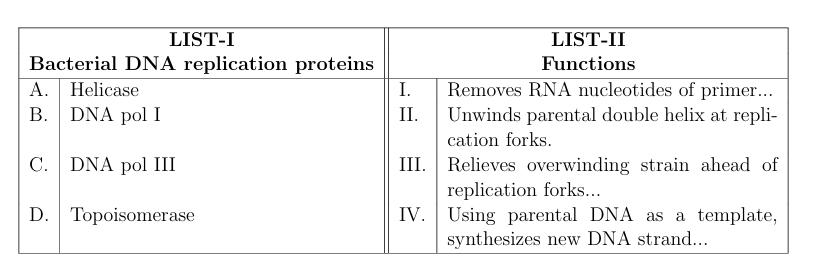
Match LIST-I with LIST-II Choose the correct answer from the options given below:
1
A-I, B- II, C - III, D - IV
2
A-I, B- III, C - II, D - IV
3
A-II, B-I, C - IV, D - III
4
A-III, B - IV, C - I, D - II
Official Solution
Correct Option:
(3)
Step 1: Understanding the Concept:
This question requires matching key enzymes and proteins involved in bacterial DNA replication with their specific functions in the process. Step 2: Detailed Explanation:
Let's match each protein from LIST-I with its function from LIST-II:
A. Helicase: This enzyme is responsible for separating the two strands of the DNA double helix, using ATP hydrolysis to power the unwinding process at the replication fork. This matches II. Unwinds parental double helix at replication forks.
B. DNA pol I: This DNA polymerase has a crucial "clean-up" role. It uses its 5' to 3' exonuclease activity to remove the RNA primers that initiated synthesis and its 5' to 3' polymerase activity to fill the resulting gaps with DNA. This matches I. Removes RNA nucleotides of primer...and replaces them with DNA nucleotides....
C. DNA pol III: This is the main replicative polymerase in bacteria. It is responsible for the rapid and processive synthesis of the new DNA strands, adding nucleotides to the 3' end of a primer. This matches IV. Using parental DNA as a template, synthesis new DNA strand by adding nucleotides....
D. Topoisomerase (specifically DNA gyrase in bacteria): As the helicase unwinds DNA, it creates positive supercoils (overwinding) ahead of the fork. Topoisomerase cuts the DNA, allows it to unswivel, and then reseals it to relieve this torsional strain. This matches III. Relieves overwinding strain ahead of replication forks....
Step 3: Final Answer:
The correct matching is A-II, B-I, C-IV, D-III.
25
PYQ 2025
medium
life-scienceID: cuet-pg-
The left-handed helix, Z-DNA is 18 \AA \ (1.8 nm) in diameter which contains _____________________.
1
10 bp per turn
2
11 bp per turn
3
10.4 bp per turn
4
12 bp per turn
Official Solution
Correct Option:
(4)
Step 1: Understanding the Concept:
DNA can exist in several different conformations. The most common is B-DNA, but others like A-DNA and Z-DNA exist under specific conditions. These forms differ in their structural parameters, including handedness, diameter, and the number of base pairs (bp) per helical turn. The question asks for the number of base pairs per turn for Z-DNA. Step 2: Detailed Explanation:
Let's compare the key features of the major DNA forms:
B-DNA: The classic Watson-Crick model. It is a right-handed helix with about 10.4-10.5 base pairs per turn. Its diameter is about 20 \AA. (Option C refers to B-DNA).
A-DNA: A dehydrated form of DNA. It is a right-handed helix that is wider and shorter than B-DNA, with 11 base pairs per turn. Its diameter is about 26 \AA. (Option B refers to A-DNA).
Z-DNA: A left-handed helix with a distinct zigzagging phosphate backbone. It is thinner and more elongated than B-DNA. Its diameter is about 18 \AA. It contains 12 base pairs per turn (or 6 dimeric units).
Step 3: Final Answer:
The left-handed Z-DNA helix contains 12 base pairs per turn.
26
PYQ 2025
medium
life-scienceID: cuet-pg-
Choose the correct sequence of events as they occur during a bacterial transcription
A. RNA polymerase sigma ( ) subunits recognizes promoters
B. DNA double helix unwind
C. Sigma ( ) subunit dissociates from the holoenzyme
D. Formation of hairpin secondary structure Choose the correct answer from the options given below:
1
A, B, C, D
2
A, C, B, D
3
B, A, D, C
4
C, B, D, A
Official Solution
Correct Option:
(1)
Step 1: Understanding the Concept:
Bacterial transcription involves three main stages: initiation, elongation, and termination. The question asks to arrange the key events of these stages in their correct chronological order. Step 2: Detailed Explanation:
Let's analyze the sequence of events:
Initiation (Step A): The process begins when the RNA polymerase holoenzyme, specifically its sigma ( ) subunit, recognizes and binds to the promoter sequence on the DNA.
Initiation (Step B): After binding, the RNA polymerase unwinds a short segment of the DNA double helix at the promoter region, forming an "open complex" and exposing the template strand.
Elongation (Step C): As the RNA polymerase moves along the DNA template synthesizing RNA (after about 10 nucleotides), the sigma ( ) subunit is no longer needed for promoter binding and dissociates from the core enzyme. The core enzyme continues elongation.
Termination (Step D): The process ends at a terminator sequence. The formation of a stable hairpin secondary structure in the newly synthesized RNA is characteristic of Rho-independent termination, which signals the RNA polymerase to dissociate from the DNA template.
Step 3: Final Answer:
The logical and chronological sequence of events is A B C D.
27
PYQ 2025
medium
life-scienceID: cuet-pg-
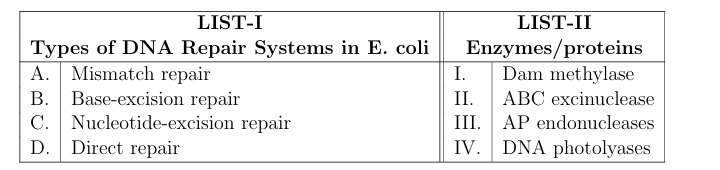
Match LIST-I with LIST-II Choose the correct answer from the options given below:
1
A-I, B-II, C - III, D- IV
2
A-I, B - III, C - II, D - IV
3
A-I, B-II, C - IV, D - III
4
A-III, B - IV, C - I, D - II
Official Solution
Correct Option:
(2)
Step 1: Understanding the Concept:
This question requires matching specific DNA repair pathways in E. coli with the key enzymes or proteins that are characteristic of each pathway. Step 2: Detailed Explanation:
Let's match each repair system with its key enzyme:
A. Mismatch repair (MMR): This system corrects errors made during DNA replication. To distinguish the new strand (with the error) from the old template strand, the E. coli MMR system relies on methylation. The Dam methylase enzyme methylates adenine bases in GATC sequences. Newly synthesized strands are temporarily unmethylated, allowing the repair machinery to identify and correct them. Thus, Dam methylase is a key component of this system's specificity. This matches I.
B. Base-excision repair (BER): This pathway removes a single damaged or incorrect base. After a DNA glycosylase removes the base, it leaves an apurinic/apyrimidinic (AP) site. An AP endonuclease then cuts the DNA backbone at this site to allow for repair. This matches III.
C. Nucleotide-excision repair (NER): This pathway removes bulky lesions. The key enzyme complex in E. coli is UvrABC, which is also known as ABC excinuclease. It recognizes the lesion and makes cuts on either side. This matches II.
D. Direct repair: This is the simplest form of repair where the damage is directly reversed. A classic example is the repair of pyrimidine dimers caused by UV light, which is directly reversed by DNA photolyases using the energy from visible light. This matches IV.
Step 3: Final Answer:
The correct matching is A-I, B-III, C-II, D-IV.
28
PYQ 2025
medium
life-scienceID: cuet-pg-
Which of the following are autosomal recessive genetic disorder?
A. Huntington disease
B. Sickle cell anemia
C. Lesch-Nyhan syndrome
D. Tay-Sachs disease Choose the correct answer from the options given below:
1
B and D only
2
A, B and C only
3
A, B, C and D
4
B, C and D only
Official Solution
Correct Option:
(1)
Step 1: Understanding the Concept:
Genetic disorders are classified based on their inheritance patterns. An autosomal recessive disorder requires an individual to inherit two copies of the mutated gene (one from each parent) to express the disease. We need to identify which of the listed diseases follow this pattern. Step 2: Detailed Explanation:
Let's determine the inheritance pattern for each disorder:
A. Huntington disease: This is a classic example of an autosomal dominant disorder. An individual needs to inherit only one copy of the mutated gene to develop the disease.
B. Sickle cell anemia: This is an autosomal recessive disorder. Individuals must be homozygous for the recessive sickle cell allele (HbS/HbS) to have the full-blown disease. Heterozygotes (HbA/HbS) have sickle cell trait but are generally healthy.
C. Lesch-Nyhan syndrome: This is an X-linked recessive disorder. It is caused by a mutation on the X chromosome and therefore primarily affects males. It is not autosomal.
D. Tay-Sachs disease: This is a lysosomal storage disorder that follows an autosomal recessive inheritance pattern. An individual must inherit two copies of the defective gene for the HEXA enzyme to have the disease.
Step 3: Final Answer:
The autosomal recessive disorders on the list are Sickle cell anemia (B) and Tay-Sachs disease (D).
About Molecular Genetics - CUET-PG
Molecular Genetics is a vital chapter for CUET-PG aspirants. Mastering the concepts covered in this chapter is essential for securing a top rank.
By rigorously practicing the previous year questions associated with this chapter, you can identify high-yield topics, understand the examiner's perspective, and boost your confidence during the actual exam.
Frequently Asked Questions
Why focus on Molecular Genetics PYQs?
Analyzing PYQs for this specific chapter reveals the most frequently tested concepts and the typical complexity of questions, allowing you to tailor your study plan efficiently.
How to best use this analysis?
Review the topic breakdown to see which sub-topics within Molecular Genetics carry the most weight. Then, tackle the questions iteratively to solidify your understanding.