Which of the following is the example of Gram-negative bacteria?
1
Lactobacillus
2
Escherichia coli
3
Bacillus subtilis
4
Staphylococcus aureus
Official Solution
Correct Option:
(2)
Gram-negative bacteria are characterized by having a thin peptidoglycan layer and an outer membrane containing lipopolysaccharides. This structure gives them a pink color when subjected to the Gram staining technique. Among the options provided: 1. Lactobacillus: A Gram-positive bacterium, commonly found in probiotics and involved in lactic acid fermentation. 2. Escherichia coli (E. coli): A Gram-negative bacterium found in the gut of warm-blooded organisms. It is distinguished by its thin peptidoglycan wall and outer membrane. 3. Bacillus subtilis: A Gram-positive bacterium, widely studied and used in industrial processes. 4. Staphylococcus aureus: Another Gram-positive bacterium, known for causing infections like MRSA. Thus, the correct answer is Escherichia coli, which is a well-known Gram-negative bacterium.
02
PYQ 2024
medium
life-scienceID: cuet-pg-
Which of the following are viral diseases? (A) Yellow fever (B) Hepatitis B (C) Chickenpox (D) Rabies Choose the correct answer from the options given below:
1
(A), (B), and (D) only
2
(A), (B), and (C) only
3
(B), (C), and (D) only
4
(A), (B), (C), and (D)
Official Solution
Correct Option:
(4)
All the diseases listed are caused by viruses: - Yellow fever: Caused by the Yellow fever virus, transmitted by Aedes mosquitoes. It primarily affects the liver and can lead to jaundice. - Hepatitis B: Caused by the Hepatitis B virus, which affects the liver and can lead to chronic liver disease or cancer. - Chickenpox: Caused by the Varicella-zoster virus, it leads to itchy blisters and can reactivate later in life as shingles. - Rabies: Caused by the Rabies virus, it is transmitted through animal bites and affects the nervous system, leading to fatal encephalitis if untreated.
03
PYQ 2024
medium
life-scienceID: cuet-pg-
Lederberg and Tatum describe the phenomena of-
1
Transformation
2
Conjugation
3
Mutation
4
Transversion
Official Solution
Correct Option:
(2)
Lederberg and Tatum discovered conjugation in bacteria, a process where genetic material is transferred between bacterial cells through direct physical contact using a pilus. This discovery demonstrated that bacteria are capable of sexual reproduction and horizontal gene transfer, influencing bacterial evolution and genetic diversity.
04
PYQ 2024
medium
life-scienceID: cuet-pg-
Match List I with List II:
List I
List II
(A) D’Herelle and Twort
(I) Bacterial transformation
(B) Beadle and Tatum
(II) Penicillin
(C) Fleming
(III) One-gene-one-enzyme hypothesis
(D) Griffith
(IV) Bacterial viruses
Choose the correct answer from the options given below:
1
(A) - (IV), (B) - (III), (C) - (II), (D) - (I)
2
(A) - (I), (B) - (III), (C) - (IV), (D) - (II)
3
(A) - (I), (B) - (II), (C) - (IV), (D) - (III)
4
(A) - (III), (B) - (IV), (C) - (I), (D) - (II)
Official Solution
Correct Option:
(1)
- D’Herelle and Twort: Independently discovered bacteriophages, viruses that infect bacteria, which are now used in phage therapy. - Beadle and Tatum: Introduced the one-gene-one-enzyme hypothesis, demonstrating that genes dictate enzyme production, foundational to molecular biology. - Fleming: Discovered penicillin, the first antibiotic, revolutionizing the treatment of bacterial infections. - Griffith: Conducted experiments showing bacterial transformation, where genetic material from one bacterium can alter another.
05
PYQ 2024
medium
life-scienceID: cuet-pg-
Vaccine is not available for which disease?
1
Hepatitis B
2
Influenza
3
AIDS
4
Mumps
Official Solution
Correct Option:
(3)
AIDS, caused by HIV, remains without a vaccine due to the virus's high mutation rate and ability to evade the immune system. In contrast, effective vaccines exist for Hepatitis B, Influenza, and Mumps, significantly reducing their global burden.
06
PYQ 2024
medium
life-scienceID: cuet-pg-
Antibody formed immediately after infection is-
1
IgM
2
IgG
3
IgD
4
IgE
Official Solution
Correct Option:
(1)
IgM is the first antibody produced in response to an infection, playing a vital role in the primary immune response. It is large in size, allowing it to form pentamers that enhance pathogen neutralization. IgG, the most abundant antibody, follows IgM and provides long-term immunity.
07
PYQ 2024
medium
life-scienceID: cuet-pg-
Arrange the steps involved in Gram-stain procedure: (A) Staining with Crystal Violet (B) Staining with Gram’s Iodine (C) Decolorization (D) Staining with Safranine Choose the correct answer from the options given below:
1
(A), (B), (C), (D)
2
(A), (B), (D), (C)
3
(B), (A), (D), (C)
4
(C), (B), (D), (A)
Official Solution
Correct Option:
(1)
The Gram-stain procedure involves: 1. Staining with Crystal Violet: This is the primary stain that binds to the peptidoglycan in bacterial cell walls. 2. Staining with Gram’s Iodine: The iodine acts as a mordant, forming a complex with Crystal Violet, increasing the dye’s binding strength. 3. Decolorization: Alcohol or acetone is used to remove the stain from Gram-negative bacteria due to their thinner peptidoglycan layer. 4. Staining with Safranine: The counterstain provides color to Gram-negative bacteria, making them appear pink under a microscope, while Gram-positive bacteria remain purple.
08
PYQ 2024
medium
life-scienceID: cuet-pg-
Yellow fever is caused due to the human-to-human transmission by-
1
Aedes aegypti
2
Culex
3
Dermacentor andersoni
4
Mycobacterium tuberculosis
Official Solution
Correct Option:
(1)
Yellow fever, a viral hemorrhagic disease, is primarily transmitted by the Aedes aegypti mosquito. This mosquito acts as a vector, spreading the virus between humans or from infected monkeys to humans. The disease affects the liver and kidneys, causing jaundice and sometimes fatal complications. Other organisms listed, such as Culex, are vectors for other diseases, and Mycobacterium tuberculosis is a bacterium unrelated to yellow fever.
09
PYQ 2025
medium
life-scienceID: cuet-pg-
Tetracycline is usually mixed with the culturing medium as selective agents in selecting transformants in gene cloning technique. It acts by:
1
Inhibiting cell wall formation; inactivated by -lactamase
2
Binding to the 30S ribosomal subunit and inhibits the binding of aminoacyl-tRNAs in bacteria
3
Blocking protein initiation complex formation and causes misreading during translation
4
Binding to 50S ribosomal subunit and inhibits protein synthesis.
Official Solution
Correct Option:
(2)
Step 1: Understanding the Concept:
Tetracycline is a broad-spectrum antibiotic commonly used as a selective agent in molecular cloning. Its effectiveness relies on a specific mechanism of action that targets a vital process in bacteria, typically protein synthesis. Step 2: Detailed Explanation:
Let's analyze the mechanism of action of tetracycline and other antibiotics mentioned in the options:
(A) Inhibiting cell wall formation; inactivated by -lactamase: This describes the mechanism of -lactam antibiotics like penicillin and ampicillin, not tetracycline.
(B) Binding to the 30S ribosomal subunit and inhibits the binding of aminoacyl-tRNAs in bacteria: This is the correct mechanism for tetracycline. It binds reversibly to the 30S subunit of the bacterial ribosome, which physically blocks the A-site. This prevents charged tRNA molecules (aminoacyl-tRNAs) from binding, thereby halting the elongation step of protein synthesis.
(C) Blocking protein initiation complex formation and causes misreading during translation: This describes the action of aminoglycoside antibiotics like streptomycin.
(D) Binding to 50S ribosomal subunit and inhibits protein synthesis: This describes the action of macrolide antibiotics (like erythromycin) and chloramphenicol, which target the larger 50S ribosomal subunit.
Step 3: Final Answer:
Tetracycline acts by binding to the 30S ribosomal subunit and preventing the attachment of aminoacyl-tRNA.
10
PYQ 2025
medium
life-scienceID: cuet-pg-
Match LIST-I with LIST-II
LIST-I (Commercial Production)
LIST-II (Microorganism)
A. Citric acid
I. Corynebacterium glutamicum
B. Ethanol
II. Aspergillus niger
C. Amino acids and nucleotides
III. Claviceps purpurea
D. Alkaloids
IV. Saccharomyces cerevisiae
Choose the correct answer from the options given below:
1
A - II, B - III, C - IV, D - I
2
A-I, B-III, C - II, D - IV
3
A - II, B - IV, C - I, D - III
4
A-III, B - IV, C - I, D - II
Official Solution
Correct Option:
(3)
Step 1: Understanding the Concept:
This question tests knowledge of industrial microbiology, specifically which microorganisms are used for the large-scale commercial production of certain chemicals and compounds. Step 2: Detailed Explanation:
Let's match each product in LIST-I with the correct microorganism from LIST-II:
A. Citric acid: The primary microorganism used for the industrial production of citric acid is the fungus Aspergillus niger. This matches II.
B. Ethanol: Ethanol fermentation for beverages and biofuel is famously carried out by the yeast Saccharomyces cerevisiae. This matches IV.
C. Amino acids and nucleotides: The bacterium Corynebacterium glutamicum is extensively used for the industrial production of amino acids, particularly L-glutamate and L-lysine. This matches I.
D. Alkaloids: Ergot alkaloids, which have various pharmaceutical applications, are produced by the fungus Claviceps purpurea. This matches III.
Step 3: Final Answer:
The correct set of matches is A-II, B-IV, C-I, D-III. This corresponds to option (C).
11
PYQ 2025
medium
life-scienceID: cuet-pg-
For sterilization, the culture media and glasswares must be generally autoclaved at:
1
121 C and 19 psi
2
121 C and 15 psi
3
112 C and 15 psi
4
120 C and 20 psi
Official Solution
Correct Option:
(2)
Step 1: Understanding the Concept:
Autoclaving is a sterilization method that uses high-pressure saturated steam. The goal is to eliminate all forms of microbial life, including highly resistant bacterial endospores, from media and equipment. This requires specific conditions of temperature, pressure, and time. Step 2: Detailed Explanation:
The standard operating conditions for a laboratory autoclave are based on the temperature required to kill bacterial spores, which are the most heat-resistant life forms.
To achieve a temperature of 121 C (250 F) with steam, the pressure must be raised above normal atmospheric pressure.
The standard pressure used to reach 121 C is approximately 15 psi (pounds per square inch) above atmospheric pressure.
These conditions (121 C, 15 psi) are typically maintained for a minimum of 15-20 minutes to ensure complete sterilization, with the exact time depending on the volume and nature of the load.
Step 3: Final Answer:
The generally accepted standard conditions for autoclaving are 121 C and 15 psi.
12
PYQ 2025
medium
life-scienceID: cuet-pg-
Benzoic acid or benzoates are used to preserve food from
A. Insects
B. Yeast
C. Clostridia
D. Molds Choose the correct answer from the options given below:
1
A and B only
2
B and C only
3
A, C and D only
4
B and D only
Official Solution
Correct Option:
(4)
Step 1: Understanding the Concept:
Benzoic acid and its salts (like sodium benzoate) are common chemical food preservatives. Their effectiveness is targeted against specific types of spoilage organisms, and they work best under certain conditions (acidic pH). Step 2: Detailed Explanation:
Let's evaluate the targets of benzoic acid:
A. Insects: Benzoic acid is an antimicrobial agent, not an insecticide. It has no effect on insects.
B. Yeast: Yeasts are a primary target for benzoates. These preservatives are highly effective at inhibiting the growth of acid-tolerant fermentative yeasts in acidic foods like fruit juices, jams, and carbonated drinks.
C. Clostridia: Clostridia are bacteria, many of which are obligate anaerobes and can form spores. Benzoates have limited antibacterial activity and are generally not the preservative of choice against spore-forming bacteria like Clostridia. Nitrites are more commonly used for this purpose, especially in cured meats.
D. Molds: Like yeasts, molds are fungi and are also primary targets for benzoates. The preservative is effective in preventing mold growth on the surface of acidic foods.
Step 3: Final Answer:
Benzoic acid and benzoates are primarily used to preserve food from yeasts (B) and molds (D).
13
PYQ 2025
medium
life-scienceID: cuet-pg-
The Bdellovibrios bacteria is a _________ bacteria:
A. Gram negative
B. Predator of gram negative bacteria
C. It has a single polar flagellum
D. Reproduce by producing spores called myxospore during nutrient deficit conditions Choose the correct answer from the options given below:
1
A, B and D only
2
A, B and C only
3
A, B, C and D
4
B, C and D only
Official Solution
Correct Option:
(2)
Step 1: Understanding the Concept:
Bdellovibrio is a genus of bacteria known for its unique predatory lifestyle. This question asks to identify the correct characteristics of this bacterium from the given list. Step 2: Detailed Explanation:
Let's analyze each statement:
A. Gram negative: This is correct. Bdellovibrio is a Gram-negative bacterium.
B. Predator of gram negative bacteria: This is correct and is the most distinctive feature of Bdellovibrio. It actively preys on other Gram-negative bacteria by invading their periplasmic space and consuming their cellular contents.
C. It has a single polar flagellum: This is correct. The free-living, "attack phase" of Bdellovibrio is highly motile due to a single, thick, sheathed polar flagellum.
D. Reproduce by producing spores called myxospore during nutrient deficit conditions: This is incorrect. Myxospores are resting spores produced by Myxobacteria (another group of interesting bacteria). Bdellovibrio has a unique reproductive cycle where it grows into a long filament inside its host and then fragments into multiple progeny cells, which then lyse the host cell. It does not form myxospores.
Step 3: Final Answer:
The correct statements are A, B, and C. Statement D is incorrect. Therefore, the correct option is (B).
14
PYQ 2025
medium
life-scienceID: cuet-pg-
Hepatitis C virus can cause liver cancer. It has:
1
ds DNA genome
2
ssDNA genome
3
ss RNA genome
4
ds RNA genome
Official Solution
Correct Option:
(3)
Step 1: Understanding the Concept:
Viruses are classified based on their genetic material (DNA or RNA, single-stranded or double-stranded). The question asks for the type of genome found in the Hepatitis C virus (HCV). Step 2: Detailed Explanation:
Hepatitis C virus (HCV) is a member of the Flaviviridae family, genus Hepacivirus.
The genome of HCV is a single-stranded, positive-sense RNA molecule.
This ss(+)RNA genome acts directly as messenger RNA (mRNA) upon entering the host cell, allowing for the immediate translation of viral proteins. It also serves as a template for replication of the viral genome.
Chronic infection with HCV is a leading cause of liver cirrhosis and hepatocellular carcinoma (liver cancer).
Other hepatitis viruses have different genomes: Hepatitis B has a dsDNA genome, while Hepatitis A also has an ssRNA genome.
Step 3: Final Answer:
Hepatitis C virus has a single-stranded RNA (ss RNA) genome.
15
PYQ 2025
medium
life-scienceID: cuet-pg-
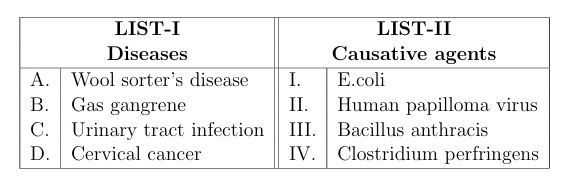
Match LIST-I with LIST-II Choose the correct answer from the options given below:
1
A - I, B - II, C - III, D - IV
2
A - I, B - III, C - II, D - IV
3
A - I, B - II, C - IV, D - III
4
A - III, B - IV, C - I, D - II
Official Solution
Correct Option:
(4)
Step 1: Understanding the Concept:
This question requires matching common infectious diseases with their specific causative agents (pathogens). Step 2: Detailed Explanation:
Let's match each disease with its pathogen:
A. Wool sorter's disease: This is the historical name for inhalational anthrax, a severe lung infection caused by inhaling the spores of the bacterium Bacillus anthracis. The name comes from its association with workers who sorted wool from infected animals. This matches III.
B. Gas gangrene: This is a life-threatening infection of muscle tissue (myonecrosis) characterized by gas production. The primary causative agent is the anaerobic, spore-forming bacterium Clostridium perfringens. This matches IV.
C. Urinary tract infection (UTI): While many bacteria can cause UTIs, the vast majority (around 80-90\%) of community-acquired cases are caused by the bacterium Escherichia coli (E. coli). This matches I.
D. Cervical cancer: Most cases of cervical cancer are caused by persistent infection with certain high-risk strains of the Human papillomavirus (HPV). This virus integrates into the host genome and produces oncoproteins that lead to malignant transformation. This matches II.
Step 3: Final Answer:
The correct matching is A-III, B-IV, C-I, D-II.
16
PYQ 2025
medium
life-scienceID: cuet-pg-
Agar is used for preparing solid media for culture. Which of the following is not true about agar media?
1
Agar is obtain from a sea weed
2
It has virtually no nutritive value.
3
It melts at 98 C and usually sets on 42 C depending on agar concentration.
4
For solid media 0.2\% to 0.5\% agar concentration is employed.
Official Solution
Correct Option:
(4)
Step 1: Understanding the Concept:
Agar is the most common solidifying agent used in microbiological culture media. The question asks to identify an incorrect statement about its properties. Step 2: Detailed Explanation:
Let's evaluate each statement:
(A) Agar is obtain from a sea weed: This is true. Agar is a polysaccharide extracted from the cell walls of certain species of red algae (seaweed), primarily from the genera Gelidium and Gracilaria.
(B) It has virtually no nutritive value: This is true. One of the key advantages of agar is that it is a complex polysaccharide that is not metabolized or degraded by the vast majority of microorganisms. It serves only as a solidifying agent, not a nutrient source.
(C) It melts at 98 C and usually sets on 42 C...: This is true. Agar exhibits hysteresis; it melts at a high temperature (around 95-100 C) but solidifies at a much lower temperature (around 40-45 C). This allows heat-sensitive components (like antibiotics or blood) to be added to the molten agar before it solidifies.
(D) For solid media 0.2\% to 0.5\% agar concentration is employed: This is not true. This concentration range (0.2-0.5\%) is used to prepare semi-solid media, which is used for motility testing. For a standard solid medium (like an agar plate or slant), a concentration of 1.5\% to 2.0\% agar is required to produce a firm gel.
Step 3: Final Answer:
The statement that 0.2\% to 0.5\% agar is used for solid media is incorrect; this concentration is for semi-solid media.
17
PYQ 2025
medium
life-scienceID: cuet-pg-
Organisms belongs to the genus bacteroides are:
1
Chemoautotrophs, aerobic and gram positive.
2
Causative agents of Lyme diseases.
3
Anaerobic, gram-negative, nonspore-forming rods and usually nonmotile.
4
Not able to degrade cellulose, pectins, and other complex carbohydrates.
Official Solution
Correct Option:
(3)
Step 1: Understanding the Concept:
The question asks for the correct description of bacteria belonging to the genus Bacteroides. These bacteria are a major component of the mammalian gut microbiota. Step 2: Detailed Explanation:
Let's evaluate each description:
(A) Chemoautotrophs, aerobic and gram positive: This is incorrect on all counts. Bacteroides are chemoheterotrophs, obligate anaerobes, and are Gram-negative.
(B) Causative agents of Lyme diseases: This is incorrect. Lyme disease is caused by the spirochete Borrelia burgdorferi.
(C) Anaerobic, gram-negative, nonspore-forming rods and usually nonmotile: This is the correct textbook description of the genus Bacteroides. They thrive in the anaerobic environment of the large intestine.
(D) Not able to degrade cellulose, pectins, and other complex carbohydrates: This is incorrect. In fact, the opposite is true. Bacteroides are renowned for their extensive repertoire of enzymes that allow them to ferment and degrade complex plant polysaccharides that are indigestible by humans. This is their key ecological role in the gut.
Step 3: Final Answer:
The most accurate description of organisms from the genus Bacteroides is given in option (C).
18
PYQ 2025
medium
life-scienceID: cuet-pg-
A method for culturing anaerobes is the GasPak System, which uses hydrogen and a ___________ catalyst to remove O .
1
Rubidium
2
Lead
3
Iridium
4
Palladium
Official Solution
Correct Option:
(4)
Step 1: Understanding the Concept:
Culturing obligate anaerobes requires an oxygen-free atmosphere. The GasPak system is a common laboratory method used to create this anaerobic environment within a sealed container. It relies on a chemical reaction to remove oxygen. Step 2: Detailed Explanation:
The GasPak system uses a disposable gas-generating envelope or sachet. When water is added, the sachet releases hydrogen (H ) and carbon dioxide (CO ).
The hydrogen gas then reacts with the free oxygen (O ) present inside the sealed jar.
This reaction (2H + O 2H O) does not occur spontaneously at room temperature. It requires a catalyst to proceed.
The catalyst is contained in a wire mesh basket, usually attached to the lid of the jar. This catalyst consists of palladium pellets.
The palladium catalyzes the chemical combination of hydrogen and oxygen, forming water and effectively removing all the free oxygen from the jar's atmosphere, creating anaerobic conditions.
Step 3: Final Answer:
The catalyst used in the GasPak system to facilitate the removal of oxygen is Palladium.
19
PYQ 2025
medium
life-scienceID: cuet-pg-
The antimicrobial agent mercuric chloride functions by
1
Interfering with cellular oxidation process.
2
Inhibiting the enzymes which contain the sulfhydryl group.
3
Alkylation reactions with organic compounds such as enzymes and other proteins.
4
Denaturation of proteins, interference with glycolysis and membrane damage.
Official Solution
Correct Option:
(2)
Step 1: Understanding the Concept:
Mercuric chloride (HgCl ) is a heavy metal compound that acts as a potent antimicrobial agent. Heavy metals typically exert their toxic effects by binding to and inactivating key cellular proteins, particularly enzymes. Step 2: Detailed Explanation:
The mode of action of heavy metal ions like mercury (Hg ) is primarily through their high affinity for sulfhydryl (-SH) groups found in the amino acid cysteine.
When Hg binds to the sulfhydryl groups of a protein, it forms a stable mercaptide (Protein-S-Hg-S-Protein).
This binding disrupts the protein's tertiary structure and inactivates its active site, especially in enzymes where cysteine residues are often crucial for catalytic activity. This process is known as sulfhydryl group inhibition.
While general protein denaturation (Option D) can occur at high concentrations, the most specific and primary mechanism at biocidal concentrations is the targeted inhibition of sulfhydryl-containing enzymes.
Option C, alkylation, is a mechanism of other agents like ethylene oxide. Option A is too general.
Step 3: Final Answer:
The primary antimicrobial function of mercuric chloride is inhibiting enzymes by binding to their sulfhydryl groups.
20
PYQ 2025
medium
life-scienceID: cuet-pg-
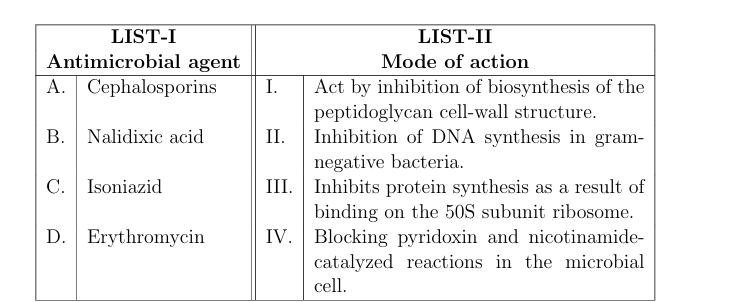
Match LIST-I with LIST-IIChoose the correct answer from the options given below:
1
A-I, B-II, C-III, D-IV
2
A-I, B-III, C-II, D-IV
3
A-I, B-II, C-IV, D-III
4
A-III, B-IV, C-I, D-II
Official Solution
Correct Option:
(3)
Step 1: Understanding the Concept:
This question requires matching different classes of antimicrobial agents with their specific mechanisms of action against microbes. Step 2: Detailed Explanation:
Let's match each agent in LIST-I with its mode of action from LIST-II:
A. Cephalosporins: Cephalosporins are -lactam antibiotics, similar to penicillin. Their primary mechanism is to inhibit the transpeptidase enzymes that catalyze the final cross-linking step in peptidoglycan synthesis. This matches I. Act by inhibition of biosynthesis of the peptidoglycan cell-wall structure.
B. Nalidixic acid: This is a quinolone antibiotic. Quinolones work by inhibiting DNA gyrase (a type II topoisomerase), an enzyme essential for DNA replication, repair, and recombination in bacteria. This matches II. Inhibition of DNA synthesis in gram-negative bacteria.
C. Isoniazid: This is a primary drug used to treat tuberculosis. It works by inhibiting the synthesis of mycolic acids, which are unique and essential components of the Mycobacterium cell wall. This mechanism effectively blocks the use of pyridoxal phosphate (derived from pyridoxine) and NAD (from nicotinamide) in mycolic acid synthesis. This matches IV. Blocking pyridoxin and nicotinamide - catalyzed reactions in the microbial cell.
D. Erythromycin: This is a macrolide antibiotic. It functions by binding to the 50S subunit of the bacterial ribosome, blocking the exit tunnel and thereby inhibiting the translocation step of protein synthesis. This matches III. Inhibits protein synthesis as a result of binding on the 50S subunit ribosome.
Step 3: Final Answer:
The correct matching is A-I, B-II, C-IV, D-III. This corresponds to option (C).
21
PYQ 2025
medium
life-scienceID: cuet-pg-
Which one of the given statement is not correct about plant viruses ?
1
In viruses, the envelope proteins may even project from the envelope surface as spikes are also called as protomers
2
In viruses, the envelope proteins may even project from the envelope surface as spikes are also called as concatemers
3
In viruses, the envelope proteins may even project from the envelope surface as spikes are also called as peplomers.
4
In viruses, the envelope proteins may even project from the envelope surface as spikes are also called as capsomers
Official Solution
Correct Option:
(2)
Step 1: Understanding the Concept:
The question asks to identify the incorrect statement regarding the terminology used for viral structures, specifically the protein spikes on a viral envelope. Although the question mentions "plant viruses," the terminology is general to virology. Most plant viruses are non-enveloped, but the question focuses on the names for envelope spikes. Step 2: Detailed Explanation:
Let's define the terms in the options:
Protomers: This is a general term for the structural protein subunits that assemble to form a larger structure, like a capsid. While envelope proteins are made of protomers, the spike itself is not called a protomer.
Peplomers: This is the correct, specific term for the glycoprotein spikes that project from the envelope of an enveloped virus. The word comes from the Greek 'peplos' (robe or envelope). So, statement (C) is correct.
Capsomers: These are the morphological subunits of the viral capsid, the protein shell that encloses the nucleic acid. They are not found on the envelope. So, statement (D) is technically incorrect as a description of envelope spikes.
Concatemers: This term refers to a long continuous DNA molecule that contains multiple copies of the same DNA sequence linked in series. It is a concept related to viral genome replication (e.g., in bacteriophages) and has nothing to do with envelope proteins or spikes. Therefore, this statement is definitively incorrect.
Comparing the incorrect statements, statement (B) uses a completely unrelated term from a different area of virology (genome replication). Statements (A) and (D) use terms related to viral structure, but apply them incorrectly to envelope spikes. However, the most fundamentally wrong term is "concatemers." Step 3: Final Answer:
The statement that is not correct is that envelope spikes are called concatemers. Concatemers are related to DNA replication, not protein structures.
22
PYQ 2025
medium
life-scienceID: cuet-pg-
Typhoid Vi vaccine consists of which type of product?
1
Viral extract
2
Bacterial product
3
Synthetic protein
4
Toxin
Official Solution
Correct Option:
(2)
The Typhoid Vi vaccine is made from purified Vi capsular polysaccharide, a bacterial component of Salmonella typhi. It helps in immunity against typhoid fever.
About Microbiology - CUET-PG
Microbiology is a vital chapter for CUET-PG aspirants. Mastering the concepts covered in this chapter is essential for securing a top rank.
By rigorously practicing the previous year questions associated with this chapter, you can identify high-yield topics, understand the examiner's perspective, and boost your confidence during the actual exam.
Frequently Asked Questions
Why focus on Microbiology PYQs?
Analyzing PYQs for this specific chapter reveals the most frequently tested concepts and the typical complexity of questions, allowing you to tailor your study plan efficiently.
How to best use this analysis?
Review the topic breakdown to see which sub-topics within Microbiology carry the most weight. Then, tackle the questions iteratively to solidify your understanding.