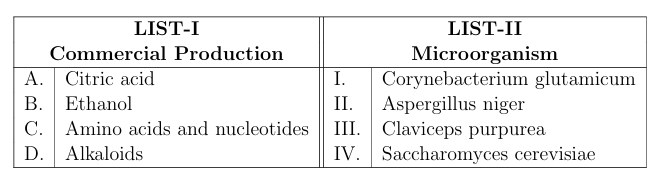
Match LIST-I with LIST-IIChoose the correct answer from the options given below:
1
A-I, B-II, C - III, D - IV
2
A-II, B-I, C - IV, D - III
3
A-IV, B - III, C - II, D-I
4
A-III, B - IV, C - I, D - II
Official Solution
Correct Option:
(3)
Step 1: Understanding the Concept:
This question tests the knowledge of different types of gene interactions (epistasis) and their characteristic modified Mendelian F2 dihybrid ratios. The standard dihybrid ratio is 9:3:3:1. Step 2: Detailed Explanation:
Let's match each type of gene interaction with its resulting F2 ratio:
A. Complementary gene action: Both dominant genes (e.g., A and B) are required to produce a particular phenotype. The absence of either dominant gene results in a different phenotype. Genotypes A_B_ produce one phenotype, while A_bb, aaB_, and aabb produce another. This combines the 3, 3, and 1 parts of the ratio, leading to a 9:7 ratio. This matches IV.
B. Supplementary gene action (Recessive Epistasis): A recessive allele at one locus (e.g., aa) masks the expression of alleles at another locus. For example, A_B_ (phenotype 1), A_bb (phenotype 2), but aaB_ and aabb are both phenotype 3. This combines the 3 and 1 parts, leading to a 9:3:4 ratio. This matches III.
C. Inhibitory gene action: A dominant allele at one locus (the inhibitor gene, I) prevents the expression of a dominant allele at another locus. For example, I_C_ and I_cc are one phenotype (e.g., white), iiC_ is the second phenotype (colored), and iicc is also the first phenotype (white). This combines the 9, 3, and 1 parts, leading to a 13:3 ratio. This matches II.
D. Masking gene action (Dominant Epistasis): A dominant allele at one locus (e.g., A) masks the expression of alleles at another locus. For example, A_B_ and A_bb produce one phenotype, aaB_ produces a second, and aabb produces a third. This combines the 9 and 3 parts, leading to a 12:3:1 ratio. This matches I.
Step 3: Final Answer:
The correct matching is A-IV, B-III, C-II, D-I.
02
PYQ 2025
medium
life-scienceID: cuet-pg-
The F hybrid (Rr Ii) is crossed with a variety double recessive for both the traits. How many types of zygotes will be produced in the cross?
1
1
2
2
3
3
4
4
Official Solution
Correct Option:
(4)
Step 1: Understanding the Concept:
The question describes a dihybrid test cross. A test cross involves crossing an individual with a dominant phenotype (but unknown genotype, here given as heterozygous RrIi) with a homozygous recessive individual (rrii) to determine the genotype of the former. The number of zygote types produced is equal to the number of different gamete types produced by the heterozygous parent. Step 2: Key Formula or Approach:
The number of different gamete types produced by an individual is given by the formula , where is the number of heterozygous gene pairs. The number of zygote types in a test cross is equal to the number of gamete types from the heterozygous parent. Step 3: Detailed Explanation:
The cross is: RrIi rrii
Gametes from the F hybrid (RrIi): This individual is heterozygous for two gene pairs ( ). According to the law of independent assortment, it will produce types of gametes in equal proportions: RI, Ri, rI, and ri.
Gametes from the double recessive parent (rrii): This individual is homozygous for both gene pairs and can only produce one type of gamete: ri.
Formation of zygotes: When the gametes combine, the following zygotes are formed:
RI + ri RrIi Ri + ri Rrii rI + ri rrIi ri + ri rrii
Step 4: Final Answer:
There are four genetically distinct types of zygotes produced in this cross.
03
PYQ 2025
medium
life-scienceID: cuet-pg-
Frequency of recombination between linked genes in Drosophila is affected by
A. Distance between genes
B. Sex of heterozygotes for linked genes
C. Age of female
D. Temperature Choose the correct answer from the options given below:
1
A, B and D only
2
A, B and C only
3
A, B, C and D
4
B, C and D only
Official Solution
Correct Option:
(3)
Step 1: Understanding the Concept:
Genetic recombination (crossing over) is the process that generates new combinations of alleles on a chromosome. The frequency of this event between two linked genes is not constant and can be influenced by several genetic and environmental factors, particularly in model organisms like Drosophila. Step 2: Detailed Explanation:
Let's analyze the effect of each factor:
A. Distance between genes: This is the most fundamental factor. According to Sturtevant's principle of gene mapping, the frequency of recombination is directly proportional to the physical distance between the genes on the chromosome. This is correct.
B. Sex of heterozygotes for linked genes: This is a well-known phenomenon in genetics, especially in Drosophila melanogaster. Crossing over and recombination are completely absent in males. Therefore, the sex of the heterozygous parent dramatically affects the outcome. This is correct.
C. Age of female: Studies in Drosophila have shown that the rate of recombination can be influenced by the age of the female fly, generally decreasing as the female gets older. This is correct.
D. Temperature: Temperature is an environmental factor that can influence recombination rates. Exposing flies to temperatures outside their optimal range (either high or low) has been shown to alter the frequency of crossing over. This is correct.
Step 3: Final Answer:
All four listed factors—distance, sex, age, and temperature—are known to affect the frequency of recombination in Drosophila.
04
PYQ 2025
medium
life-scienceID: cuet-pg-
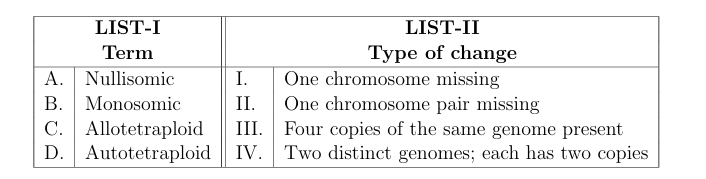
Match the LIST-I with LIST-II Choose the correct answer from the options given below:
1
A-I, B - II, C - III, D - IV
2
A-II, B-I, C - III, D - IV
3
A-I, B-II, C - IV, D - III
4
A-II, B-I, C - IV, D - III
Official Solution
Correct Option:
(4)
Step 1: Understanding the Concept:
This question tests the terminology for different types of chromosomal number variations, including aneuploidy (loss or gain of individual chromosomes) and polyploidy (presence of extra sets of chromosomes). Step 2: Detailed Explanation:
Let's match each term with its correct definition:
A. Nullisomic: This is a form of aneuploidy where a complete homologous pair of chromosomes is lost. The chromosomal composition is represented as (2n - 2). This matches II. One chromosome pair missing.
B. Monosomic: This is a form of aneuploidy where a single chromosome from a homologous pair is lost. The composition is (2n - 1). This matches I. One chromosome missing.
C. Allotetraploid: This is a form of polyploidy where an organism contains four sets of chromosomes derived from two or more different species. For example, if species 1 has genome A and species 2 has genome B, an allotetraploid would be AABB. This matches IV. Two distinct genomes; each has two copies.
D. Autotetraploid: This is a form of polyploidy where an organism has four sets of chromosomes, all derived from a single species. For example, if the basic genome is A, an autotetraploid would be AAAA. This matches III. Four copies of the same genome present.
Step 3: Final Answer:
The correct matching is A-II, B-I, C-IV, D-III.
05
PYQ 2025
medium
life-scienceID: cuet-pg-
In general F , F and the subsequent generations do not show segregation for a cytoplasmically inherited trait. This is because
1
The F individuals generally receive plasmagenes from one parent only.
2
The F individuals generally receive nuclear genes from one parent only.
3
The F individuals generally receive plasmagenes from both parents.
4
The F individuals generally receive nuclear genes from both parents.
Official Solution
Correct Option:
(1)
Step 1: Understanding the Concept:
Cytoplasmic inheritance (also known as extranuclear or maternal inheritance) refers to traits controlled by genes located in organelles within the cytoplasm, such as mitochondria and chloroplasts. These are called plasmagenes. The question asks why these traits do not show Mendelian segregation in F and later generations. Step 2: Detailed Explanation:
Mendelian segregation (e.g., the 3:1 ratio in F ) occurs because nuclear genes from both parents are combined in the F zygote and then segregate during meiosis when the F individual produces gametes.
In contrast, during fertilization in most animals and plants, the male gamete (sperm or pollen) contributes almost no cytoplasm to the zygote. The zygote receives nearly all of its cytoplasm, and thus its mitochondria and chloroplasts, from the female gamete (the egg).
This means that the F individuals inherit their plasmagenes from only one parent, the mother. This is the basis of maternal inheritance.
Since the F individuals have plasmagenes from only one source, there are no alternative alleles (like there would be for nuclear genes in a heterozygote) to segregate during meiosis.
Consequently, all offspring in the F , F , and subsequent generations will have the same cytoplasmic genotype as the original maternal parent. No segregation is observed.
Step 3: Final Answer:
The lack of segregation is because the F generation inherits its cytoplasmic genes (plasmagenes) from a single parent (usually the mother). Option (A) correctly states this reason. Options (B) and (D) are incorrect as nuclear genes are received from both parents. Option (C) is incorrect as plasmagenes are typically received from only one parent.
06
PYQ 2025
medium
life-scienceID: cuet-pg-
Which of the given factors can affect frequency in Mendelian population?
A. Migration
B. Mutation
C. Selection
D. Random shift Choose the correct answer from the options given below:
1
A, B and D only
2
A, B and C only
3
A, B, C and D
4
B, C and D only
Official Solution
Correct Option:
(3)
Step 1: Understanding the Concept:
The question asks about the factors that can alter allele and genotype frequencies in a Mendelian population. This relates to the principles of population genetics, specifically the forces that cause a population to evolve and deviate from Hardy-Weinberg equilibrium. Step 2: Detailed Explanation:
The Hardy-Weinberg principle states that allele frequencies in a population will remain constant in the absence of certain evolutionary influences. These influences are the factors that cause changes in allele frequencies. Let's analyze the given factors:
A. Migration (Gene Flow): The movement of individuals into or out of a population can introduce new alleles or change the proportions of existing alleles, thus affecting the allele frequency.
B. Mutation: The ultimate source of all new genetic variation. Mutations create new alleles, directly changing the allele frequency, although usually at a very slow rate.
C. Selection (Natural Selection): When certain genotypes have a higher fitness (survival and reproductive success) than others, the alleles responsible for those genotypes will increase in frequency over generations.
D. Random shift (Genetic Drift): This refers to random, chance fluctuations in allele frequencies, which have a more significant effect in smaller populations. It's a non-selective force that can lead to the loss or fixation of alleles.
Step 3: Final Answer:
All four factors—Migration, Mutation, Selection, and Genetic Drift (Random shift)—are the primary evolutionary forces that can affect allele frequencies in a population.
07
PYQ 2025
medium
life-scienceID: cuet-pg-
In the F1 generation (RrIi), if recessive genes are crossed, how many zygotes will form?
1
4
2
8
3
16
4
32
Official Solution
Correct Option:
(3)
A dihybrid cross (RrIi × RrIi) follows Mendelian inheritance patterns. Using a Punnett square, the total number of possible zygotic combinations is 16 (from a 4×4 grid).
08
PYQ 2025
medium
life-scienceID: cuet-pg-
Which one is termed as the "guardian of the genome"?
1
p21
2
p27
3
p53
4
Rb protein
Official Solution
Correct Option:
(3)
The p53 protein is a crucial tumor suppressor that monitors DNA integrity, halts cell division if damage is detected, and triggers apoptosis if the damage is irreparable. This prevents cancerous mutations.
09
PYQ 2025
medium
life-scienceID: cuet-pg-
If a sequence has the initiator codon AUG, which codes for methionine, then: Statement I: Yes, the translation process starts with methionine (AUG is the universal start codon) Statement II: Methionine may or may not be present in the final protein, as it can be cleaved during post-translational modifications.
1
Only Statement I is true
2
Only Statement II is true
3
Both statements are true
4
Both statements are false
Official Solution
Correct Option:
(3)
AUG is the universal start codon in mRNA translation, marking the beginning of protein synthesis. However, methionine may be removed later during post-translational modifications.
10
PYQ 2026
medium
life-scienceID: cuet-pg-
What happens to the Vmax of an enzyme-catalyzed reaction when the substrate concentration is equal to the Km?
1
(V = Vmax)
2
(V = Vmax / 2)
3
(V = 2Vmax)
4
(V = 0)
Official Solution
Correct Option:
(2)
Concept:
The relationship between substrate concentration and reaction velocity in enzyme-catalyzed reactions is described by the Michaelis–Menten equation:
[
V = \frac{V_{max}[S]}{K_m + [S]}
]
where (V) is the reaction velocity, (V_{max}) is the maximum velocity, (K_m) is the Michaelis constant, and ([S]) is the substrate concentration. Step 1:Substitute the condition ( [S] = K_m ).
If the substrate concentration equals the Michaelis constant:
[
V = \frac{V_{max}K_m}{K_m + K_m}
] Step 2:Simplify the expression.}
[
V = \frac{V_{max}K_m}{2K_m}
] Step 3:Final result.}
[
V = \frac{V_{max}}{2}
] Thus, when the substrate concentration equals (K_m), the reaction velocity is half of the maximum velocity.
11
PYQ 2026
medium
life-scienceID: cuet-pg-
What is the role of Topoisomerase during the process of DNA replication?
1
Synthesizes RNA primers
2
Unwinds the DNA helix
3
Relieves supercoiling ahead of the replication fork
4
Joins Okazaki fragments
Official Solution
Correct Option:
(3)
Concept:
During DNA replication, the double helix must unwind to allow replication machinery to access the DNA strands. This unwinding creates tension and supercoiling ahead of the replication fork, which must be relieved to allow replication to continue smoothly. Step 1:Action of helicase.
DNA helicase unwinds the double helix by breaking hydrogen bonds between complementary base pairs. This unwinding generates torsional strain and supercoiling in the DNA ahead of the replication fork. Step 2:Role of topoisomerase.
Topoisomerase enzymes relieve this tension by temporarily cutting one or both strands of the DNA molecule. Step 3:Relief of supercoiling.
After cutting the DNA, topoisomerase allows the DNA strands to rotate and release the accumulated tension. The enzyme then reseals the broken DNA strands. This process prevents excessive twisting and ensures smooth progression of the replication machinery. Thus, the primary role of topoisomerase during DNA replication is to relieve supercoiling ahead of the replication fork.
12
PYQ 2026
medium
life-scienceID: cuet-pg-
In the lac operon, which molecule acts as the inducer to initiate transcription?
1
Lactose
2
Allolactose
3
Glucose
4
Galactose
Official Solution
Correct Option:
(2)
Concept:
The lac operon is a gene regulatory system found in {E. coli} that controls the metabolism of lactose. It is an example of an inducible operon, meaning that transcription is normally off but can be activated in the presence of an inducer molecule. Step 1:Structure of the lac operon.
The lac operon consists of:
Structural genes: (lacZ), (lacY), (lacA)
Promoter and operator regions
A regulatory gene producing the lac repressor
Step 2:Role of the lac repressor.
In the absence of lactose, the lac repressor protein binds to the operator region and blocks RNA polymerase from transcribing the structural genes. Step 3:Action of the inducer molecule.
When lactose enters the cell, a small portion of it is converted into allolactose. Allolactose binds to the lac repressor and changes its shape, preventing it from binding to the operator. Step 4:Initiation of transcription.
Once the repressor is removed from the operator, RNA polymerase can bind to the promoter and initiate transcription of the lac operon genes. Thus, the molecule that acts as the true inducer of the lac operon is allolactose.
13
PYQ 2026
medium
life-scienceID: cuet-pg-
According to Chargaff's rules, which base relationship is constant across all species?
1
(A = C)
2
(A = G)
3
(A = T)
4
(G = T)
Official Solution
Correct Option:
(3)
Concept:
Chargaff's rules describe the base composition relationships found in double-stranded DNA. These rules were discovered by the biochemist Erwin Chargaff and helped in understanding the structure of DNA. Step 1:Complementary base pairing in DNA.
In double-stranded DNA, nitrogenous bases pair specifically through hydrogen bonding:
[
\text{Adenine (A)} \leftrightarrow \text{Thymine (T)}, \quad
\text{Guanine (G)} \leftrightarrow \text{Cytosine (C)}
] Step 2:Chargaff's base ratio observation.
Chargaff observed that in DNA extracted from different organisms:
[
A = T \quad \text{and} \quad G = C
] Step 3:Implication of the rule.
Although the overall base composition may vary among species, the pairing rule ensures that the amount of adenine is always equal to thymine, and guanine equals cytosine. Thus, according to Chargaff's rules, the constant base relationship is:
[
A = T
]
About Genetics - CUET-PG
Genetics is a vital chapter for CUET-PG aspirants. Mastering the concepts covered in this chapter is essential for securing a top rank.
By rigorously practicing the previous year questions associated with this chapter, you can identify high-yield topics, understand the examiner's perspective, and boost your confidence during the actual exam.
Frequently Asked Questions
Why focus on Genetics PYQs?
Analyzing PYQs for this specific chapter reveals the most frequently tested concepts and the typical complexity of questions, allowing you to tailor your study plan efficiently.
How to best use this analysis?
Review the topic breakdown to see which sub-topics within Genetics carry the most weight. Then, tackle the questions iteratively to solidify your understanding.