Ability to move at a high speed for longer duration of time
B
Locomotor Ability
II
Ability to perform a single movement in minimum possible time
C
Speed Endurance
III
To maintain maximum speed when in motion for maximum possible distance
D
Movement speed
IV
Ability to achieve high speed of locomotion from a stationary position
Choose the correct answer from the options given below
1
(A)-(IV), (B)-(III), (C)-(I), (D)-(II)
2
(A)-(IV), (B)-(I), (C)-(III), (D)-(II)
3
(A)-(1), (B)-(II), (C)-(IV), (D)-(III)
4
A)-(II), (B)-(I), (C)-(IV), (D)-(III)
Official Solution
Correct Option: (1)
The correct option is (A) : (A)-(IV), (B)-(III), (C)-(I), (D)-(II)
02
PYQ 2023
medium
physical-educationID: cuet-ug-
Which of the following training methods was designed by Anderson and Morgan?
1
Continuous
2
Circuit
3
Repetition
4
Fartlek
Official Solution
Correct Option: (2)
The training method designed by Anderson and Morgan is Circuit. The Circuit Training method involves moving through different exercise stations targeting various muscle groups, improving both cardiovascular fitness and muscular endurance. Anderson and Morgan developed this method to help people with a diverse fitness regimen that includes strength, agility, and endurance training.
03
PYQ 2023
medium
physical-educationID: cuet-ug-
Identify the odd outcome with specific reference to weight training.
1
Develops strength
2
Improves posture
3
Improves agility
4
Develops strength and endurance
Official Solution
Correct Option: (3)
The odd one out is Improves agility. Weight training primarily focuses on building strength, endurance, and improving posture. While agility is important for many sports, it is generally not the primary focus of weight training. Agility typically improves through dynamic exercises, plyometrics, and coordination drills rather than traditional weightlifting exercises.
04
PYQ 2023
medium
physical-educationID: cuet-ug-
In which type of training an athlete changes his speed at his own accord during the activity because of changes in terrain and feelings?
1
Interval Training
2
Continuous Training
3
Fartlek Training
4
Repetition Training
Official Solution
Correct Option: (3)
The correct answer is Fartlek Training. Fartlek, which means "speed play" in Swedish, is a type of training where an athlete varies their speed and intensity at their discretion. This method allows for spontaneous changes in pace and terrain, combining elements of both interval and continuous training. The athlete’s effort can be modified depending on how they feel during the session.
05
PYQ 2023
medium
physical-educationID: cuet-ug-
Identify the odd outcome with specific reference to weight training.
1
Develops strength
2
Improves posture
3
Improves agility
4
Develops strength and endurance
Official Solution
Correct Option: (3)
The odd outcome is Improves agility. Weight training is primarily designed to build strength, endurance, and improve posture by strengthening muscles. However, agility is more closely associated with cardiovascular conditioning, plyometric exercises, and coordination training, rather than weight training itself.
06
PYQ 2023
medium
physical-educationID: cuet-ug-
In which type of training an athlete changes his speed at his own accord during the activity because of changes in terrain and feelings?
1
Interval Training
2
Continuous Training
3
Fartlek Training
4
Repetition Training
Official Solution
Correct Option: (3)
Fartlek Training allows athletes to adjust their speed based on terrain and personal feelings during the activity. This type of training combines both continuous and interval training, providing a more flexible approach to fitness that can be adapted to different conditions.
07
PYQ 2024
medium
physical-educationID: cuet-ug-
Which of the following movement is observed while performing 'Stand at Ease' position?
1
Abduction
2
Adduction
3
Flexion
4
Extension
Official Solution
Correct Option: (2)
To determine the movement in the 'Stand at Ease' position, we need to understand the different types of body movements:
Abduction: Movement away from the midline of the body.
Adduction: Movement towards the midline of the body.
Flexion: Bending movement that decreases the angle between two body parts.
Extension: Straightening movement that increases the angle between body parts.
In the 'Stand at Ease' position, legs are positioned apart and hands are brought to the sides. Here, when considering the part of the command that involves bringing arms or hands back towards the body (from an extended 'Attention' position), the primary movement is Adduction, as this involves moving the arms from an outward position back towards the body (midline).
Thus, the correct answer is: Adduction
08
PYQ 2024
medium
physical-educationID: cuet-ug-
Arrange the following steps of standing broad jump in a sequential order from last to first: (A) Lean forward, swing arms behind both knees to gain momentum (B) Distance will be measured from back to the heel to the take off line (C) Stand behind the take off line (D) Jump as far as possible landing on both the feet (E) Push the surface and take off while swinging arms forward
Choose the correct answer from the options given below:
1
(B), (D), (E), (A), (C)
2
(B), (D), (C), (A), (E)
3
(C), (A), (E), (D), (B)
4
(E), (B), (C), (D), (A)
Official Solution
Correct Option: (3)
To effectively execute a standing broad jump, follow these steps in reverse order for a complete understanding:
Stand behind the take-off line, preparing your stance for the jump.
Lean forward and swing your arms behind both knees to build momentum.
Push against the surface with your feet and take off, while simultaneously swinging your arms forward to maximize distance.
Jump as far as possible, ensuring you land on both feet.
Measure the distance from the back of the heel to the take-off line to determine the distance of the jump.
The correct sequence based on the steps provided is: (C), (A), (E), (D), (B).
09
PYQ 2024
medium
physical-educationID: cuet-ug-
Arrange the steps of interval training session in a sequential order from first to last: (A) Short Break (B) Warm-up (C) Resume similar intensity running (D) Fast pace running where heart goes up to 180 beats per minute (E) Heart beat goes down to 120-130 beats per minute Choose the correct answer from the options given below:
1
(D), (E), (C), (A), (B)
2
(C), (A), (B), (E), (D)
3
(A), (B), (C), (D), (E)
4
(B), (D), (A), (E), (C)
Official Solution
Correct Option: (4)
To effectively organize an interval training session, it's important to follow a structured sequence of activities. Let's go through the steps in the correct order:
Warm-up: Begin with a warm-up to prepare the body for more intense activity. This helps in gradually increasing the heart rate and muscle temperature.
Fast pace running where heart goes up to 180 beats per minute: This step involves engaging in a fast pace run to significantly raise the heart rate.
Short Break: Implement a short break allowing the body to rest momentarily after an intense session.
Heart beat goes down to 120-130 beats per minute: During this time, ensure the heart rate decreases to a moderate level which aids in recovery.
Resume similar intensity running: Finally, resume a similar intensity running session to maintain the endurance and pacing capability.
So, the correct option is (D): (B), (D), (A), (E), (C).
10
PYQ 2024
medium
physical-educationID: cuet-ug-
Arrange the following stretching exercises in a sequential order from toe to head. (A) Pectoral stretch (B) Quadriceps stretch (C) Thoracic extension stretch (D) Lumbar extension stretch Choose the correct answer from the options given below :
1
(B), (C), (A), (D)
2
(B), (C), (D), (A)
3
(B), (D), (A), (C)
4
(B), (D), (C), (A)
Official Solution
Correct Option: (3)
To sequence the stretching exercises from toe to head, we need to consider the order in terms of stretching each anatomical region of the body, starting from the lower extremities and progressing upwards. Let's examine each stretch to understand the target muscle group or body part:
Quadriceps stretch (B): Focuses on the quadriceps, located in the front part of the thigh, which is lower in the body than other stretches.
Lumbar extension stretch (D): Targets the lower back or lumbar region, which comes after the thighs in our upward progression.
Pectoral stretch (A): Involves the chest muscles, or pectorals, moving further upward in the body's anatomy.
Thoracic extension stretch (C): Aims at the thoracic spine area, located between the neck and lower back; it is the highest point in this list that we consider last.
Hence, the correct sequential order from bottom to top is: (B), (D), (A), (C).
11
PYQ 2024
medium
physical-educationID: cuet-ug-
Identify the incorrect statement listed below about sports training:
1
Based on scientific principles
2
Helps in improving higher performance
3
Aims to provide multi-sports experience
4
Aims to identify individual’s best potential
Official Solution
Correct Option: (3)
In the context of sports training, the goal is to optimize and improve an individual's performance in a specific sport by following certain principles based on scientific methods. Let's examine the statements to identify the incorrect one:
Based on scientific principles: Sports training utilizes scientific principles to enhance athletic performance, making this statement true.
Helps in improving higher performance: The primary objective of sports training is to boost an athlete's performance level, thus this statement is correct.
Aims to provide multi-sports experience: Training typically focuses on honing skills specific to one sport rather than offering a broad, multi-sport experience. This makes the statement incorrect.
Aims to identify individual’s best potential: Sports training seeks to bring out an athlete's optimal potential in a particular sport, rendering this statement valid.
Conclusively, the incorrect statement about sports training is: Aims to provide multi-sports experience.
12
PYQ 2024
medium
physical-educationID: cuet-ug-
Which Motor Fitness component can be developed by working out with sufficient speed for a duration to take heart rate up to 180 bpm and taking a short break before starting the workout again?
1
Speed
2
Strength
3
Endurance
4
Agility
Official Solution
Correct Option: (3)
In physical education, maintaining a high heart rate through exercise with minimal rest is a method to develop specific components of motor fitness. When the heart rate reaches up to 180 beats per minute and short breaks are taken before continuing the workout, this primarily targets and develops the component known as Endurance.
Endurance refers to the ability of an individual's body to sustain prolonged physical activity and delay the onset of fatigue. By engaging in activities that elevate the heart rate to such intensities with controlled breaks, the body's cardiovascular and muscular systems adapt to handle longer periods of exertion efficiently.
Among the given options:
Speed: This focuses on moving quickly over a short period.
Strength: It involves the muscle's ability to exert force.
Endurance: The ability to sustain activity over an extended period, which aligns with the described workout method.
Agility: The ability to move quickly and change direction with ease.
Therefore, the component most closely associated with the described exercise approach of high intensity followed by short breaks is Endurance.
13
PYQ 2024
medium
physical-educationID: cuet-ug-
Maintenance of plank position is an example of which type of strength development exercise?
1
Isometric
2
Isotonic
3
Isokinetic
4
Isonomic
Official Solution
Correct Option: (1)
The maintenance of a plank position is an example of isometric strength development exercise. In physical education, different types of exercises contribute to various forms of strength building. Here's a breakdown of the options provided, highlighting why "isometric" is the correct answer:
Isometric: Involves a static position where the muscle length does not change, such as holding a plank. The muscles are engaged and exerting force without movement.
Isotonic: Involves changes in muscle length while performing movements, such as lifting weights where the muscle shortens and lengthens.
Isokinetic: Refers to exercises performed with a constant speed of movement, often requiring specialized equipment that provides consistent resistance.
Isonomic: This term is not related to exercise types in the context of strength development.
Thus, the correct answer is "isometric," as the plank is held without any change in muscle length, focusing on strength and endurance.
14
PYQ 2024
medium
physical-educationID: cuet-ug-
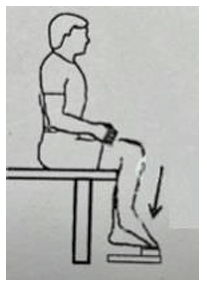
Identify the movement of the exercise shown in the picture given below:
1
Isometric ankle plantar flexion
2
Isometric ankle flexion
3
Isotonic ankle flexion
4
Isotonic ankle plantar flexion
Official Solution
Correct Option: (4)
To determine the movement shown in the image, let's analyze the definitions of each type of exercise: 1. Isometric Exercise: Involves muscle contraction without a change in muscle length or joint movement. Example: Holding a position/static hold. 2. Isotonic Exercise: Involves muscle contraction with movement and a change in muscle length. Example: Lifting weights.
Now, consider the movement terms: - Ankle Flexion: Decreasing the angle between the foot and the leg, moving the toes upward. - Ankle Plantar Flexion: Increasing the angle, moving the toes downward, similar to standing on tiptoes.
By combining these definitions, we can analyze the options:
Option
Definition
Isometric Ankle Plantar Flexion
Holding a static position engaging plantar flexor muscles without movement.
Isometric Ankle Flexion
Holding a static position engaging flexor muscles of the ankle.
Isotonic Ankle Flexion
Moving the ankle to flex the foot upwards.
Isotonic Ankle Plantar Flexion
Moving the ankle to extend the foot downwards, as in rising on toes.
Given the options and definitions, Isotonic Ankle Plantar Flexion is the accurate movement depicted, as it involves movement with plantar flexion, typical in exercises like calf raises.
15
PYQ 2024
medium
physical-educationID: cuet-ug-
Which training method is another variation of variable pace method?
1
Fartlek method
2
Interval method
3
Repetition method
4
Continuous method
Official Solution
Correct Option: (1)
The training method that is a variation of the variable pace method is the Fartlek method. In physical education, the Fartlek method is known for its combination of different speeds and intensities throughout an exercise session. Unlike the consistent pace of the continuous method or the structured rest intervals of the interval method, the Fartlek method allows for spontaneous changes in speed and intensity. This makes it a form of variable pace training where athletes can switch between jogging, sprinting, and running based on their own disposition or the terrain. This approach helps in improving aerobic and anaerobic capacities simultaneously.
Therefore, the Fartlek method is an effective way to vary pace during a workout, enhancing cardiovascular endurance and versatility.