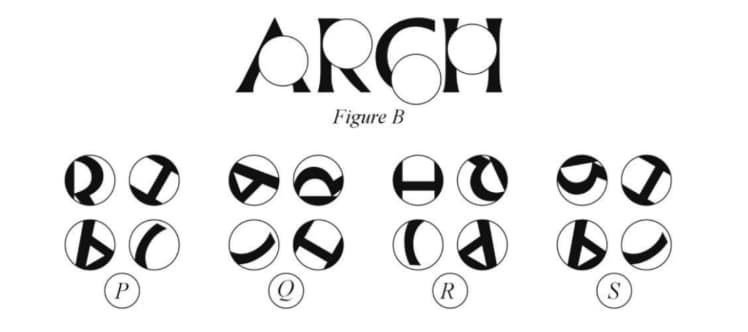
Four circular cutouts have been made in the text in Figure B. Identify the option with the group of those four cutouts.
1
2
3
4
Official Solution
Correct Option:
(3)
Step 1: Observe the word "ARCH" in Figure B. Four circular cutouts have been made within the letters. These cutouts contain unique sections of the letters. Step 2: Compare the cutouts from Figure B with the given options ( ). The correct group should exactly match the missing sections in terms of alignment, shape, and letter strokes. Step 3: After careful observation, the group labeled contains the four exact cutouts extracted from "ARCH". The patterns within the circles align with the letter fragments in Figure B. Thus, the correct answer is option C ( ).
02
PYQ 2024
medium
architectureID: jee-adva
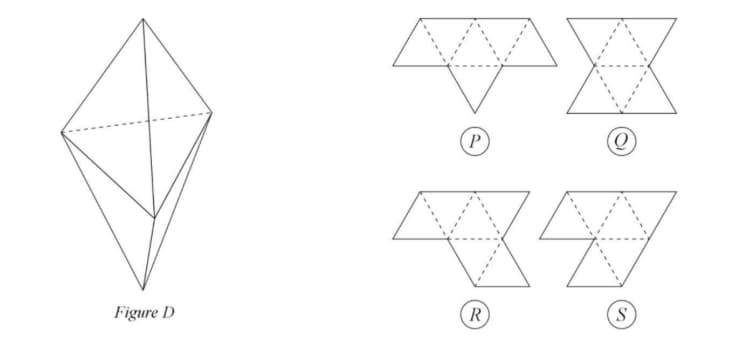
Consider a 3D hollow geometry with six faces and nine equal edges, as indicated in Figure D. Which of the given shapes will generate the described 3D geometry when folded along the dotted lines?
1
Only
2
and
3
and
4
Only
Official Solution
Correct Option:
(3)
Step 1: Analyze the given 3D hollow geometry (Figure D). It consists of six triangular faces and nine equal edges, forming a symmetrical structure.
Step 2: Identify which given net diagrams (P, Q, R, S) can be folded along the dotted lines to form the described 3D shape. - Option P: Contains six triangles arranged in a way that they can be folded into a symmetrical 3D figure. - Option Q: Also consists of six triangles correctly placed for forming the shape. - Option R: Maintains the same triangular face count and edge arrangement, making it valid. - Option S: The triangular faces are not arranged correctly to form the required 3D structure.
Step 3: Since P, Q, and R can be folded into the required 3D shape, the correct answer is: Thus, the correct answer is option C.
03
PYQ 2024
medium
architectureID: jee-adva
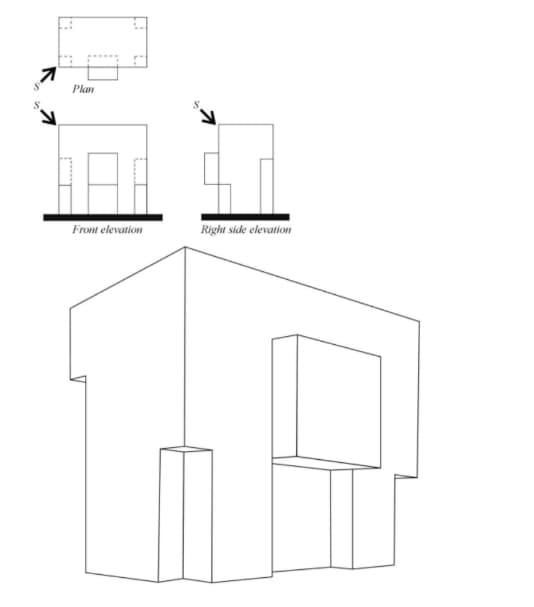
The schematic plan, front elevation, and side elevation, of an office building block are given below. The direction of the incident sunrays is indicated as ‘S’. Sketch the shading and shadows that would be generated by the sunrays in the view of the building block provided in Figure J.
Official Solution
Correct Option:
(1)
Step 1: Understanding light and shadow projection.
- The sunlight is directed diagonally from the top-left, as indicated.
- Elevated or protruding elements will cast longer shadows, while recessed areas will remain darker.
Step 2: Identifying shadowed regions. - The surfaces facing left and top will receive the most light.
- The right and bottom surfaces will experience the most shading.
- Overhanging elements and recessed spaces will create deeper shadows beneath them.
Step 3: Applying shading techniques.
- Darker tones should be used for shadowed areas.
- Apply gradual shading to depict soft, diffused shadows.
- Use sharp contrasts to emphasize cast shadows and enhance depth perception.
04
PYQ 2024
medium
architectureID: jee-adva
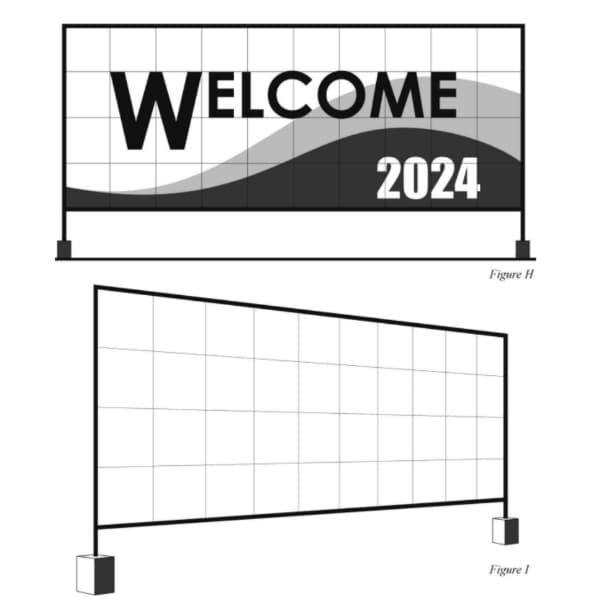
The front elevation of a city hoarding is shown in Figure H. Given below (Figure I) is the outline of the human-eye view of the hoarding.Fill it up with text and graphic elements indicated in Figure H, maintaining geometry and proportion. Use the indicative grid provided.
Official Solution
Correct Option:
(1)
Step 1: Analyzing the design components.
- The hoarding depicted in Figure H incorporates the following elements: - Bold typography displaying "WELCOME 2024". - Abstract curved graphical elements in the background. - A structured grid layout to maintain proper alignment and proportions.
Step 2: Ensuring proportion and alignment.
- Utilize the grid framework to accurately position text and graphical elements.
- Verify that the perspective representation in Figure I correctly reflects visual distortions.
Step 3: Executing the final design.
- Begin by sketching the curved background elements while preserving their alignment.
- Incorporate the text "WELCOME 2024" with precise scaling and positioning.
- Apply shading or hatching techniques to emphasize depth and contrast between dark and light areas.
05
PYQ 2024
medium
architectureID: jee-adva
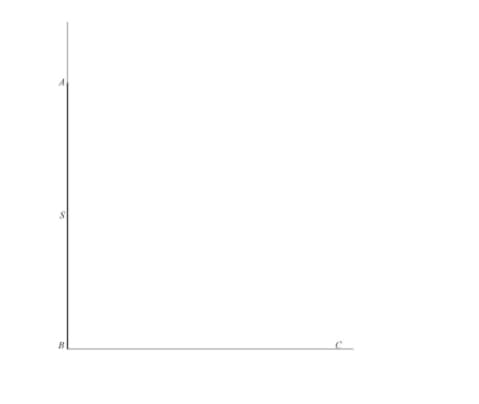
A rod AB of length 8 units, having mid-point at S, is in a vertical position as shown below. The end A is sliding vertically down, while end B is moving horizontally to your right till it reaches the point C, which is 8 units from the point B. Draw the locus of the mid-point S, using a minimum of 8 positions of AB.
Official Solution
Correct Option:
(1)
Step 1: Analyzing the motion of the rod.
- Point A moves vertically downward, while point B moves horizontally to the right.
- The rod remains rigid and maintains a fixed length of 8 units.
Step 2: Determining the locus of midpoint S.
- As both ends of the rod move simultaneously in perpendicular directions, the midpoint S follows a quarter-circle trajectory.
Step 3: Plotting at least 8 positions of the rod.
- Identify and mark 8 distinct positions of the rod as it moves.
- Determine the corresponding midpoints S for each position.
- Smoothly connect these midpoints to visualize the curved path traced by S.
06
PYQ 2024
medium
architectureID: jee-adva
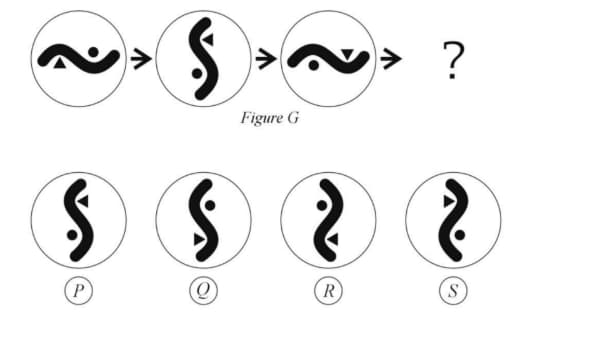
Identify the last figure in the sequence shown in Figure G.
1
2
3
4
Official Solution
Correct Option:
(4)
Step 1: Identify the pattern in the sequence of figures. - The first figure consists of a curved shape with a small dot.
- In the second figure, the shape becomes more twisted and structured while maintaining the dot.
- The third figure returns to a curved shape with additional internal modifications. Observing the pattern, it appears that the curved shape alternates between different orientations, and small triangular modifications appear at different positions.
Step 2: Predict the next transformation. - The alternation suggests that the next figure should return to the structured, twisted shape with additional modifications.
- Checking the answer options, Option S maintains the correct orientation with additional internal modifications that match the observed pattern. Thus, the correct answer is option D.
07
PYQ 2024
medium
architectureID: jee-adva
A hemispherical vessel of radius 30 cm is full of mixture to prepare kulfis. Kulfi-moulds are right circular cones of 5 cm diameter at base, having a height of 10 cm. Maximum how many kulfis can be prepared by filling the moulds up to the brim?
1
432
2
864
3
536
4
216
Official Solution
Correct Option:
(2)
Step 1: Calculating the volume of the hemispherical vessel. - The formula for the volume of a hemisphere is:
- Given cm:
Step 2: Calculating the volume of one kulfi-mould. - The formula for the volume of a cone is:
- Given cm and cm:
Step 3: Finding the number of kulfis that can be made.
Thus, the correct answer is option B (864).
About Geometrical Drawing - JEE-ADVANCED
Geometrical Drawing is a vital chapter for JEE-ADVANCED aspirants. Mastering the concepts covered in this chapter is essential for securing a top rank.
By rigorously practicing the previous year questions associated with this chapter, you can identify high-yield topics, understand the examiner's perspective, and boost your confidence during the actual exam.
Frequently Asked Questions
Why focus on Geometrical Drawing PYQs?
Analyzing PYQs for this specific chapter reveals the most frequently tested concepts and the typical complexity of questions, allowing you to tailor your study plan efficiently.
How to best use this analysis?
Review the topic breakdown to see which sub-topics within Geometrical Drawing carry the most weight. Then, tackle the questions iteratively to solidify your understanding.