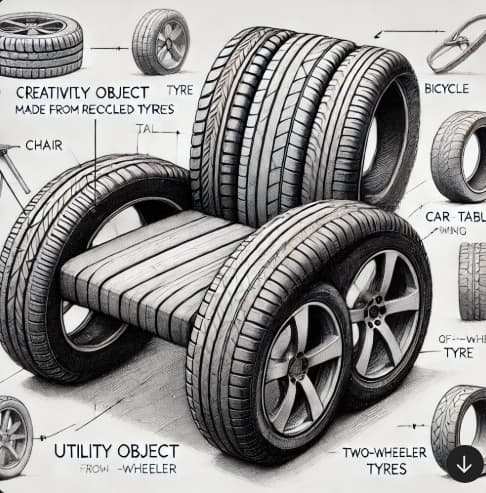
Re-using waste material is an accepted principle of sustainability. Used tyres are one such waste material. You are required to design and sketch a utility object made of tyres, which could be of different sizes and types (e.g. bicycle, car, two-wheeler tyres, etc.).
Official Solution
Correct Option: (1)
Step 1: Exploring potential utility objects. - Old tyres can be creatively repurposed into functional objects, such as: - Furniture (chairs, tables, swings). - Playground equipment (climbing structures, jungle gyms). - Decorative or practical planters. - Artistic installations using recycled tyres.
Step 2: Conceptualizing the design. - Select an object that maximizes the use of tyre shapes. - Utilize different tyre sizes and arrangements for structural stability. - Maintain a balance between functionality and aesthetics.
Step 3: Illustrating the design. - Provide a clear front-view sketch of the object. - Include annotations to describe the integration of tyres. - Apply texture and shading to enhance realism.
02
PYQ 2024
medium
architectureID: jee-adva
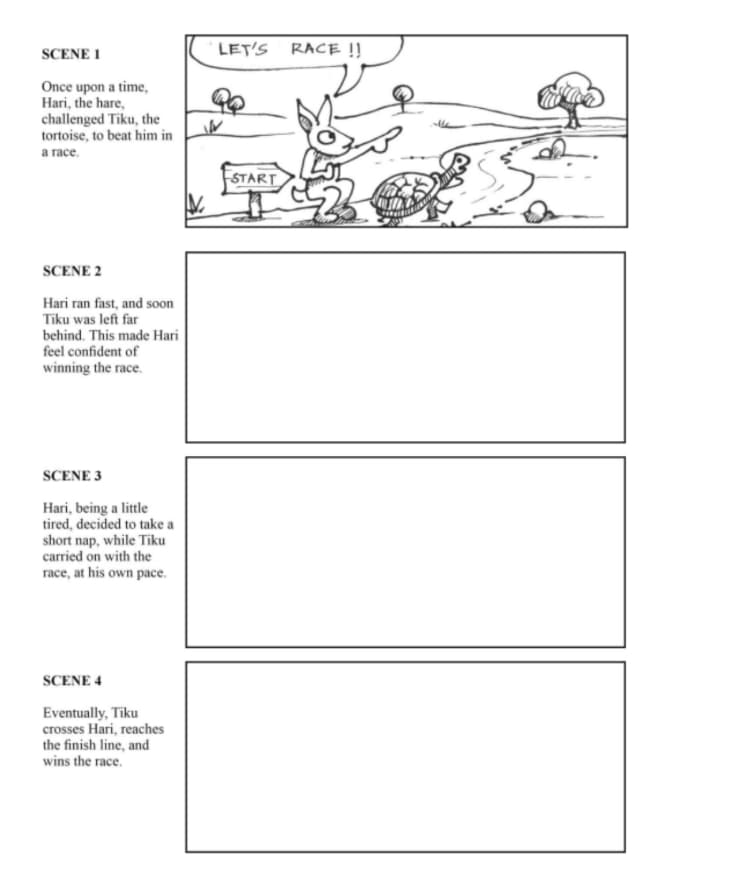
Below is the story of a hare and a tortoise narrated in four scenes. Fill up the blank frames with appropriate illustrations to complete the narration. You may add text balloons, if required. \newpage
Official Solution
Correct Option: (1)
Step 1: Depicting key moments in the story.
- Scene 2: Illustrate the Hare sprinting ahead while the Tortoise trails behind.
- Scene 3: Show the Hare asleep under a tree while the Tortoise steadily moves forward.
- Scene 4: Portray the Tortoise crossing the finish line as the Hare wakes up too late.
Step 2: Enhancing the scenes with expressions and visual elements.
- Use motion lines to emphasize the Hare’s speed.
- Add "Zzz..." near the Hare’s head to indicate sleep.
- Include a cheering crowd at the finish line to heighten the final scene’s impact.
03
PYQ 2024
medium
architectureID: jee-adva
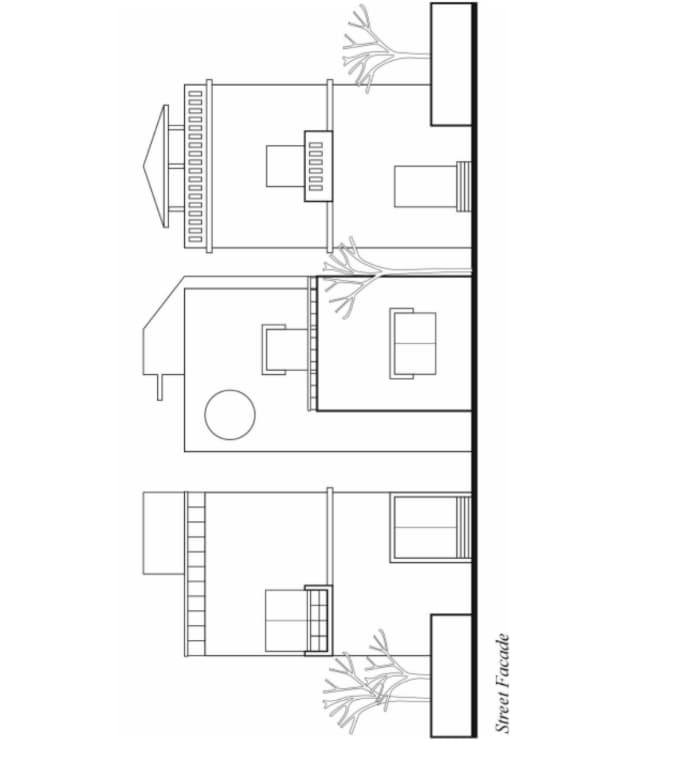
Certain cities across the globe are known by their uniquely coloured street façades. Colour the given street façade with minimum three colours of your choice. The façade elements such as cornice, entry steps, door, window, parapet etc. are to be considered while planning the colour scheme for the street façade.
Official Solution
Correct Option: (1)
Step 1: Analyzing the composition of the façade.
- The façade includes architectural components such as windows, doors, cornices, parapets, and entry steps.
- Different colors should be used to highlight and distinguish these elements.
Step 2: Selecting an appropriate color scheme.
- Choose at least three colors to create a visually balanced design.
- Utilize either contrasting or harmonious tones to accentuate key features.
- Neutral shades (white, beige, grey) work well for walls, while bold colors (red, blue, green) can highlight doors, windows, and decorative elements.
Step 3: Strategically applying colors.
- Assign one primary color for the base structure.
- Use accent colors to emphasize doors, windows, and ornamental details.
- Distribute colors evenly to maintain aesthetic harmony across the façade.
04
PYQ 2024
medium
architectureID: jee-adva
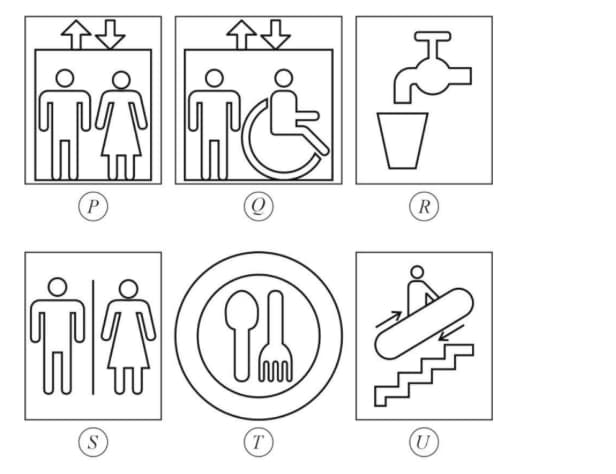
You have sprained your ankle and are on a wheelchair. You want to join your friends for a party at the food court located on the top floor of a shopping mall, which you are visiting for the first time. Since you are alone, and also do not know your way around, signs would help you. \textit{Which of the following signs will you require to conveniently reach your destination on your own?}
1
Only and
2
and
3
Only and
4
Only
Official Solution
Correct Option: (3)
Step 1: Identify the signs required to reach the food court while using a wheelchair. - Since you are on a wheelchair, accessibility and navigation signs are important.
- You need to find an elevator suitable for wheelchairs and a sign indicating the food court.
Step 2: Analyze the given signs. - Option P: Represents a general elevator, but does not specifically indicate wheelchair accessibility.
- Option Q: Represents an elevator with wheelchair accessibility, which is essential.
- Option R: Represents a water facility, which is not necessary for reaching the destination.
- Option S: Represents restrooms, which may be useful but are not required for reaching the food court.
- Option T: Represents food and dining, indicating the food court location.
- Option U: Represents an escalator, which is not suitable for wheelchair users.
Step 3: Identify the correct choices. - The most relevant signs are Q (Wheelchair-accessible elevator) and T (Food court).
- Other signs such as R, S, and U are not necessary to reach the food court. Thus, the correct answer is option C.