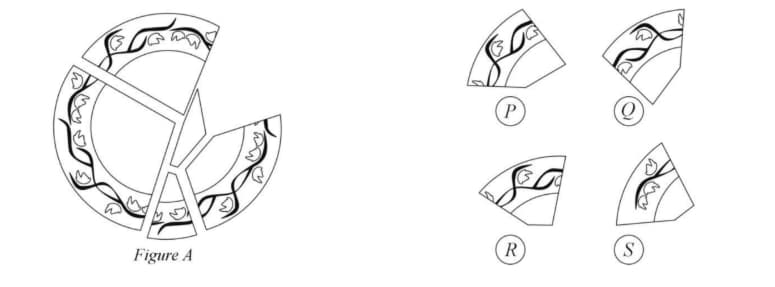
A dinner plate was broken into six pieces. Five of the pieces are indicated in Figure A. Find out the missing piece from the options given below.
1
2
3
4
Official Solution
Correct Option: (3)
Step 1: Carefully observe the arrangement of the broken plate in Figure A. It consists of six pieces, but only five are placed. The missing piece must complete the overall structure. Step 2: Analyze the shape and design of the missing portion. The curvature and pattern on the plate must align perfectly with the given options ( ). Step 3: Compare each of the given choices with the missing space. Piece matches the missing section precisely, both in terms of design continuity and shape. Thus, the correct answer is option C ( ).
02
PYQ 2024
hard
architectureID: jee-adva
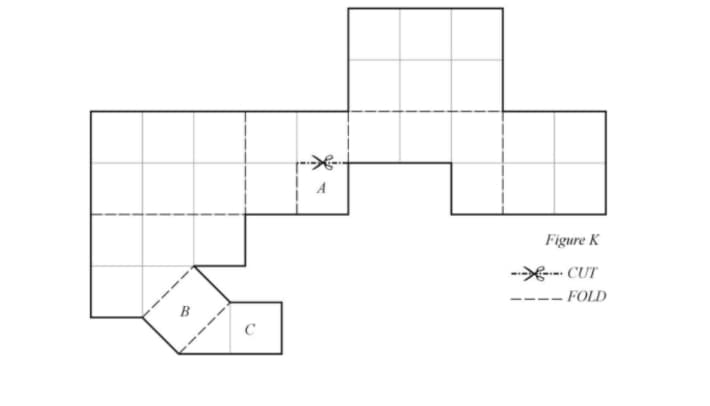
Consider the developed surface in Figure K. Lines of cut and fold are indicated. Draw the 3D view of the solid in a manner that the faces A, B, and C are visible.
Official Solution
Correct Option: (1)
Step 1: Analyzing the developed surface.
- The provided net consists of rectangular and polygonal faces that, when folded, form a three-dimensional solid.
- The cut lines define the separation between different faces, while fold lines indicate the bending points.
Step 2: Folding the net into a 3D shape.
- The central square acts as the base or primary face.
- Faces A, B, and C become prominent after folding.
- Due to the diagonal fold lines, faces B and C will be positioned at angles.
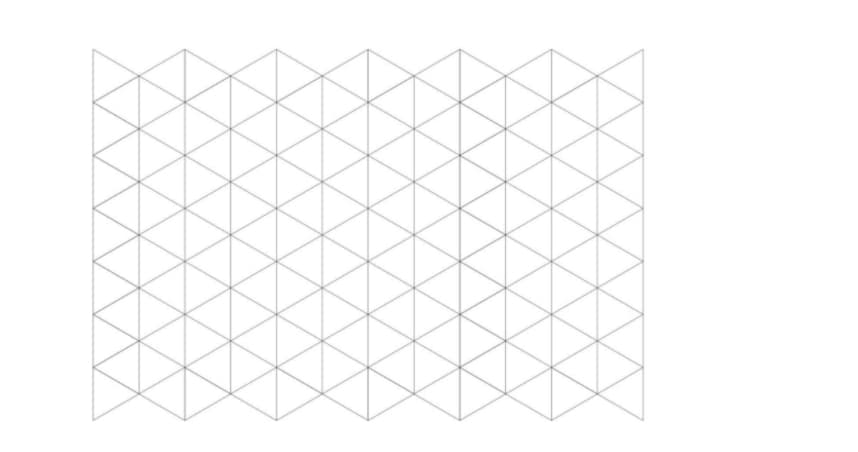
Step 3: Sketching the 3D form on an isometric grid.
- Utilize projection techniques to accurately map edges onto the 3D plane.
- Ensure that faces A, B, and C are distinctly represented.
- Apply hatching or shading to differentiate between visible and hidden surfaces.
03
PYQ 2024
hard
architectureID: jee-adva
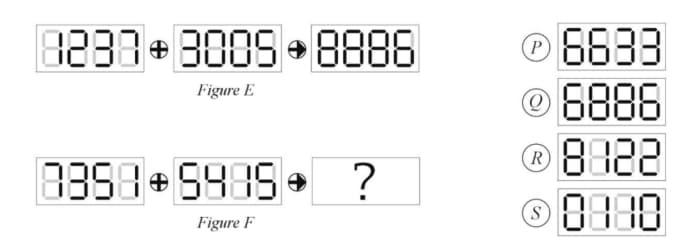
Considering the operation given in Figure E, what is the result of the operation in Figure F?
1
2
3
4
Official Solution
Correct Option: (2)
Step 1: Identify the transformation rule in Figure E. The operation modifies the digits using a seven-segment display pattern rather than traditional arithmetic. Given:
By analyzing the digit-wise transformation:
-
-
-
-
Step 2: Apply the same transformation to Figure F. Using the same pattern:
-
-
-
- Thus, the result is , which matches option Q.
04
PYQ 2024
hard
architectureID: jee-adva
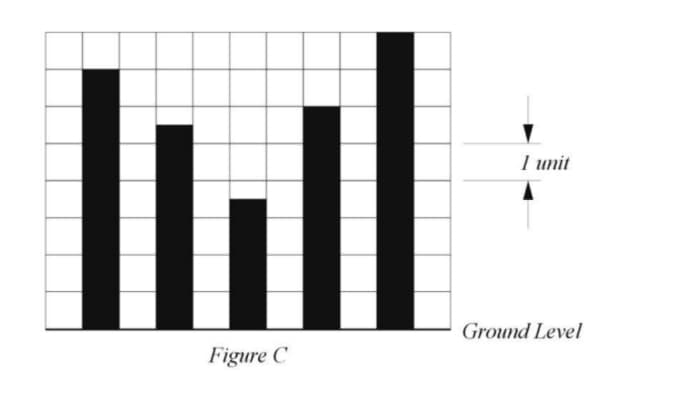
Five identical pillars, having equal height of 10 units and equal cross section, are inserted into the ground. Figure C shows only the portions of the pillars visible above ground. Which of the options given below indicates the ratio of the total volume of the pillars above and below the ground?
1
1:1
2
2:3
3
3:2
4
2:1
Official Solution
Correct Option: (3)
1. Determine the Visible Height of Each Pillar:
Pillar 1: 7 units
Pillar 2: 5 units
Pillar 3: 3 units
Pillar 4: 6 units
Pillar 5: 9 units
2. Calculate the Buried Height of Each Pillar:
Since each pillar has a total height of 10 units, subtract the visible height from 10 to find the buried height:
Pillar 1: 10 - 7 = 3 units
Pillar 2: 10 - 5 = 5 units
Pillar 3: 10 - 3 = 7 units
Pillar 4: 10 - 6 = 4 units
Pillar 5: 10 - 9 = 1 unit
3. Calculate the Total Visible Height:
7 + 5 + 3 + 6 + 9 = 30 units
4. Calculate the Total Buried Height:
3 + 5 + 7 + 4 + 1 = 20 units
5. Determine the Ratio:
The ratio of the total volume above the ground to the total volume below the ground is the same as the ratio of their heights because they have equal cross sections.
This ratio is 30:20, which simplifies to 3:2.
Therefore, the ratio of the total volume of the pillars above and below the ground is 3:2.
05
PYQ 2024
medium
architectureID: jee-adva
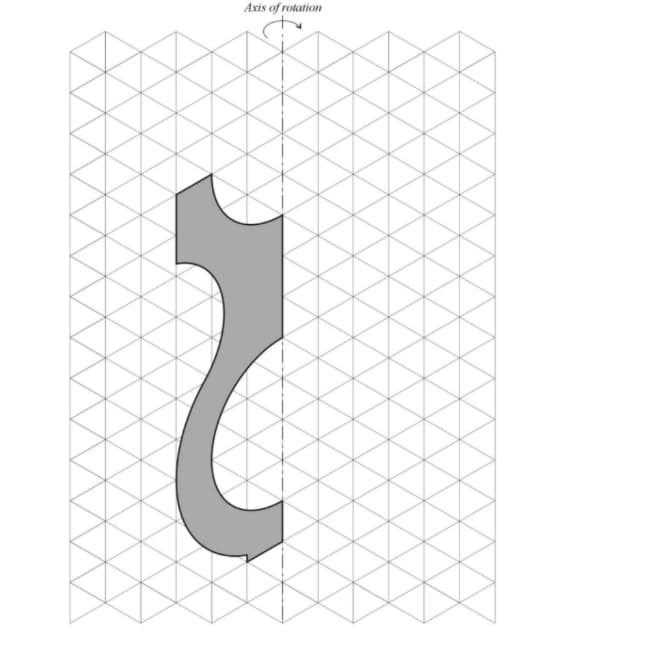
The shaded plane given below is rotated clockwise around the given axis, up to an angle of 270 degrees. Draw the solid form resulting from this rotation.
Official Solution
Correct Option: (1)
Step 1: Understanding solids of revolution.
- When a two-dimensional shape rotates around an axis, it generates a three-dimensional solid of revolution.
- In this case, the given shape rotates through 270 degrees, resulting in a partially formed solid.
Step 2: Constructing the final solid.
- The solidβs outer contour is determined by tracking the movement of the shape during rotation.
- Key features such as curvature, edges, and symmetry must be identified.
- The final shape will resemble a sculpted 3D form, influenced by the original cross-section.
Step 3: Representing the solid on an isometric grid.
- Utilize the isometric grid to maintain correct proportions.
- Draw reference curves to guide smooth rotational transitions.
- Apply shading techniques to enhance depth and three-dimensional perception.