For the following question, enter the correct numerical value upto TWO decimal places. If the numerical value has more than two decimal places, round-off the value to TWO decimal places. (For example: Numeric value 5 will be written as 5.00 and 2.346 will be written as 2.35) A body moves along a circular path of radius 10 m and the coefficient of friction is 0.5. What should be its angular velocity in rad/s if it is not to slip from the surface? ____. ( )
Official Solution
Correct Option:
(1)
Step 1: For a body moving in a horizontal circular path, the centripetal force required is provided by friction. Maximum frictional force:
Step 2: Centripetal force required:
For no slipping:
Step 3: Cancel from both sides:
Step 4: Solve for angular velocity:
Step 5: Substitute the given values:
Final Answer (up to two decimal places):
02
PYQ 2022
medium
physicsID: lpunest-
For the following question, enter the correct numerical value upto TWO decimal places. If the numerical value has more than two decimal places, round-off the value to TWO decimal places. (For example: Numeric value 5 will be written as 5.00 and 2.346 will be written as 2.35) The image of an object placed in front of a concave mirror of focal length 12 cm is formed at a point which is 10 cm more distant from the mirror than the object. The magnification of the image is ____.
Official Solution
Correct Option:
(1)
Step 1: Let the object distance from the mirror be cm and the image distance be cm. Given that the image is formed 10 cm farther from the mirror than the object:
Step 2: Using the mirror formula:
For a concave mirror:
Substitute:
Step 3: Simplifying:
Solving:
Step 4: Then,
Step 5: Magnification for a mirror is:
Final Answer (up to two decimal places):
03
PYQ 2024
medium
physicsID: lpunest-
In Young’s double slit experiment, the two slits act as coherent sources of equal amplitude and wavelength . In another experiment with the same set up the two slits are sources of equal amplitude and wavelength but are incoherent. The ratio of the intensity of light at the mid-point of the screen in the first case to that in the second case is:
1
2
3
4
Official Solution
Correct Option:
(1)
Step 1: Identify the point of observation. The mid-point of the screen corresponds to the point where the path difference between the two waves is zero. Step 2: Intensity at the mid-point for coherent sources. For two coherent waves of equal amplitude : Resultant amplitude:
Since intensity is proportional to the square of amplitude:
Step 3: Intensity at the mid-point for incoherent sources. For incoherent sources, intensities simply add: Intensity due to one slit:
Total intensity:
Step 4: Find the ratio of intensities. However, note that in Young’s experiment the maximum intensity at the center for coherent sources is four times the intensity due to one slit, whereas for incoherent sources it is equal to the sum of individual intensities. Thus:
Hence, the correct answer is .
04
PYQ 2024
medium
physicsID: lpunest-
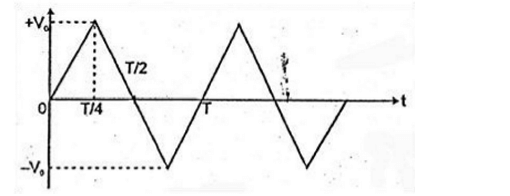
The voltage time graph of a triangular wave having peak value Vo is as shown in figure.The rms value of V in time interval from t = to is
1
2
3
4
Official Solution
Correct Option:
(4)
Step 1: For triangular wave over full period:
Step 2: Any fraction of a linear ramp preserves same rms coefficient because Hence rms .
05
PYQ 2025
medium
physicsID: lpunest-
G. P. Thomson experimentally confirmed the existence of matter waves by the phenomenon of:
1
diffraction
2
refraction
3
polarization
4
scattering
Official Solution
Correct Option:
(1)
Step 1: Recall the concept of matter waves. According to de Broglie’s hypothesis, moving particles such as electrons exhibit wave-like properties. Step 2: Identify G. P. Thomson’s contribution. G. P. Thomson experimentally verified the wave nature of electrons by passing them through thin metal foils. Step 3: Observe the phenomenon involved. The electrons produced diffraction patterns, similar to X-ray diffraction, which is a characteristic property of waves. Step 4: Analyze the options.
(A) Diffraction — direct evidence of wave nature ✔
(B) Refraction — not observed for electrons
(C) Polarization — applies to transverse waves like light
(D) Scattering — not specific proof of wave nature
Step 5: Final conclusion. The phenomenon that confirmed the existence of matter waves is diffraction.
06
PYQ 2025
medium
physicsID: lpunest-
The phenomenon that best supports the theory that matter has a wave nature is:
1
electron momentum
2
electron diffraction
3
photon momentum
4
photon diffraction
Official Solution
Correct Option:
(2)
Step 1: Recall the wave nature of matter. According to de Broglie hypothesis, every moving particle has an associated wavelength:
Step 2: Identify experimental evidence. The wave nature of matter is confirmed experimentally by diffraction and interference phenomena. Step 3: Analyze the options.
(A) Electron momentum — property of particles, not wave evidence
(B) Electron diffraction — direct evidence of wave nature ✔
(C) Photon momentum — photons are already waves/particles
(D) Photon diffraction — supports wave nature of light, not matter
Step 4: Final conclusion. Electron diffraction best supports the theory that matter has a wave nature.
About Optics - LPUNEST
Optics is a vital chapter for LPUNEST aspirants. Mastering the concepts covered in this chapter is essential for securing a top rank.
By rigorously practicing the previous year questions associated with this chapter, you can identify high-yield topics, understand the examiner's perspective, and boost your confidence during the actual exam.
Frequently Asked Questions
Why focus on Optics PYQs?
Analyzing PYQs for this specific chapter reveals the most frequently tested concepts and the typical complexity of questions, allowing you to tailor your study plan efficiently.
How to best use this analysis?
Review the topic breakdown to see which sub-topics within Optics carry the most weight. Then, tackle the questions iteratively to solidify your understanding.