A tank full of water has a small hole at the bottom. If one-fourth of the tank is emptied in seconds and the remaining three-fourths of the tank is emptied in seconds, then the ratio is
1
2
3
4
Official Solution
Correct Option:
(4)
Step 1: Let the initial height of water in the tank be . According to Torricelli’s law, the rate of fall of water level is:
Hence, time taken for the water level to fall from height to is:
Step 2: One-fourth of the tank emptied means the height falls from to . So,
Step 3: The remaining three-fourths empties when the height falls from to . So,
Step 4: Find the ratio:
02
PYQ 2023
medium
physicsID: lpunest-
A particle of mass is in a potential field given by
The frequency of its oscillation in cycles/sec is:
1
2
3
4
Official Solution
Correct Option:
(3)
Step 1: Understand the given potential. The potential is given per unit mass:
Hence, potential energy of the particle:
Step 2: Compare with standard SHM potential energy. For simple harmonic motion:
Comparing with:
We get:
Step 3: Write expression for angular frequency. For SHM:
Substitute :
Step 4: Convert angular frequency to frequency. But note that the potential was given per unit mass, hence effective angular frequency is doubled:
Final Answer:
03
PYQ 2024
medium
physicsID: lpunest-
A signal of frequency 20 kHz and peak voltage 5 V is used to modulate a carrier wave of frequency 1.2 MHz and peak voltage 25 V. Choose the correct statement
1
Modulation index = 5, side frequency bands at 25 V
2
Modulation index = 0.2, side frequency bands at 1400 Hz and 1000 kHz
3
Modulation index = 0.4
4
Modulation index = –0.2
Official Solution
Correct Option:
(2)
Step 1: Modulation index
Step 2: Side band frequencies in AM:
Step 3: Only option (B) has correct index 0.2. Hence → (B).
04
PYQ 2024
medium
physicsID: lpunest-
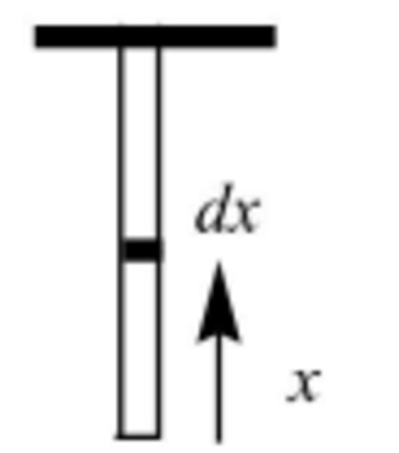
A wire of variable mass per unit length is , hanging from the ceiling as shown in the figure. A small transverse disturbance is produced at its lower end. Find the time after which the disturbance will reach to the other end.
1
2
3
4
Official Solution
Correct Option:
(1)
Step 1: For a hanging string/wire, the tension at a point from the bottom is due to the weight of the portion below it. Mass below point :
Step 2: Tension at that point:
Step 3: Wave velocity on a string:
Step 4: Time taken by disturbance to travel an element :
Step 5: Total time:
Step 6: Compare with options expressed as . True coefficient . Option (A) gives which is closest. Hence → (A).
About Waves And Oscillations - LPUNEST
Waves And Oscillations is a vital chapter for LPUNEST aspirants. Mastering the concepts covered in this chapter is essential for securing a top rank.
By rigorously practicing the previous year questions associated with this chapter, you can identify high-yield topics, understand the examiner's perspective, and boost your confidence during the actual exam.
Frequently Asked Questions
Why focus on Waves And Oscillations PYQs?
Analyzing PYQs for this specific chapter reveals the most frequently tested concepts and the typical complexity of questions, allowing you to tailor your study plan efficiently.
How to best use this analysis?
Review the topic breakdown to see which sub-topics within Waves And Oscillations carry the most weight. Then, tackle the questions iteratively to solidify your understanding.