A particle at rest on a frictionless table is acted upon by a horizontal force which is constant in magnitude and direction. A graph is plotted for the work done on the particle against the speed of the particle . If there are no frictional forces acting on the particle, the graph will look like:
1
Option a
2
Option b
3
Option c
4
Option d
Official Solution
Correct Option:
(4)
Step 1: Apply the work–energy theorem. The work done by the force on the particle is equal to the change in kinetic energy:
Since the particle starts from rest,
Step 2: Express work as a function of velocity. This shows that work done varies as the square of the speed. Step 3: Analyse the nature of the graph. At ,
As increases, increases non-linearly
The curve is a parabola opening upward Step 4: Match with the given options. (a) Linear graph — incorrect
(b) Constant work — incorrect
(c) Saturating curve — incorrect
(d) Upward curving parabola — correctFinal Answer:
02
PYQ 2023
medium
physicsID: lpunest-
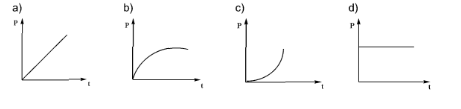
A motor drives a body along a straight line with a constant force.
The power developed by the motor must vary with time as:
1
Option a
2
Option b
3
Option c
4
Option d
Official Solution
Correct Option:
(1)
Step 1: Use Newton’s second law. Since the force applied by the motor is constant:
Hence, the acceleration of the body is constant. Step 2: Write velocity as a function of time. For constant acceleration (starting from rest):
Thus, velocity increases linearly with time. Step 3: Write expression for power. Instantaneous power is given by:
Since is constant:
Step 4: Substitute . This shows:
So, power increases linearly with time, starting from zero. Step 5: Match with the given graphs. (a) Straight line through origin — Correct (b) Saturating curve — Incorrect
(c) Exponential-like curve — Incorrect
(d) Constant power — Incorrect Final Answer:
About Work Energy And Power - LPUNEST
Work Energy And Power is a vital chapter for LPUNEST aspirants. Mastering the concepts covered in this chapter is essential for securing a top rank.
By rigorously practicing the previous year questions associated with this chapter, you can identify high-yield topics, understand the examiner's perspective, and boost your confidence during the actual exam.
Frequently Asked Questions
Why focus on Work Energy And Power PYQs?
Analyzing PYQs for this specific chapter reveals the most frequently tested concepts and the typical complexity of questions, allowing you to tailor your study plan efficiently.
How to best use this analysis?
Review the topic breakdown to see which sub-topics within Work Energy And Power carry the most weight. Then, tackle the questions iteratively to solidify your understanding.