An ideal gas enclosed in a cylinder is at pressure atm and temperature . The mean time between two successive collisions is . If the pressure is doubled and temperature is increased to , the mean time between two successive collisions will be close to
1
2
3
4
Official Solution
Correct Option:
(2)
Step 1: Mean time between collisions is inversely proportional to number density and average speed:
Step 2: For an ideal gas,
Step 3: Hence,
Step 4: Therefore,
Given:
Step 5: Substitute:
Step 6: Hence,
02
PYQ 2022
medium
physicsID: lpunest-
Two point charges and are placed on the -axis at and respectively. The electric field (in V/m) at a point on the -axis is (take )
1
2
3
4
Official Solution
Correct Option:
(3)
Step 1: Coordinates of charges and field point. Step 2: Electric field due to a point charge:
Step 3: Field due to . Vector from to :
Step 4: Field due to . Vector from to :
Step 5: Resultant electric field:
Expressing in required form:
03
PYQ 2024
medium
physicsID: lpunest-
Modern vacuum pumps can evacuate a vessel down to a pressure of . At room temperature (300 K), taking and , the mean distance between molecules of gas in an evacuated vessel will be of the order of:
1
2
3
4
Official Solution
Correct Option:
(2)
Step 1: Convert pressure into SI units. Since,
Step 2: Use the ideal gas equation to find number of moles per unit volume. Step 3: Convert moles into number of molecules per unit volume. Step 4: Find the volume available per molecule. Step 5: Estimate the mean distance between molecules. The mean separation is approximately the cube root of volume per molecule:
Hence, the correct answer is .
04
PYQ 2024
medium
physicsID: lpunest-
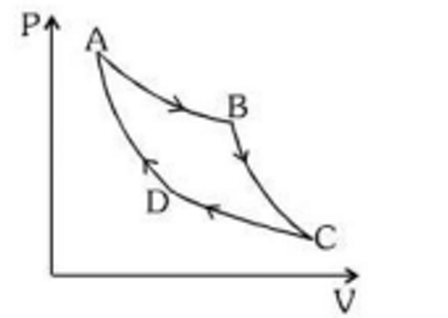
In the indicator diagram fig. shown of Carnot cycle Ta, Tb, Te, Td represent temperature of gas at A, B, C, D respectively. Which of the following is correct relation
1
2
3
4
Official Solution
Correct Option:
(4)
Step 1: Carnot cycle has two isotherms and two adiabats. Step 2: Points on same isotherm have same temperature. Step 3: From diagram A→B is isothermal; C→D is other isothermal. Step 4: Therefore:
Hence → (D).
05
PYQ 2025
medium
physicsID: lpunest-
A wooden cube floating in water supports a mass on its top. When the mass is removed, the cube rises by . The side of the cube is (density of water ):
1
2
3
4
Official Solution
Correct Option:
(4)
Step 1: Use the principle of buoyancy. When the mass is removed, the cube rises, meaning the decrease in buoyant force equals the weight of the removed mass. Step 2: Write the relation. Loss of buoyant force weight of mass removed:
where = area of the cube’s face, . Step 3: Cancel from both sides.
Step 4: Substitute given values.
Step 5: Find the side of the cube. Since the cube has a square face:
Step 6: Final conclusion. The side of the cube is .
06
PYQ 2025
medium
physicsID: lpunest-
Which of the following is carried by waves from one place to another?
1
Mass
2
Velocity
3
Wavelength
4
Energy
Official Solution
Correct Option:
(4)
Step 1: Recall the basic property of waves. A wave is a disturbance that transfers energy from one place to another without transporting matter. Step 2: Analyze each option.
(A) Mass — not carried by waves
(B) Velocity — property of particles, not transported
(C) Wavelength — a characteristic of the wave, not something carried
(D) Energy — carried by waves ✔
Step 3: Final conclusion. Waves transfer energy from one place to another.
About Thermodynamics - LPUNEST
Thermodynamics is a vital chapter for LPUNEST aspirants. Mastering the concepts covered in this chapter is essential for securing a top rank.
By rigorously practicing the previous year questions associated with this chapter, you can identify high-yield topics, understand the examiner's perspective, and boost your confidence during the actual exam.
Frequently Asked Questions
Why focus on Thermodynamics PYQs?
Analyzing PYQs for this specific chapter reveals the most frequently tested concepts and the typical complexity of questions, allowing you to tailor your study plan efficiently.
How to best use this analysis?
Review the topic breakdown to see which sub-topics within Thermodynamics carry the most weight. Then, tackle the questions iteratively to solidify your understanding.