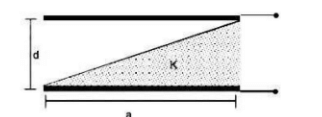
A parallel plate capacitor is made of two square plates of side , separated by a distance ( ). The lower triangular portion is filled with a dielectric of dielectric constant , as shown in the figure. The capacitance of this capacitor is
1
2
3
4
Official Solution
Correct Option: (3)
Step 1: Since , fringe effects are neglected. The capacitor can be treated as a parallel combination of infinitesimal capacitors along the horizontal direction. Step 2: Consider a thin vertical strip of width at a distance from the left end. The height of dielectric in this strip increases linearly from to :
Step 3: The infinitesimal capacitance of this strip is:
where the effective permittivity varies continuously from to . Step 4: The equivalent capacitance is obtained by integrating:
Step 5: Simplify and integrate:
Step 6: Evaluating the limits:
02
PYQ 2024
medium
physicsID: lpunest-
Three concentric conducting shells carry charges +4Q on inner, –2Q on middle and +6Q on outer. The charge on inner surface of the outer shell is
1
0
2
4Q
3
Q
4
–2Q
Official Solution
Correct Option: (4)
Step 1: For electrostatic equilibrium, field inside conductor = 0. Step 2: Charge enclosed by outer conductor must be neutralized on its inner surface. Total charge inside outer shell:
Step 3: To cancel this, inner surface must have:
Hence → (D).
03
PYQ 2025
medium
physicsID: lpunest-
The velocity of sound is largest in:
1
water
2
air
3
metal
4
vacuum
Official Solution
Correct Option: (3)
Step 1: Recall how sound propagates. Sound is a mechanical wave and requires a material medium to travel. It cannot propagate in a vacuum. Step 2: Compare the speed of sound in different media. The speed of sound depends on the elasticity and density of the medium:
Step 3: Analyze the given options.
(A) Water (liquid) — faster than air, slower than solids
(B) Air (gas) — slowest among material media
(C) Metal (solid) — highest speed ✔
(D) Vacuum — sound cannot travel
Step 4: Final conclusion. The velocity of sound is largest in metal.