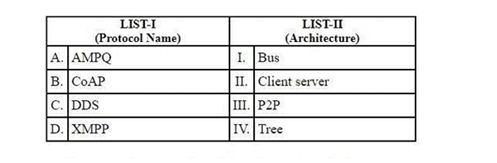
IoT Communication Protocols and their architecture name are given in the following table. Match List-I (Protocol Name) with List-II (Architecture).
1
A - I, B - II, C - III, D - IV
2
A - I, B - III, C - II, D - IV
3
A - I, B - II, C - IV, D - III
4
A - III, B - IV, C - I, D - II
Official Solution
Correct Option:
(1)
Step 1: Match each protocol with its architecture.
(A) AMQP (Advanced Message Queuing Protocol): This is a publish-subscribe protocol that uses a central broker to pass messages between publishers and subscribers. The broker acts as a central message (I) Bus. (B) CoAP (Constrained Application Protocol): This protocol is designed for constrained devices and is modeled on HTTP. It uses a request-response pattern, which is the hallmark of a (II) Client-server architecture. (C) DDS (Data Distribution Service): This is a data-centric middleware standard for real-time systems. It operates without a central broker, allowing nodes to communicate directly. This is a (III) P2P (Peer-to-Peer) or publish-subscribe architecture. (D) XMPP (Extensible Messaging and Presence Protocol): This is a protocol for instant messaging and presence. While it is client-server, its federated nature, where servers communicate with other servers, can be represented as a hierarchical or (IV) Tree structure.
Step 2: Combine the matches.
The correct matching is A-I, B-II, C-III, D-IV.
02
PYQ 2025
medium
electronics-engineeringID: cuet-pg-
The commonly used operating systems for IoT devices are A. Contiki B. TinyOS C. Linux D. Nano-RK Choose the correct answer from the options given below:
1
A, B and D only
2
A, B and C only
3
A, B, C and D
4
B, C and D only
Official Solution
Correct Option:
(3)
Step 1: Evaluate each listed operating system for its use in IoT.
A. Contiki: An open-source operating system specifically designed for low-power, memory-constrained IoT devices. It is very commonly used. B. TinyOS: Another open-source OS designed for low-power wireless devices, such as those used in sensor networks and IoT. It is also very common. C. Linux: While full desktop distributions are too heavy, embedded versions of Linux (like Yocto or OpenWrt) and Android (which is based on the Linux kernel) are extremely popular for more powerful IoT devices like gateways, smart home hubs, and single-board computers (e.g., Raspberry Pi). D. Nano-RK: A real-time operating system (RTOS) developed for use in wireless sensor networks, which are a key component of the IoT ecosystem.
Step 2: Conclude the selection.
All four options listed are indeed operating systems used in the context of IoT, ranging from highly constrained microcontrollers to more powerful embedded systems. Therefore, A, B, C, and D are all correct.
03
PYQ 2025
medium
electronics-engineeringID: cuet-pg-
Communication Protocols that are currently used in IoT are: A. HTTP/Rest, B. IPv6, C. TCP, D. MAC. The Communication Protocols used at each layer of IoT Network Stack: Application Layer, Transport Layer, Network Layer, Link Layer, respectively, in a sequence are
1
A, B, C, D
2
A, C, B, D
3
B, A, D, C
4
C, B, D, A
Official Solution
Correct Option:
(2)
Step 1: Map each protocol to its corresponding layer in the TCP/IP or IoT network stack.
A. HTTP/Rest: Hypertext Transfer Protocol and its RESTful architecture are used by applications to communicate. This operates at the Application Layer. B. IPv6: The Internet Protocol version 6 is responsible for addressing and routing packets between networks. This operates at the Network Layer (or Internet Layer). C. TCP: The Transmission Control Protocol provides reliable, ordered, and error-checked delivery of a stream of octets between applications. This operates at the Transport Layer. D. MAC: The Media Access Control protocol operates as a sublayer of the Data Link Layer. It controls access to the physical transmission medium. This is part of the Link Layer.
Step 2: Arrange the protocols in the requested sequence.
The question asks for the sequence: Application, Transport, Network, Link.
Based on the mapping in Step 1, the sequence is: HTTP/Rest (A), TCP (C), IPv6 (B), MAC (D).
The correct sequence is A, C, B, D.
04
PYQ 2025
medium
electronics-engineeringID: cuet-pg-
Consider the following statements on TCP/IP A. At the physical and data link layers, TCP/IP does not define any specific protocol. B. At the internetwork layer, TCP/IP supports the Internetworking Protocol. C. At the transport layer, TCP/IP defines five protocols. Choose the correct answer from the options given below:
1
A only
2
A and C only
3
A and B only
4
A, B and C
Official Solution
Correct Option:
(3)
Step 1: Evaluate statement A.
"At the physical and data link layers, TCP/IP does not define any specific protocol."
This is True. The TCP/IP model is a protocol suite that primarily deals with the Network layer and above. It is designed to be independent of the underlying network hardware and data link protocols. It can run over Ethernet, Wi-Fi, PPP, etc., but it does not define these lower-level protocols itself. Step 2: Evaluate statement B.
"At the internetwork layer, TCP/IP supports the Internetworking Protocol."
This is True. The Internetworking Protocol is another name for the Internet Protocol (IP), which is the core protocol of the internetwork layer in the TCP/IP suite. Step 3: Evaluate statement C.
"At the transport layer, TCP/IP defines five protocols."
This is False. The two primary and most well-known protocols defined at the transport layer of the TCP/IP suite are TCP (Transmission Control Protocol) and UDP (User Datagram Protocol). While other transport protocols exist (like SCTP), the suite does not define five main ones. Step 4: Combine the correct statements.
Statements A and B are true. Therefore, the correct option is "A and B only".
About Computer Networks - CUET-PG
Computer Networks is a vital chapter for CUET-PG aspirants. Mastering the concepts covered in this chapter is essential for securing a top rank.
By rigorously practicing the previous year questions associated with this chapter, you can identify high-yield topics, understand the examiner's perspective, and boost your confidence during the actual exam.
Frequently Asked Questions
Why focus on Computer Networks PYQs?
Analyzing PYQs for this specific chapter reveals the most frequently tested concepts and the typical complexity of questions, allowing you to tailor your study plan efficiently.
How to best use this analysis?
Review the topic breakdown to see which sub-topics within Computer Networks carry the most weight. Then, tackle the questions iteratively to solidify your understanding.