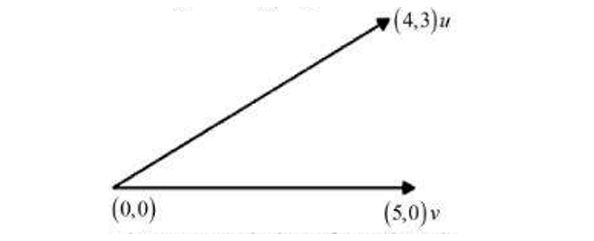
In the given figure, the vectors u and v are related as by a transformation matrix A. The correct choice of matrix A is
% Vector details
u = (4,3), v = (5,0)
1
2
3
4
Official Solution
Correct Option:
(3)
Step 1: Analyze the vectors and . The initial vector is . The transformed vector is . Let's calculate their magnitudes (lengths): . . Since the magnitudes are equal, the transformation is a rotation.
Step 2: Determine the angle of rotation. The vector makes an angle with the positive x-axis, where and . The vector lies on the positive x-axis, so its angle is 0. To transform to , we need to rotate by an angle of .
Step 3: Construct the rotation matrix. The general rotation matrix for an angle is . We need to use the angle . We know that and . Substituting these into the rotation matrix formula:
Step 4: Verify the result. Let's multiply the matrix with vector : The result matches, so the matrix is correct.
02
PYQ 2025
medium
electronics-engineeringID: cuet-pg-
For a given vector , the vector is normal to the plane defined by .
1
2
3
4
Official Solution
Correct Option:
(4)
Step 1: Understand the equation of a plane.
The general vector equation of a plane is given by , where is a vector normal (perpendicular) to the plane, is the position vector of any point on the plane, and is a constant related to the distance of the plane from the origin. Step 2: Analyze the given equation.
The given equation is . Let's write this in vector notation.
Let and .
Then .
The equation is the dot product .
This is the standard form of a plane equation. Step 3: Identify the normal vector.
By comparing the given equation with the general form , we can directly identify the normal vector as the vector .
Given , the column vector is , or .
Therefore, the vector normal to the plane is .
About Linear Algebra - CUET-PG
Linear Algebra is a vital chapter for CUET-PG aspirants. Mastering the concepts covered in this chapter is essential for securing a top rank.
By rigorously practicing the previous year questions associated with this chapter, you can identify high-yield topics, understand the examiner's perspective, and boost your confidence during the actual exam.
Frequently Asked Questions
Why focus on Linear Algebra PYQs?
Analyzing PYQs for this specific chapter reveals the most frequently tested concepts and the typical complexity of questions, allowing you to tailor your study plan efficiently.
How to best use this analysis?
Review the topic breakdown to see which sub-topics within Linear Algebra carry the most weight. Then, tackle the questions iteratively to solidify your understanding.