Consider an air filled rectangular waveguide with dimensions a = 2.286 cm and b = 1.016 cm. The increasing order of the cut-off frequencies for different modes is: A. TE , B. TE , C. TE , D. TE . Choose the correct answer from the options given below:
Official Solution
Correct Option:
(1)
02
PYQ 2025
easy
electronics-engineeringID: cuet-pg-
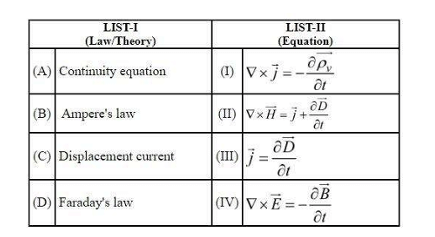
The law/Theory and equations are given in the table below. Match List-I with List-II
Official Solution
Correct Option:
(1)
03
PYQ 2025
medium
electronics-engineeringID: cuet-pg-
Solution of Laplace's equation, which are continuous through the second derivative, are called
1
Bessel functions
2
Odd functions
3
Harmonic functions
4
Fundamental functions
Official Solution
Correct Option:
(3)
Step 1: State Laplace's Equation.
Laplace's equation is a second-order partial differential equation given by , where is the Laplacian operator. In Cartesian coordinates, it is . Step 2: Define the solutions.
By definition, any scalar function that is a solution to Laplace's equation is called a harmonic function. The condition that the function is continuous through the second derivative is a requirement for the Laplacian to be well-defined and equal to zero. These functions are fundamental to many areas of physics, including electromagnetism (electrostatic potential in charge-free regions), fluid dynamics, and heat flow.
About Electromagnetics - CUET-PG
Electromagnetics is a vital chapter for CUET-PG aspirants. Mastering the concepts covered in this chapter is essential for securing a top rank.
By rigorously practicing the previous year questions associated with this chapter, you can identify high-yield topics, understand the examiner's perspective, and boost your confidence during the actual exam.
Frequently Asked Questions
Why focus on Electromagnetics PYQs?
Analyzing PYQs for this specific chapter reveals the most frequently tested concepts and the typical complexity of questions, allowing you to tailor your study plan efficiently.
How to best use this analysis?
Review the topic breakdown to see which sub-topics within Electromagnetics carry the most weight. Then, tackle the questions iteratively to solidify your understanding.