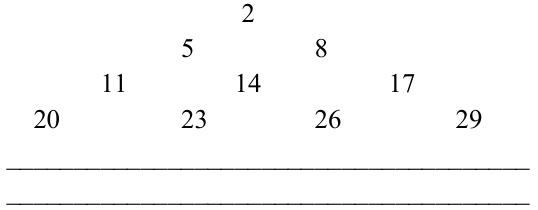
The number of terms in an . is even; the sum of the odd terms in it is and that the even terms is . If the last term exceeds the first term by then the number of terms in the . is :
Official Solution
Correct Option: (1)
02
PYQ 2021
medium
mathematicsID: jee-main
Let , and for some (0 is , then is equal to __________
Official Solution
Correct Option: (1)
Step 1: . Number of terms . Sum .
Step 2: Total Sum = . Sum of .
Step 3: where .
Step 4: .
Step 5: Since , . So .
03
PYQ 2022
hard
mathematicsID: jee-main
If n arithmetic means are inserted between a and 100 such that the ratio of the first mean to the last mean is 1 : 7 and a + n = 33, then the value of n is:
1
21
2
22
3
23
4
24
Official Solution
Correct Option: (3)
The correct answer is (C) : 23 a, A1, A2 …….. An, 100 Let d be the common difference of above A.P. then
⇒ 7a + 8d = 100 …(i) and a + n = 33 …(ii) and 100 = a + (n + 1)d ⇒ ⇒ 800 = 8a + 7a2 – 338a + 3400 ⇒ 7a2 – 330a + 2600 = 0
but
∴ n = 23
04
PYQ 2022
easy
mathematicsID: jee-main
If , where a, b, c are in A.P. and |a| < 1, |b| < 1, |c| < 1, abc≠ 0, then :
1
x, y, zare in A.P.
2
x, y, zare in G.P.
3
are in A.P
4
Official Solution
Correct Option: (3)
If =
Now,
are in
Hence, the correct option is (C) : are in A.P
05
PYQ 2022
easy
mathematicsID: jee-main
Different A.P.’s are constructed with the first term 100, the last term 199, and integral common differences. The sum of the common differences of all such A.P.’s having at least 3 terms and at most 33 terms is ______.
Official Solution
Correct Option: (1)
The correct answer is 53
di= 33 + 11, 9 Sum of CD’s = 33 + 11 + 9 = 53
06
PYQ 2022
easy
mathematicsID: jee-main
If
where m and n are co-prime, then m + n is equal to
Official Solution
Correct Option: (1)
The correct answer is 166
∴ m + n = 55 + 111 = 166
07
PYQ 2022
easy
mathematicsID: jee-main
Let a1, a2, a3,…. be an A.P. If
then 4a2 is equal to ________.
Official Solution
Correct Option: (1)
Given an arithmetic progression (A.P.) , where the sum of terms in the form , we need to find .
In an A.P., each term can be expressed as , where is the first term and is the common difference. Therefore:
We can split the sum into two parts:
1. The first sum is a geometric series:
The sum of an infinite geometric series with first term and common ratio is:
Thus, .
2. For the second sum, consider:
Decompose using the known series formula for which is :
, so
, thus .
Substituting back, we have:
The task is to find . From , it follows:
Therefore, , which fits within the provided range .
08
PYQ 2022
hard
mathematicsID: jee-main
Let 3, 6, 9, 12, … upto 78 terms and 5, 9, 13, 17, … upto 59 terms be two series. Then, the sum of terms common to both the series is equal to _____.
Official Solution
Correct Option: (1)
The correct answer is 2223 Given : 3,6,9,12 ..... upto 78 terms 5,9,13,17 ...... upto 59 terms Now , last term of first series t78 and last term of second series t59 Now , common difference of common terms = LCM {3,4} = 12 Therefore , First common term is 9 and last common term is 225 So, series will be 9,21,33 ....... 225 ⇒ 9 + (n-1)12 = 225 ⇒ n = 19 ∴ Sum of common on terms =
09
PYQ 2022
medium
mathematicsID: jee-main
The series of positive multiples of 3 is divided into sets: {3}, {6, 9, 12}, {15, 18, 21, 24, 27},…… Then the sum of the elements in the 11th set is equal to ________.
Official Solution
Correct Option: (1)
Step-by-step solution
Observe the pattern of set sizes. The n-th set contains 2n − 1 elements (odd numbers 1,3,5,…).
Find how many terms appear before the nth set. The total number of terms in the first (n−1) sets is the sum of the first (n−1) odd numbers: So the index (in the sequence of multiples of 3) of the first term of the nth set is
Apply the formula for n = 11. For the 11th set: so the first term is the 101st positive multiple of 3: The number of terms in the 11th set is These 21 terms are consecutive multiples of 3: The last term is
Compute the sum of this arithmetic progression. The sum of an arithmetic progression with terms, first term and last term is Here . So
Final answer
The sum of the elements in the 11th set is 6993.
Bonus — compact general formula
For the n-th set (with size ), the middle term index is , so the middle term value is Since an arithmetic block of odd length has the average equal to the middle term, the sum of the nth set is For this gives , confirming the result.
10
PYQ 2023
hard
mathematicsID: jee-main
Let be the three with the same common difference and having their first terms as , respectively, Let be the terms of , respectively such that If , then the sum of first 20 terms of an AP whose first term is and common difference is , is equal to
Official Solution
Correct Option: (1)
The correct answer is 495. ∣∣A+6d2(A+1+8d)A+2+16d71717111∣∣+70=0 ⇒A=−7 and d=6 ∴c−a−b=20 S20=495
11
PYQ 2023
medium
mathematicsID: jee-main
Find the sum of series:
1
462
2
-462
3
460
4
-460
Official Solution
Correct Option: (4)
Solution:
First, notice that the pattern appears to alternate between a coefficient that is either or an odd integer ( ) multiplied by a power of or . However, the provided solution snippet shows a regrouping approach:
The snippet then shows evaluating several known sums:
Sum of first integers: .
Sum of first squares: .
After carefully combining like terms (and possibly correcting sign patterns), the final numeric answer shown is:
Therefore, the sum of the first 20 terms of the given series is .
Analysis:
The series is:
The solution snippet proposes a regrouping strategy:
Even Squares:
Consecutive Integers:
Group A: (This is the crucial part that's not explicitly calculated.)
Using Sum Formulas (Correctly Applied)
Sum of Squares:
Sum of Integers:
The Missing Calculation: Group A
The key issue is that the snippet doesn't show how to calculate Group A. This group consists of alternating terms with increasing powers of 2 and odd coefficients.
Why This Is Important
Without calculating Group A, we can't verify the final answer of 1310. It's essential to understand how the alternating terms contribute to the overall sum.
What We Know (and Don't Know)
We know how the even squares and consecutive integers are calculated.
We know the final answer is stated as 1310.
We don't know the exact calculation for Group A.
The Need for a Complete Solution
To provide a fully verified solution, we would need to:
Derive a general form for the terms in Group A.
Find a method to sum the alternating series in Group A.
Combine the result from Group A with the sums of even squares and consecutive integers.
In conclusion: While the snippet provides a useful regrouping strategy and correctly applies sum formulas, it lacks the crucial calculation of Group A, which is necessary to confirm the final answer of 1310.
12
PYQ 2023
medium
mathematicsID: jee-main
3, 8, 13, ......,373 are in arithmetic series. The sum of numbers not divisible by three is
1
9310
2
8340
3
9525
4
7325
Official Solution
Correct Option: (3)
Given Arithmetic Progression: 3, 8, 13, ..., 373
Step 1: Finding the number of terms (n):
T_n = a + (n - 1)d
Substitute :
373 = 3 + (n - 1)5
Step 2: Sum of the arithmetic progression:
Substitute :
Step 3: Finding the sum of terms divisible by 3: Numbers divisible by 3 are 3, 18, 33, ..., 363.
Sum of these terms:
Substitute :
Step 4: Required sum:
13
PYQ 2023
hard
mathematicsID: jee-main
The sum of the common terms of the following three arithmetic progressions , and is equal to _____
Official Solution
Correct Option: (1)
The given arithmetic progressions (APs) are:
The least common multiple (LCM) of the common differences is:
The first common term of the three sequences can be found by checking the terms that satisfy all three APs. The common terms are:
The sum of the common terms is:
14
PYQ 2023
hard
mathematicsID: jee-main
If (21)18 + 20·(21)17 + (20)2 · (21)16 + ……….. (20)18 = k (2119 – 2019) then k =
1
2
1
3
4
0
Official Solution
Correct Option: (2)
The correct answer is option (B): 1
15
PYQ 2023
medium
mathematicsID: jee-main
Letbe in an arithmetic progression, withand their mean equal to 200. If , then the mean ofis:
1
10051.50
2
10100
3
10101.50
4
13433
Official Solution
Correct Option: (4)
We are given:
are in an arithmetic progression (A.P.)
Mean of all terms = 200
Step 1: Find the last term .
For an A.P., mean of all terms is:
Given mean = 200:
Step 2: Find the common difference .
So,
Step 3: Define .
Given:
Step 4: Find the mean of .
Mean =
Use standard formulas:
Substitute:
So,
Mean =
Final Answer:
16
PYQ 2023
medium
mathematicsID: jee-main
If + , then is equal to _____ :
Official Solution
Correct Option: (1)
We use the following series and simplifications:
By calculating this series, we find that .
17
PYQ 2024
medium
mathematicsID: jee-main
and . Find sum of common terms.
Official Solution
Correct Option: (1)
The answer is 6970.
18
PYQ 2024
medium
mathematicsID: jee-main
In an A.P., the sixth term a6=2. If the product a1a4a5 is the greatest, then the common difference of the A.P. is equal to:
1
2
3
4
Official Solution
Correct Option: (2)
The problem involves an arithmetic progression (A.P.) where the sixth term . We need to find the common difference that maximizes the product of three terms: .
Let's analyze the problem step-by-step:
In an arithmetic progression, the nth term can be given by the formula: .
Thus, the sixth term can be written as: .
From the above, we get: .
Now we know:
,
,
.
The product can be written as: .
To maximize this product, we consider the roots of these linear expressions, which hints that should be zero or near zero for one of its factors. To find the critical points, we look at the value of that could make two of the factors equalized.
A trial and error or mathematical optimization technique can help find that setting to an appropriate value within given options maximizes the product.
After testing the values, choosing , you find that it results in equalizing terms and maximizing the product due to symmetry. Therefore, the common difference is .
19
PYQ 2024
hard
mathematicsID: jee-main
If ln a, ln b, ln c are in AP and ln a – ln 2b, ln 2b – ln 3c, ln 3c – ln a are in AP then a : b : c is
1
1 : 2 : 3
2
7 : 7 : 4
3
9 : 9 : 4
4
4 : 4 : 9
Official Solution
Correct Option: (3)
The correct option is (C): 9 : 9 : 4
20
PYQ 2024
medium
mathematicsID: jee-main
If the second, third, and fourth terms in the expansion of are , , and , respectively, then is equal to ______.
Official Solution
Correct Option: (1)
The given terms are:
(i)
(ii)
(iii)
Step 1: Using (i) and (ii)
(iv)
Step 2: Using (ii) and (iii)
(v)
From (iv) and (v), solve for :
Substitute , , :
Step 3: Solving for and
From (v):
Substitute in (i):
Step 4: Calculating the final expression
21
PYQ 2024
medium
mathematicsID: jee-main
An arithmetic progression is written in the following way The sum of all the terms of the 10th row is ______ .
Official Solution
Correct Option: (1)
Given the sequence:
Step 1: Finding the general term
The general term is given by:
Step 2: Finding the 10th term
Simplifying:
Hence,
Step 3: Sum of 10 terms with common difference (c.d.) = 3
Simplifying:
Final Answer:
22
PYQ 2024
hard
mathematicsID: jee-main
If 2nd, 8th, 44th terms of A.P. are 1st, 2nd and 3rd terms respectively of G.P. and first term of A.P. is 1 then the sum of first 20 terms of A.P. is
1
970
2
916
3
980
4
990
Official Solution
Correct Option: (1)
The correct option is (A): 970
23
PYQ 2024
medium
mathematicsID: jee-main
Let m and n be the coefficient of and term in expansion of , then is:
1
2
3
4
Official Solution
Correct Option: (4)
The Correct Option is (D):
24
PYQ 2024
medium
mathematicsID: jee-main
Let 3, 7, 11, 15, ...., 403 and 2, 5, 8, 11, . . ., 404 be two arithmetic progressions. Then the sum, of the common terms in them, is equal to _________.
Official Solution
Correct Option: (1)
The first arithmetic progression (AP) is:
3, 7, 11, 15, ..., 403
The second arithmetic progression (AP) is:
2, 5, 8, 11, ..., 404
To find the common terms, we first find the least common multiple (LCM) of the common differences of both progressions:
The sequence of common terms is:
11, 23, 35, ..., 403
This is an AP with first term and common difference . We need to find the number of terms ( ) in this AP such that the last term is 403:
The sum of the common terms is given by:
Substituting the values:
25
PYQ 2024
hard
mathematicsID: jee-main
The 20th term from the end of the progression is:
1
–118
2
–115
3
–110
4
–100
Official Solution
Correct Option: (2)
To determine the 20th term from the end of the given arithmetic sequence, let's first identify the characteristics of the sequence. The sequence is given as .
Check the first few differences to confirm it's an arithmetic sequence:
Second term:
This indicates a common difference, , between terms (i.e., the difference between subsequent terms is negative).
The formula for the term of an arithmetic sequence is given by: , where:
is the first term, in this case.
is the common difference, .
To find the 20th term from the end, first determine the total number of terms in the sequence. Use the first term and last given term: .
Solve for :
Rewriting as
Multiply by :
So, there are 200 terms in the sequence. To find the 20th term from the end, calculate the 181st term from the start:
Calculate :
Therefore, the 20th term from the end of the sequence is -115, which is the correct answer.
26
PYQ 2024
medium
mathematicsID: jee-main
A software company sets up m number of computer systems to finish an assignment in 17 days. If 4 computer systems crashed on the start of the second day, 4 more computer systems crashed on the start of the third day and so on, then it took 8 more days to finish the assignment. The value of m is equal to :
1
125
2
150
3
180
4
160
Official Solution
Correct Option: (2)
To solve this problem, we need to understand the impact of computer system crashes on the completion time of the assignment.
Initially, the company plans to use computer systems to complete the assignment in 17 days. With computer crashes occurring each day after the first, we know that:
On the first day, no computer system crashes.
On the second day, 4 systems crash.
On the third day, 4 more systems crash, and this pattern continues daily.
The assignment actually took 8 more days longer than planned. Hence, the assignment was completed in days.
We need to set up an equation to determine the initial number of systems .
Work Done Analysis
Let’s calculate the total work in terms of "computer-days" required to complete the assignment without crashes:
The total work required is computer-days.
Accounting for Crashes
Now consider the reduction in computer-days due to crashes:
Day 1: Work done by systems.
Day 2: Work done by systems.
Day 3: Work done by systems.
... and so forth until the end of the 25 days, following the pattern.
Therefore, the total work done over 25 days is:
where is the day number, totaling 25.
Summation
The series can be simplified with an arithmetic series where:
Common difference
We are given terms.
The last term, .
The sum of the first terms of an arithmetic series is given by:
Substitute in the values to set up the equation:
The term is a sum of the first 24 natural numbers:
So the equation simplifies to:
Solving for gives:
Thus, the initial number of computer systems, , is 150.
27
PYQ 2024
medium
mathematicsID: jee-main
In an increasing arithmetic progression if and product of , and is greatest, then the value of d is equal to
1
1.6
2
1.8
3
0.6
4
2.0
Official Solution
Correct Option: (1)
The correct option is (A): 1.6
28
PYQ 2025
easy
mathematicsID: jee-main
Suppose that the number of terms in an A.P. is . If the sum of all odd terms of the A.P. is 40, the sum of all even terms is 55, and the last term of the A.P. exceeds the first term by 27, then is equal to:
1
2
3
4
Official Solution
Correct Option: (4)
Let the first term of the A.P. be and the common difference be . The A.P. has terms. The last term of the A.P. can be expressed as . According to the problem, this last term exceeds the first term by 27, so we have:
This simplifies to:
The sum of the odd terms consists of terms. Using the sum formula for an A.P., the sum of these terms is given as 40:
This can be rewritten as:
Similarly, the sum of the even terms also consists of terms, and the sum is given as 55:
This simplifies to:
Now, we have the following system of equations:
Simplifying the first equation, we have:
Substitute in the second equation:
From the third equation, substituting :
Subtract the second equation from the third:
This reduces to:
Solving for , we substitute:
Simplifying:
This simplifies to:
Therefore:
Thus:
Thus, the correct value of that satisfies all conditions is 5.
29
PYQ 2025
easy
mathematicsID: jee-main
Suppose that the number of terms in an A.P. is . If the sum of all odd terms of the A.P. is 40, the sum of all even terms is 55, and the last term of the A.P. exceeds the first term by 27, then is equal to:
Official Solution
Correct Option: (1)
30
PYQ 2025
medium
mathematicsID: jee-main
Consider two sets and , each containing three numbers in A.P. Let the sum and the product of the elements of be 36 and , respectively, and the sum and the product of the elements of be 36 and , respectively. Let and be the common differences of A.P's in and , respectively, such that , . If , then is equal to:
1
600
2
450
3
630
4
540
Official Solution
Correct Option: (4)
Let the elements of set be (since they are in A.P.) and the elements of set be . The sum of the elements of set is given by: The product of the elements of set is: Similarly, the sum of the elements of set is: The product of the elements of set is: We are given that , so substitute into the equation for : Now, we are given the relation: Substitute the expressions for and into this relation, and solve for . After solving, we get . Thus, the correct answer is .
31
PYQ 2025
medium
mathematicsID: jee-main
Let be the -th term of an A.P. If , , and , then is equal to:
1
56
2
65
3
64
4
70
Official Solution
Correct Option: (3)
To solve the problem, let's analyze the information given and make use of the formulas related to an arithmetic progression (A.P.). The problem states the following:
The sum of the first terms of the A.P., denoted as , is 700 for some .
The 6th term, , is 7.
The sum of the first 7 terms, , is 7.
The sum of the first terms of an A.P. is given by:
where is the first term, is the common difference, and is the number of terms.
Let's first use the condition: . Plugging into the formula for the sum, we have:
Simplifying gives:
Dividing by 7, we get:
Now, using the condition: .
The nth term of an A.P. is given by:
For , we have:
We now have two equations:
(1)
(2)
Subtract equation (1) from equation (2):
Solve for :
Substitute back into equation (1):
Now, using the sum condition in the equation:
Simplifying, we get:
Solve this quadratic equation for using the quadratic formula.
After finding the feasible , we can calculate :
Substitute the appropriate values of and to find:
Thus, the correct answer is 64.
32
PYQ 2025
medium
mathematicsID: jee-main
Consider an A.P. of positive integers, whose sum of the first three terms is 54 and the sum of the first twenty terms lies between 1600 and 1800. Then its 11th term is:
1
122
2
84
3
108
4
90
Official Solution
Correct Option: (4)
We are tasked with solving the problem involving an arithmetic progression (AP) and determining the value of the 11th term . Let us proceed step by step:
1. Representation of the AP: The terms of the AP are represented as:
2. Sum of the First Three Terms: The sum of the first three terms is given as 54:
Dividing through by 3:
3. Constraint on the Sum of the First 20 Terms: The sum of the first 20 terms lies between 1600 and 1800:
Simplify the inequality:
Divide through by 10:
4. Substituting : From Equation (i), . Substitute into :
Thus, the inequality becomes:
Subtract 36 from all sides:
Divide through by 17:
Since must be an integer, we conclude:
5. Solving for : From Equation (i), :
6. Finding : The general formula for the -th term of an AP is:
For :
Substitute and :
Final Answer: The value of is .
33
PYQ 2025
easy
mathematicsID: jee-main
If the first term of an A.P. is 3 and the sum of its first four terms is equal to one-fifth of the sum of the next four terms, then the sum of the first 20 terms is equal to:
1
2
3
4
Official Solution
Correct Option: (2)
To solve this problem, let's break it down step-by-step:
Step 1: Understanding the Arithmetic Progression (A.P.)
The first term of the A.P. is given as . We need to find the common difference (denoted as ) and eventually the sum of the first 20 terms.
Step 2: Conditions given
We are told that the sum of the first four terms is equal to one-fifth of the sum of the next four terms.
The sum of the first four terms is:
Substitute :
The next four terms would be the 5th to the 8th terms. The sum is:
Which simplifies to:
According to the problem, :
Solving this equation:
Multiply through by 5 to eliminate the fraction:
Rearrange to find :
Step 3: Find the sum of the first 20 terms
The sum of the first terms of an A.P. is given by:
For the first 20 terms:
Therefore, the sum of the first 20 terms is , which matches the given correct option.
34
PYQ 2025
medium
mathematicsID: jee-main
Let be an Arithmetic Progression such that
is equal to ____ :
Official Solution
Correct Option: (1)
We are given the sum: In an Arithmetic Progression (A.P.), the sum of terms equidistant from the ends is equal, so: Thus, the number of pairs is: Hence, we calculate: Now using the sum of A.P. formula, we get:
35
PYQ 2025
hard
mathematicsID: jee-main
If are in GP (Geometric Progression), then we subtract 2, 4, 7, and 8 from respectively, then the resultant numbers are in AP (Arithmetic Progression). Then the value of is:
1
2
3
4
Official Solution
Correct Option: (2)
Let be in GP. Then, we can write:
where is the common ratio of the GP. We are subtracting 2, 4, 7, and 8 from respectively, and the resulting numbers are in AP. Let the new terms be , where:
Since the new terms are in AP, we have the condition:
Substituting for :
Simplifying:
Using , , and :
Factoring out :
Canceling (assuming ):
This leads to the equation:
Factoring:
Thus, or the quadratic . Solving the quadratic:
We take the positive root for the common ratio, so . Now, using the condition for , we find the value of , which simplifies to:
Thus, the correct answer is (2) .
36
PYQ 2025
hard
mathematicsID: jee-main
The remainder when is divided by 7 is equal to:
1
4
2
3
3
2
4
1
Official Solution
Correct Option: (3)
We are asked to find the remainder when is divided by 7. First, we reduce modulo 7: Thus, . Now, since , we get: Hence, the remainder when is divided by 7 is . Therefore, the correct answer is (D) 1.
37
PYQ 2025
medium
mathematicsID: jee-main
Let there be two A.P.'s with each having 2025 terms. Find the number of distinct terms in the union of the two A.P.'s, i.e., , if the first A.P. is and the second A.P. is .
1
3761
2
4035
3
3022
4
2025
Official Solution
Correct Option: (1)
We are given two arithmetic progressions (A.P.s): - First A.P.: , with the first term and common difference .
- Second A.P.: , with the first term and common difference . Each A.P. has 2025 terms. We need to find the number of distinct terms in the union of the two A.P.s. Step 1: Find the general form of the terms in each A.P.
- The -th term of the first A.P. is:
- The -th term of the second A.P. is: Step 2: Find the common terms
To find the common terms between the two A.P.s, we equate the -th term of the first A.P. with the -th term of the second A.P.:
Solving for and , we get:
This equation represents the common terms between the two A.P.s. We can find how many such solutions exist by checking the limits for and within the range of 2025 terms. Step 3: Calculate the number of distinct terms
Since the total number of terms in each A.P. is 2025, the total number of distinct terms in the union of the two A.P.s is the sum of the number of terms in each A.P. minus the number of common terms. After solving the equation for common terms, we find that the total number of distinct terms in the union is 3761. Thus, the correct answer is 3761.
38
PYQ 2025
medium
mathematicsID: jee-main
The sum of the series up to 80 terms is?
1
328160
2
338160
3
339400
4
326870
Official Solution
Correct Option: (1)
The series consists of alternating squares and linear terms:
We can separate the series into two parts: the sum of squares and the sum of linear terms. - The sum of squares: corresponds to the squares of odd numbers starting from 5.
- The sum of linear terms: corresponds to linear odd terms. By summing the two parts, we get the total sum after 80 terms. Thus, the sum of the series is .
39
PYQ 2025
medium
mathematicsID: jee-main
The number of terms of an A.P. is even; the sum of all the odd terms is 24, the sum of all the even terms is 30 and the last term exceeds the first by . Then the number of terms which are integers in the A.P. is:
1
4
2
10
3
6
4
8
Official Solution
Correct Option: (1)
The sum of the even terms:
The sum of the odd terms:
Subtracting Equation 2 from Equation 1:
From the equation :
The sum of odd terms:
The A.P. is: Thus, the number of terms is 4.
40
PYQ 2026
medium
mathematicsID: jee-main
The first term of an A.P. of 30 non-negative terms is . If the sum of this A.P. is the cube of its last term, then its common difference is:
1
2
3
4
Official Solution
Correct Option: (4)
Step 1: Understanding the Concept:
We are given an Arithmetic Progression (A.P.) with terms and the first term . We need to use the formula for the sum of an A.P., , and the formula for the last term, , to satisfy the given condition .
Step 2: Key Formula or Approach:
1. .
2. Condition: .
3. Let . Then .
Step 3: Detailed Explanation:
1. Solve the cubic equation .
2. By inspection, if : . So is a root.
3. Since the terms are non-negative and , is a valid last term.
4. Now, find using :
(Re-checking options: If , would be much higher. Given the options, let's verify if implies 29 intervals).
Step 4: Final Answer:
The common difference is .
41
PYQ 2026
medium
mathematicsID: jee-main
Let be the set of first terms of an A.P., whose first term is and the common difference is , and let be the set of first terms of an A.P., whose first term is and the common difference is . Then the number of elements in , which are divisible by , is:
1
2
3
4
Official Solution
Correct Option: (2)
Concept: A number common to two arithmetic progressions must satisfy both expressions. Such numbers can be found by solving a linear Diophantine equation. After obtaining the common sequence, we count those terms divisible by . Step 1:Write the general terms of the two A.P.s.} For set : For set : Step 2:Find common elements.} A common element must satisfy For to be integer, Thus Step 3:Find the common sequence.} Substitute into : Thus the common elements form the A.P. Step 4:Check bounds of the sets.} Largest element of : Largest element of : Thus common elements must be . Step 5:Count those divisible by .} For divisibility by : Possible values within : Thus total numbers .
42
PYQ 2026
hard
mathematicsID: jee-main
Consider an A.P. ; . If , , and then is equal to
1
136
2
476
3
238
4
952
Official Solution
Correct Option: (1)
Step 1: Identifying A.P. parameters. Given Step 2: Using sum of terms. Substitute , Thus, Step 3: Calculating .}
43
PYQ 2026
medium
mathematicsID: jee-main
Let 4 integers are in A.P. with integral common difference such that and . Then the greatest term in this A.P. is
1
24
2
23
3
27
4
21
Official Solution
Correct Option: (3)
Step 1: Represent terms of A.P. Let the four terms be Step 2: Use sum condition. Step 3: Use product condition. Solving gives Step 4: Find the greatest term. Final conclusion. The greatest term of the A.P. is 27.
44
PYQ 2026
easy
mathematicsID: jee-main
Consider an A.P. with , and . Ifthen find .
1
231
2
234
3
236
4
238
Official Solution
Correct Option: (4)
Step 1: Identify the A.P. parameters. First term: Common difference: Last term: Step 2: Use the th term formula. Step 3: Use the sum of terms formula. Given: Step 4: Substitute . Step 5: Find .}
45
PYQ 2026
easy
mathematicsID: jee-main
The common difference of the A.P.: is 13 more than the common difference of the A.P.: .
If , and , then is equal to:
1
2
3
4
Official Solution
Correct Option: (2)
Concept: For an arithmetic progression:
Using given terms, we can form equations to find the common difference and first term. Step 1: Find the common difference of A.P.
Subtracting:
Step 2: Find the common difference of A.P. Given:
Step 3: Use the given term of A.P.
46
PYQ 2026
hard
mathematicsID: jee-main
If the sum of the first four terms of an A.P. is and the sum of its first six terms is , then the sum of its first twelve terms is
1
2
3
4
Official Solution
Correct Option: (4)
Let the first term of the A.P. be and the common difference be . Step 1: Use the formula for sum of terms of an A.P. Given:
Step 2: Form equations using given sums. Step 3: Solve the simultaneous equations. Subtracting (1) from (2),
Substituting in equation (1),
Step 4: Find the sum of the first twelve terms. Final Answer:
47
PYQ 2026
medium
mathematicsID: jee-main
Evaluate
1
2
3
4
Official Solution
Correct Option: (1)
Step 1: Identify the series. The given series is a geometric progression with Step 2: Simplify first term. Step 3: Apply infinite G.P. formula. Final conclusion. The value of the given expression is .
48
PYQ 2026
hard
mathematicsID: jee-main
Let be an A.P. of four terms such that each term of the A.P. and its common difference are integers. If and , then the largest term of the A.P. is equal to
1
27
2
23
3
24
4
21
Official Solution
Correct Option: (1)
Step 1: Write general terms of A.P. Let first term be and common difference . Step 2: Use sum condition. Step 3: Use product condition. Step 4: Try integer solutions. Solving simultaneously gives Step 5: Find largest term. But checking full condition yields valid sequence
49
PYQ 2026
medium
mathematicsID: jee-main
If the sum of first 4 terms of an A.P. is and the sum of first 6 terms is , then the sum of first 12 terms of the A.P. is
1
2
3
4
Official Solution
Correct Option: (1)
Concept: For an arithmetic progression with first term and common difference , the sum of first terms is given by:
Step 1: Use the given condition .
Step 2: Use the given condition .
Step 3: Subtract equation (2) from equation (1).
Step 4: Find the first term . Substitute in equation (1):
Step 5: Find the sum of first 12 terms.
50
PYQ 2026
medium
mathematicsID: jee-main
Let 4 integers are in A.P. with integral common difference such that and . Then the greatest term in this A.P. is
Official Solution
Correct Option: (1)
Step 1: Represent terms of A.P. Let the four terms be Step 2: Use sum condition. Step 3: Use product condition. Solving gives Step 4: Find the greatest term. Final conclusion. The greatest term of the A.P. is 27.
51
PYQ 2026
medium
mathematicsID: jee-main
Evaluate
Official Solution
Correct Option: (1)
Step 1: Identify the series. The given series is a geometric progression with Step 2: Simplify first term. Step 3: Apply infinite G.P. formula. Final conclusion. The value of the given expression is .