Sets
41 previous year questions.
High-Yield Trend
Chapter Questions 41 MCQs
Both R1 and R2 are equivalence relations
Neither R1 nor R2 is an equivalence relation
R1 is an equivalence relation but R2 is not
R2 is an equivalence relation but R1 is not
The number of for which the system of linear equations has no solution is :
Let A = {n∈N : H.C.F. (n, 45) = 1} and
Let B = {2k :k∈ {1, 2, …,100}}. Then the sum of all the elements of is ___________
Let
Then, the value of ∑n∈S f(n) is equal to ________.
Let denote the power set of . Define the relations and on as if and iffor all . Then:
both and are equivalence relations
only is an equivalence relation
only is an equivalence relation
both and are not equivalence relations
21
25
24
23
21
25
24
23
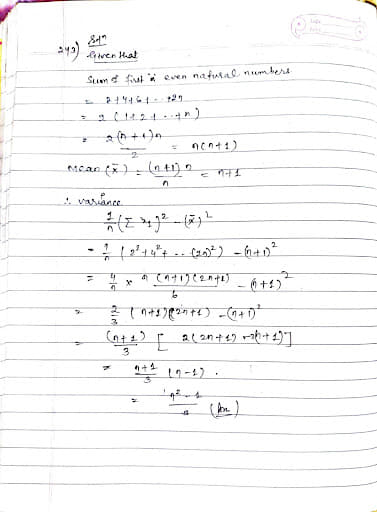
Consider two sets A and B. Set A has 5 elements whose mean & variance are 5 and 8 respectively. Set B has also 5 elements whose mean & variance are 12 & 20 respectively. A new set C is formed by subtracting 3 from each element of set A and by adding 2 to each element of set B. The sum of mean & variance of the set C is
Negation of (p⇒q)⇒(q⇒p) is
if f : S → P(S), where P(S) is power set of S. Then number of one-one functions f can be made is
(32)5
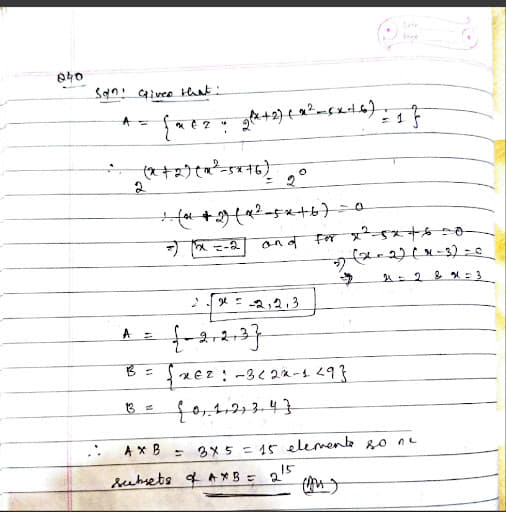
Then the number of elements in is:
Let Then
About Sets - JEE-MAIN
Sets is a vital chapter for JEE-MAIN aspirants. Mastering the concepts covered in this chapter is essential for securing a top rank.
By rigorously practicing the previous year questions associated with this chapter, you can identify high-yield topics, understand the examiner's perspective, and boost your confidence during the actual exam.
Frequently Asked Questions
Why focus on Sets PYQs?
Analyzing PYQs for this specific chapter reveals the most frequently tested concepts and the typical complexity of questions, allowing you to tailor your study plan efficiently.
How to best use this analysis?
Review the topic breakdown to see which sub-topics within Sets carry the most weight. Then, tackle the questions iteratively to solidify your understanding.