Types Of Differential Equations
67 previous year questions.
High-Yield Trend
Chapter Questions 67 MCQs
Let
and
For k ∈ N, if X’AkX = 33, then k is equal to ____ .
Let S be the sample space of all five digit numbers. It p is the probability that a randomly selected number from S, is multiple of 7 but not divisible by 5, then 9p is equal to
Let
and
Then n(S ⋂ T) is equal to ____ .
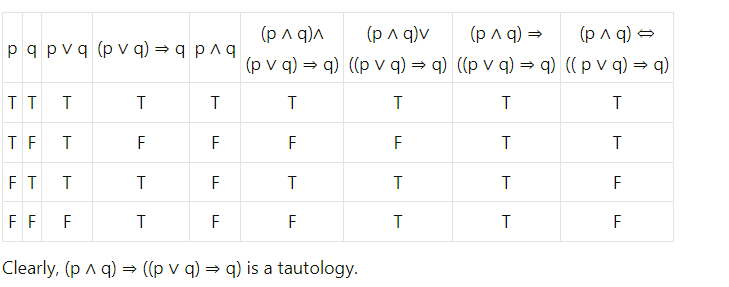
The statement
is NOT equivalent to
Let α, β(α > β) be the roots of the quadratic equation x2 – x – 4 = 0.
If then
is equal to _______.
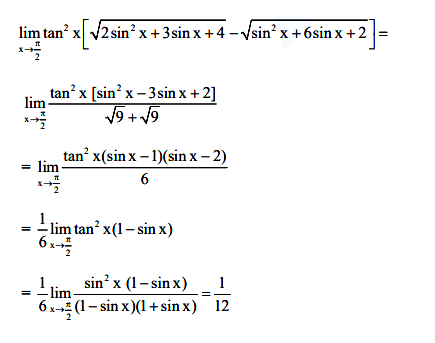
Let ℝ → ℝ be function defined as
f(x) = αsin( +[2-x],α∈R
where [t] is the greatest integer less than or equal to t.
If lim x→1 f(x) exists, then the value of f(x)dx
is equal to
Let ƒ R ⇒ R be a function defined by
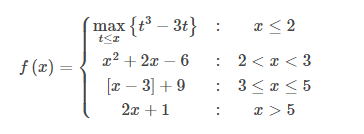
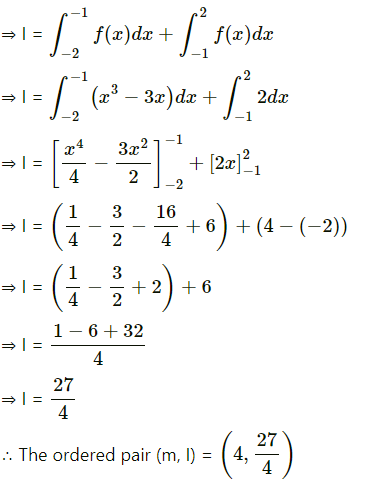
where [t] is the greatest integer less than or equal to t. Let m be the number of points where ƒ is not differentiable and
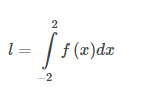
Then the ordered pair (m, I) is equal to :
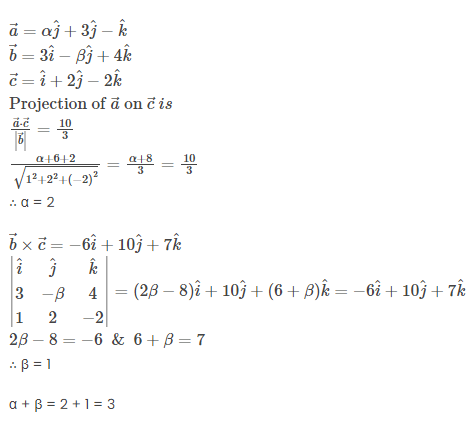
Let
where α,β∈R, be three vectors. If the projection of
then the value of α+β is equal to
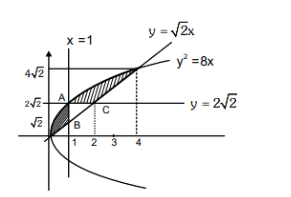
The area enclosed by y2 = 8x and y = √2x that lies outside the triangle formed by , is equal to
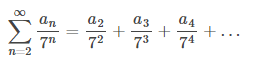
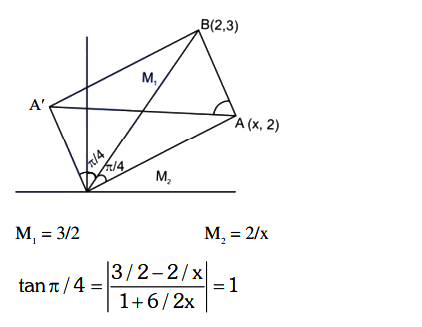
Let f(x) = [2x2 + 1] and where [t] is the greatest integer ≤ t. Then, in the open interval (–1, 1), the number of points where fog is discontinuous is equal to _______.
The area enclosed by the closed curve given by the differential equation is .
Let and be the points of intersection of the curve and the -axis If normals at and on the curve intersect -axis at points and respectively, then the length of the line segment is
(S1) : (p ⇒ q)∧(q ∧(~q)) is a contradiction and
(S2) : (p∧q) v ((~p)∧q) v (p ∧ (~q)) v ((~p) ∧ (~q)) is a tautology
Let g(x) = f(x) + f(1 - x) and f''(x) > 0, x ∈ (0,1). If g is decreasing in the interval (0, α) and increasing in the interval (α, 1), then tan-1 (2α) + tan-1 ( ) + tan-1 is equal to
Let be the solution of the differential equation such that Then is equal to :
If fn (x) = (fofof____upto n times) (x), then ( f n(x))dx is equal to ___.
then is equal to ____.
x + y + az = b
2x + 5y + 2z = 6
x + 2y + 3z = 3
Has infinitely many solutions, then 2a + 3b is equal to
(S2): (p∧q)v((~q)v((~p)∧ q)v (p∧(~q))v((~p)∧ (~q)) is a tautology
| List I | List II | ||
| A | Spring constant | I | [T-1] |
| B | Angular speed | II | [MT-2] |
| C | Angular momentum | III | [ML2] |
| D | Moment of Inertia | IV | [ML2T-1] |
Choose the correct answer from the options given below:
If the domain of the function is , then is equal to:
About Types Of Differential Equations - JEE-MAIN
Types Of Differential Equations is a vital chapter for JEE-MAIN aspirants. Mastering the concepts covered in this chapter is essential for securing a top rank.
By rigorously practicing the previous year questions associated with this chapter, you can identify high-yield topics, understand the examiner's perspective, and boost your confidence during the actual exam.
Frequently Asked Questions
Why focus on Types Of Differential Equations PYQs?
Analyzing PYQs for this specific chapter reveals the most frequently tested concepts and the typical complexity of questions, allowing you to tailor your study plan efficiently.
How to best use this analysis?
Review the topic breakdown to see which sub-topics within Types Of Differential Equations carry the most weight. Then, tackle the questions iteratively to solidify your understanding.