Relations And Functions
86 previous year questions.
High-Yield Trend
Chapter Questions 86 MCQs
=
be continuous at x = 0. Then α is equal to
If [t] denotes the greatest integer ≤ t, then the number of points, at which the function
is not differentiable in the open interval (–20, 20), is ____ .
The domain of the function
is :
Let be a function such that.
Then is equal to __________.
Let be a function defined by
, and Consider two statements
(I) is an increasing function in
(II) is one-one in Then,
Let be a relation on defined by if and only if Then is
Let for
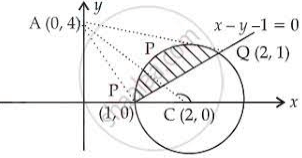
Then area bounded by the curve and the lines is equal to
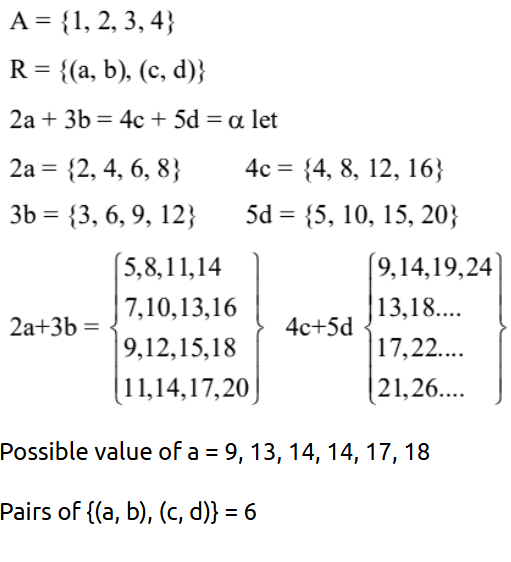
Let and . Total number of onto functions such that , is equal to:
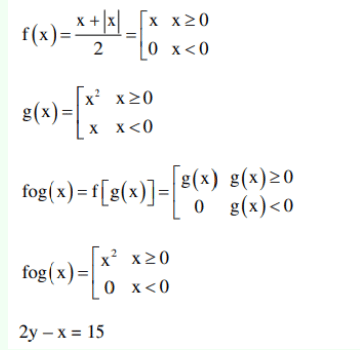
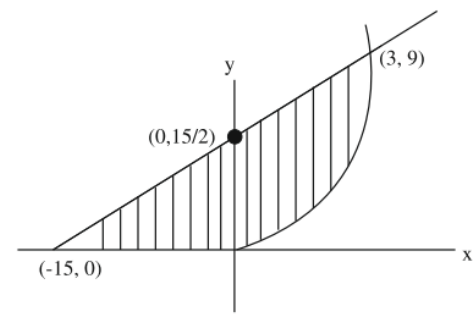
For , two real‐valued functions and are such that
A has 5 elements and B has 2 elements. The number of subsets of A × B such that the number of elements in subset is more than or equal to 3 and less than 6, is?
602
484
582
704
Let is equal to
Where [x] denotes the greatest integer function. If m and n respectively are the number of points in (-2, 2) at which y = |f(x)| is not continuous and not differentiable, then m + n is equal to ______.
Let A={0, 3, 4, 6, 7, 8, 9, 10 } and R be the relation defined on A such that R = {(x, y)∈A×A:x-y is odd positive integer or x-y=2}. The minimum number of elements that must be added to the relation R, so that it is a symmetric relation, is equal to _______.
Consider the two statements:
[(I)] is reflexive but not symmetric.
[(II)] is transitive.
Then which one of the following is true:
be given by
and
.
If and be the minimum number of elements required to be added in and , respectively, in order to make the relations symmetric, then equals:
and .Then, the number of elements in is equal to
12
10
11
9
Let , . If and , then the quadratic equation having roots and is:
Let A = . Let R be a relation on A defined by xRy if and only if . Let be the number of elements in R and m be the minimum number of elements required to be added in R to make it a reflexive relation. then is equal to
Let be the set of all functions and be a relation on such that $ R $ is:
Symmetric and transitive but not reflective
Symmetric but neither reflective nor transitive
Reflexive but neither symmetric nor transitive
Transitive but neither reflexive nor symmetric
2. both are true
3. only is true
4. both are false
Let and . Consider the two statements:
Statement 1: Total number of elements in is 18.
Statement 2: is symmetric but not reflexive and transitive.
If the domain of the function is , then is equal to
Let . Let be a relation on defined by if and only if . Let be the number of reflexive elements in and be the minimum number of elements required to be added in to make it reflexive and symmetric relations, respectively. Then is equal to
The number of relations defined on the set that are both reflexive and symmetric is equal to:
Let . Let be a relation on defined by if and only if is a multiple of . Given below are two statements:
Statement I: .
Statement II: is an equivalence relation.
In the light of the above statements, choose the correct answer from the options given below.
Let be a relation defined on the set by Then the number of elements in is
15
= number of elements in ,
= minimum number of elements to be added to to make it reflexive,
= minimum number of elements to be added to to make it symmetric. Then is:
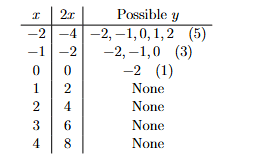
S : Number of elements in is 36.
S : is an equivalence relation.
Which of the following is correct?
Let , if a relation R defined on set M such that R = . How many elements should be added to R to make it symmetric.
About Relations And Functions - JEE-MAIN
Relations And Functions is a vital chapter for JEE-MAIN aspirants. Mastering the concepts covered in this chapter is essential for securing a top rank.
By rigorously practicing the previous year questions associated with this chapter, you can identify high-yield topics, understand the examiner's perspective, and boost your confidence during the actual exam.
Frequently Asked Questions
Why focus on Relations And Functions PYQs?
Analyzing PYQs for this specific chapter reveals the most frequently tested concepts and the typical complexity of questions, allowing you to tailor your study plan efficiently.
How to best use this analysis?
Review the topic breakdown to see which sub-topics within Relations And Functions carry the most weight. Then, tackle the questions iteratively to solidify your understanding.