Differential Equations
204 previous year questions.
High-Yield Trend
Chapter Questions 204 MCQs
Given that dy/dx = yex such that x = 0, y = e. The value of y(y > 0) when x = 1 will be
e
1/e
ee
e2
.
If , then is equal to _________.
If y = y(x) is the solution of the differential equation
then the local maximum value of the function
is
0
Choose the correct answer:
1. Let A = {x ∈ R : | x + 1 | < 2} and B = {x ∈ R : | x – 1| ≥ 2}. Then which one of the following statements is NOT true?
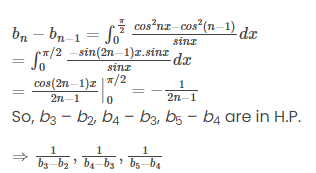
If y = y(x) is the solution of the differential equation
such that
then y(1) is equal to
If the angle made by the tangent at the point (x0, y0) on the curve x = 12(t + sin t cos t),
with the positive x-axis is π/3, then y0 is equal to
The general solution of the differential equation is :
Suppose y = y(x) be the solution curve to the differential equation
such that
is finite. If a and bare respectively the x – and y – intercepts of the tangent to the curve at x = 0, then the value of a – 4b is equal to _____.
Let the solution curve y = f(x) of the differential equation
pass through the origin. Then
is
satisfies y(0) = 0, then the value of y(2) is ______.
-1
1
0
(y2+x)4=C|(y2+2x)3|
(y2+2x)4=C|(y2+x)3|
|(y2+x)3|=C(2y2+x)4
|(y2+2x)3|=C(2y2+x)4
If y = y (x) is the solution of the differential equation
and y(0) = 0, then
is equal to
If
then the maximum value of y(x) is:
Let y = y(x) be the solution of the differential equation
with y(2) = –2. Then y(3) is equal to
( )
( )
( )
Let the solution curve y = y(x) of the differential equation (4 + x2)dy – 2x(x2 + 3y + 4)dx = 0 pass through the origin. Then y(2) is equal to _______.
Let
. Let y = y(x), x∈S, be the solution curve of the differential equation
.If the sum of abscissas of all the points of intersection of the curve y = y(x) with the curve
is ,
then k is equal to _________.
Let y = y(x) be the solution curve of the differential equation
which passes through the point . Then
is equal to _______.
Let x = x(y) be the solution of the differential equation
such that x(1) = 0. Then, x(e) is equal to
Let ƒ :R→R be a function defined by
Then
is equal to ________.
Let the solution curve y = y(x) of the differential equation
pass through the points (1, 0) and (2α, α), α> 0. Then α is equal to
Let y = y(x), x > 1, be the solution of the differential equation
with . If ,
then the value of α + β is equal to ____.
Let . If n(S) denotes the number of elements in S then :
and only one element in is less than
and the element in is less than .
and the elements in is more than .
Let αx=exp(xβyγ) be the solution of the differential equation 2x2ydy−(1−xy2) dx = 0, x>0 , y(2)= . Then α+β−γ equals :
+ y = If y(1) = 2, then the value of y(2) is:
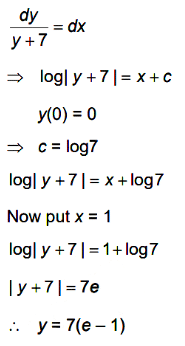
f''(x)=g''(x)+6x
f''(1)=4g'(1)-3=9
f(2)=3g(2)=12.
Then which of the following is NOT true?
There exists such that
Then,
If the equation of the normal to the curve at the point is , then the value of is:
2
2
Let be a differentiable function such that for all . Then the area of the region bounded by and the coordinate axes is
Let be the solution of the differential equation such that . Then is equal to _____.
Let be a differentiable function. If
for all , then the value of is ______.
18
32
22
20
Let be a twice differentiable function such that for all . If and satisfies , where , then the area of the region R = {(x, y) | 0 y f(ax), 0 x 2 is :
Let be the solution of the differential equation
such that , then is equal to:
If and
and , then the value of equals to:
Let be the solution of the differential equation such that . If then is equal to ______.
Let be the solution of the differential equation:
satisfying .
If , then the value of is ________.
for all , then the value of is
and , then the value of is:
If xdy - ydx = dx. If y = y(x) y(1) = 0 then y(3) is :
About Differential Equations - JEE-MAIN
Differential Equations is a vital chapter for JEE-MAIN aspirants. Mastering the concepts covered in this chapter is essential for securing a top rank.
By rigorously practicing the previous year questions associated with this chapter, you can identify high-yield topics, understand the examiner's perspective, and boost your confidence during the actual exam.
Frequently Asked Questions
Why focus on Differential Equations PYQs?
Analyzing PYQs for this specific chapter reveals the most frequently tested concepts and the typical complexity of questions, allowing you to tailor your study plan efficiently.
How to best use this analysis?
Review the topic breakdown to see which sub-topics within Differential Equations carry the most weight. Then, tackle the questions iteratively to solidify your understanding.