Explanation: Ethyl alcohol reacts with acetic acid in the presence of concentrated sulphuric acid and heat to form ethyl acetate (an ester) and water. This reaction is known as **esterification**.
ii. Phenol to Benzene:
C6H5OH ⟶Zn dust, heat C6H6 + ZnO
Explanation: When phenol is heated with zinc dust, it undergoes reduction. The –OH group is removed as ZnO and the product formed is **benzene**.
iii. Diethyl Ether to Ethyl Chloride:
(C2H5)2O + 2HCl ⟶ZnCl2, heat 2C2H5Cl + H2O
Explanation: Diethyl ether reacts with concentrated hydrochloric acid in the presence of anhydrous zinc chloride upon heating to form **ethyl chloride** and water. This is an example of **cleavage of ether** by halogen acids.
Topic: Alcohols, Phenols, and Ethers — Conversion Reactions
02
PYQ 2023
medium
chemistryID: maharash
Write Dow process for preparation of Phenol. What is the action of bromine water on phenol? Give reason: Group 16th elements have lower ionisation enthalpy compared to group 15th elements. Write two uses of dioxygen.
Official Solution
Correct Option: (1)
Answer: In the Dow process, phenol is prepared by heating chlorobenzene with aqueous sodium hydroxide at high temperature and pressure.
Explanation:
The reaction involves nucleophilic substitution of the –Cl group by –OH group.
Reaction:
Thus, phenol is obtained after acidification of sodium phenoxide.
Answer:
Phenol reacts readily with bromine water to form 2,4,6-tribromophenol, which is a white precipitate.
Explanation:
Reaction:
The white precipitate formed is 2,4,6-tribromophenol.
Reason: The –OH group activates the benzene ring towards electrophilic substitution, especially at the ortho and para positions, making bromination easy even in mild conditions.
Give reason: Group 16 elements have lower ionisation enthalpy compared to Group 15 elements.
Answer:
Group 16 elements have lower ionisation enthalpy than Group 15 elements because of extra electron–electron repulsion due to paired electrons in the p-orbitals.
Explanation:
Group 15 elements have half-filled p-orbitals (more stable configuration), whereas in Group 16 elements, one of the p-orbitals contains a pair of electrons.
This extra electron–electron repulsion in Group 16 elements reduces the energy required to remove an electron, thereby lowering ionisation enthalpy.
Write two uses of dioxygen.
Answer:
(i) Dioxygen is used in oxy-acetylene flames for welding and cutting metals. (ii) It is essential for respiration and combustion processes.
Explanation:
- Oxygen supports combustion and is vital for life processes. - It is also used in industries for the manufacture of steel, nitric acid, and as an oxidizing agent in various chemical reactions.
03
PYQ 2026
medium
chemistryID: maharash
Write the hydrolysis reaction of ethyl methyl ether.
Official Solution
Correct Option: (1)
Step 1: Understanding the Concept: Ethers are generally quite stable. However, they can be cleaved (hydrolyzed) by heating them with dilute sulfuric acid under pressure. Step 2: Detailed Explanation: Hydrolysis of an unsymmetrical ether like ethyl methyl ether ( ) results in the formation of two different alcohols. The bond between the Oxygen and the alkyl groups is broken, and water adds across it. The reaction is:
Products: Methanol and Ethanol. Step 3: Final Answer: The hydrolysis of ethyl methyl ether yields methanol and ethanol.
04
PYQ 2026
medium
chemistryID: maharash
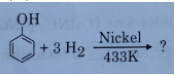
Complete the following reaction :
Official Solution
Correct Option: (1)
Step 1: Understanding the Concept: The reaction is the catalytic hydrogenation of phenol. Phenol is an aromatic compound containing a benzene ring. Step 2: Detailed Explanation: When phenol is treated with hydrogen gas in the presence of a Nickel catalyst at a temperature around 433 K, the aromatic ring undergoes complete reduction (addition of hydrogen). The three double bonds of the benzene ring are saturated. The reaction is:
The product formed is a cyclic secondary alcohol called Cyclohexanol. Step 3: Final Answer: The product is Cyclohexanol.
05
PYQ 2026
medium
chemistryID: maharash
Convert Ethanol into sodium ethoxide.
Official Solution
Correct Option: (1)
Step 1: Understanding the Concept: Alcohols react with active metals like Sodium ( ) to form metal alkoxides and evolve hydrogen gas. This demonstrates the acidic nature of alcohols. Step 2: Detailed Explanation: When ethanol ( ) is treated with sodium metal, the acidic hydrogen of the hydroxyl group is replaced by the sodium ion. Reaction:
The product formed is Sodium ethoxide. Step 3: Final Answer: Ethanol reacts with metallic sodium to give sodium ethoxide and hydrogen gas.
06
PYQ 2026
medium
chemistryID: maharash
Convert Bromomethane into methoxyethane.
Official Solution
Correct Option: (1)
Step 1: Understanding the Concept: The formation of an unsymmetrical ether from an alkyl halide and a sodium alkoxide is known as Williamson's synthesis. Step 2: Detailed Explanation: To prepare methoxyethane ( ) from bromomethane ( ), we react the halide with sodium ethoxide ( ). The alkoxide ion acts as a nucleophile and attacks the methyl halide via an mechanism. Reaction:
Step 3: Final Answer: Bromomethane is heated with sodium ethoxide to produce methoxyethane.
07
PYQ 2026
medium
chemistryID: maharash
Convert Phenol into o-phenol sulfonic acid.
Official Solution
Correct Option: (1)
Step 1: Understanding the Concept: Phenol undergoes electrophilic substitution. The sulfonation of phenol is temperature-dependent. Step 2: Detailed Explanation: When phenol is treated with concentrated sulfuric acid ( ) at room temperature or low temperature (around 288 K), the major product is ortho-phenol sulfonic acid. At higher temperatures (373 K), the major product shifts to para-phenol sulfonic acid due to thermodynamic stability. Reaction:
Step 3: Final Answer: Phenol is converted to o-phenol sulfonic acid by reacting it with conc. at 288 K.