Assertion (A): Arthropods are schizocoelomates
Reason (R): Coelom in arthropods is formed by splitting of mesoderm
1
A and R are true; R is correct explanation of A
2
A and R are true; R is not correct explanation of A
3
A is true, R is false
4
A is false, R is true
Official Solution
Correct Option: (1)
- Schizocoelomates: Organisms with coelom formed by mesoderm splitting (true for arthropods).
- R explains A correctly, as both statements are true and linked.
Sea urchins belong to the phylum Echinodermata, which also includes starfish, brittle stars, and sea cucumbers. They are marine animals characterized by radial symmetry and a calcareous endoskeleton.
04
PYQ 2025
medium
zoologyID: ap-eapce
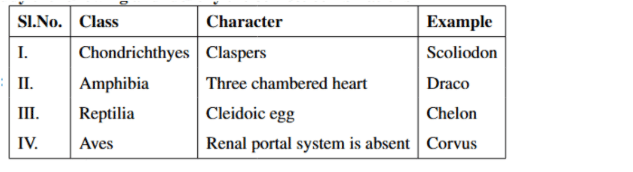
Study the following and identify the correct combinations
1
I and III
2
II and IV
3
III and IV
4
I, II and III
Official Solution
Correct Option: (1)
Step 1: Understand the question.
The question requires evaluating each combination of 'Class', 'Character', and 'Example' provided in the table and identifying which combinations are correct. Step 2: Evaluate each combination individually. \begin{itemize} \item Combination I: Chondrichthyes | Claspers | ScoliodonClass: Chondrichthyes (Cartilaginous fishes) - This class includes sharks, rays, etc.. Character: Claspers - Male cartilaginous fishes possess claspers, which are pelvic fin modifications used for internal fertilization. This character is correct for Chondrichthyes. Example: Scoliodon - Scoliodon (dogfish shark) is an example of a cartilaginous fish. Therefore, Combination I is Correct. \item Combination II: Amphibia | Three chambered heart | DracoClass: Amphibia - Amphibians typically have a three-chambered heart (two atria and one ventricle). This character is correct for Amphibia. Example: Draco - Draco is a genus of gliding lizards, which belong to the class Reptilia, not Amphibia. Therefore, Combination II is Incorrect due to the incorrect example. \item Combination III: Reptilia | Cleidoic egg | ChelonClass: Reptilia - Reptiles are amniotes and typically lay cleidoic (shelled, terrestrial) eggs that are adapted for development on land, preventing desiccation. This character is correct for Reptilia. Example: Chelon - Chelon refers to sea turtles, which are reptiles. Therefore, Combination III is Correct. \item Combination IV: Aves | Renal portal system is absent | CorvusClass: Aves (Birds) - Birds do possess a renal portal system, although it is greatly reduced and less prominent than in reptiles or amphibians. It is not entirely absent. Example: Corvus - Corvus (crow) is an example of a bird (Aves). Therefore, Combination IV is Incorrect because the renal portal system is present, not absent, in Aves.
\end{itemize} Step 3: Identify the correct option based on the evaluation.
Based on the analysis, combinations I and III are correct, while combinations II and IV are incorrect.
Thus, the correct option listing the correct combinations is (1) I and III. The final answer is .
05
PYQ 2025
medium
zoologyID: ap-eapce
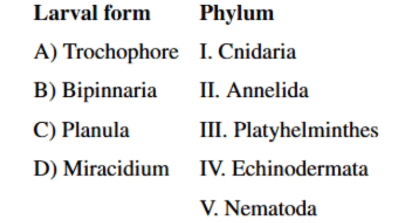
Match the following
1
A-II, B-V, C-III, D-IV
2
A-IV, B-II, C-III, D-I
3
A-III, B-V, C-IV, D-II
4
A-II, B-IV, C-I, D-III
Official Solution
Correct Option: (4)
Step 1: Match each larval form with its respective Phylum. \begin{itemize} \item A. Trochophore: The trochophore larva is a characteristic free-swimming larval stage found in many marine invertebrates, particularly in Annelida (segmented worms) and Mollusca. \item Therefore, A matches with II. Annelida. \item B. Bipinnaria: The bipinnaria larva is a characteristic free-swimming larval stage unique to certain members of the phylum Echinodermata, specifically starfish (Asteroidea). \item Therefore, B matches with IV. Echinodermata. \item C. Planula: The planula larva is a free-swimming, ciliated, and elongated larval form found in most species of the phylum Cnidaria (e.g., jellyfish, corals, sea anemones). It settles down to form a polyp. \item Therefore, C matches with I. Cnidaria. \item D. Miracidium: The miracidium larva is the first larval stage of digenetic trematodes (flukes), which are parasitic flatworms belonging to the phylum Platyhelminthes. This larva is typically free-swimming and infects a snail intermediate host. \item Therefore, D matches with III. Platyhelminthes.
\end{itemize} Step 2: Combine the matches.
A - II
B - IV
C - I
D - III Step 3: Check against the given options.
\begin{itemize} \item Option (1) A-II, B-V, C-III, D-IV (Incorrect, B and D are wrong) \item Option (2) A-IV, B-II, C-III, D-I (Incorrect, A, B, and D are wrong) \item Option (3) A-III, B-V, C-IV, D-II (Incorrect, A, B, C, and D are wrong) \item Option (4) A-II, B-IV, C-I, D-III (Matches our derived combinations)
\end{itemize} The final answer is .
06
PYQ 2025
medium
zoologyID: ap-eapce
Match the following:
Animal
Class
A) Feather star
V) Crinoidea
B) Acorn worm
IV) Enteropneusta
C) Pearl oyster
I) Bivalvia
D) Millipede
III) Diplopoda
1
A-II, B-IV, C-III, D-I
2
A-V, B-III, C-I, D-II
3
A-V, B-IV, C-I, D-III
4
A-III, B-I, C-IV, D-V
Official Solution
Correct Option: (3)
A) Feather star — Crinoidea (V): Crinoids are marine animals that include feather stars. B) Acorn worm — Enteropneusta (IV): Acorn worms are hemichordates belonging to Enteropneusta. C) Pearl oyster — Bivalvia (I): Pearl oysters are mollusks under class Bivalvia. D) Millipede — Diplopoda (III): Millipedes are arthropods in the class Diplopoda.
07
PYQ 2025
medium
zoologyID: ap-eapce
Taxonomic hierarchy includes the following obligate categories:
Class, Family, Kingdom, Order, Species, Phylum, Genus Arrange them in correct sequence.
1
III, I, VI, IV, VII, II, V
2
II, VII, IV, VI, I, V, III
3
IV, I, II, III, VII, VI, V
4
III, VI, I, IV, VII, II, V
Official Solution
Correct Option: (4)
The correct taxonomic hierarchy (from higher to lower rank) is:
Kingdom Phylum Class Order Family Genus Species Thus, mapping:
\begin{itemize} \item III = Kingdom \item VI = Phylum \item I = Class \item IV = Order \item VII = Family \item II = Genus \item V = Species
\end{itemize}
08
PYQ 2025
medium
zoologyID: ap-eapce
Identify the flatworms among the following non-chordate animals:
I. Euspongia
II. Aurelia
III. Beroe
IV. Taenia
V. Wuchereria
VI. Convoluta
1
I, III
2
II, IV
3
IV, VI
4
V, VI
Official Solution
Correct Option: (3)
- Taenia (IV): A flatworm (phylum Platyhelminthes); it is a tapeworm — parasitic, ribbon-like body.
- Convoluta (VI): Also a flatworm (Platyhelminthes), free-living — found in aquatic habitats.
Study the following and pick up the correct combinations
S.No.
Group
Salient Feature
Example
I
Aves
Pneumatic bones
Columba
II
Mammalia
Corpus callosum
Macaca
III
Reptilia
Epidermal scales
Calotes
IV
Chondrichthyes
Cartilagenous skeleton
Scoliodon
1
I only
2
I and II only
3
I, II and III only
4
I, II, III, IV
Official Solution
Correct Option: (4)
All given combinations are correct. Aves have pneumatic bones, Mammals have corpus callosum, Reptiles show epidermal scales, and Chondrichthyes have cartilaginous skeleton.
10
PYQ 2025
medium
zoologyID: ap-eapce
Study the following and pick up the correct combinations:
Sl.No.
Classes
Features
Examples
I
Osteichthyes
Filamentous gills
Scoliodon
II
Amphibia
Sternum appeared first time
Ichthyophis
III
Reptiles
Temporal fossae
Bungarus
IV
Aves
Corpus callosum in brain
Corvus
1
I, II
2
II, III
3
III, IV
4
I, IV
Official Solution
Correct Option: (2)
- I - Incorrect: {Scoliodon} is a cartilaginous fish (Chondrichthyes), not a bony fish (Osteichthyes). Also, filamentous gills is incorrect here.
- II - Correct: Sternum appears for the first time in amphibians. {Ichthyophis} is a limbless amphibian.
- III - Correct: Temporal fossae (skull depressions) are present in reptiles like {Bungarus}.
- IV - Incorrect: Corpus callosum is found only in mammals, not in birds like {Corvus}.
11
PYQ 2025
medium
zoologyID: ap-eapce
Identify the schizocoelomate phyla from the following. I. Platyhelminthes II. Nematoda III. Annelida IV. Chordata V. Arthropoda VI. Echinodermata VII. Mollusca
1
II, III, IV
2
III, V, VII
3
IV, VI
4
I, II
Official Solution
Correct Option: (2)
Step 1: Understand Coelom Types
The coelom (body cavity) is a fluid-filled space between the digestive tract and the outer body wall. Its development varies among different animal phyla.
There are broadly three types based on the presence and origin of the coelom:
\begin{itemize} \item Acoelomates: Animals without a body cavity (e.g., Platyhelminthes). \item Pseudocoelomates: Animals with a body cavity that is not lined by mesoderm (e.g., Nematoda). \item Coelomates (Eucoelomates): Animals with a true coelom, which is a body cavity lined by mesoderm. Coelomates are further divided based on the origin of the coelom: \begin{itemize} \item Schizocoelomates: The coelom arises from the splitting of the mesoderm. These are typically protostomes. Examples include Annelida, Arthropoda, and Mollusca. \item Enterocoelomates: The coelom arises from pouches of the archenteron (embryonic gut). These are typically deuterostomes. Examples include Echinodermata and Chordata. \end{itemize}
\end{itemize} Step 2: Classify each given phylum based on coelom type
Let's go through each phylum in the list: \ I. Platyhelminthes (Flatworms): These are acoelomates (no true body cavity). II. Nematoda (Roundworms): These are pseudocoelomates. III. Annelida (Segmented worms): These are schizocoelomates. IV. Chordata (Vertebrates and related): These are enterocoelomates. V. Arthropoda (Insects, crustaceans, spiders): These are schizocoelomates. VI. Echinodermata (Starfish, sea urchins): These are enterocoelomates. VII. Mollusca (Snails, clams, octopuses): These are schizocoelomates. Step 3: Identify the schizocoelomate phyla
Based on the classification in Step 2, the schizocoelomate phyla are: III. Annelida V. Arthropoda VII. Mollusca Step 4: Choose the correct option
The option that includes only III, V, and VII is (2).