Fasciola hepatica, also known as the liver fluke, has a complex life cycle involving larval stages such as miracidia, sporocysts, rediae, and cercariae which develop in snail hosts. These larval stages cause enlargement (gigantism) of the snail body due to parasitic castration and manipulation of the hostages physiology.
02
PYQ 2023
medium
zoologyID: ap-eapce
Hemozoin is
1
Insoluble, crystalline substance released during malarial parasite infection.
2
Soluble, amorphous and released during pneumonia attack.
3
Antigen released by plasmodium.
4
Antibody released by malaria patient.
Official Solution
Correct Option: (1)
Hemozoin is a waste product formed by the Plasmodium parasite from the digestion of host hemoglobin. It accumulates in the host’s bloodstream, triggering immune responses such as fever.
03
PYQ 2023
medium
zoologyID: ap-eapce
Identify the correct option Statement – I: Excessive dosage of cocaine causes hallucinations
Statement – II: Intake of cocaine does not cause euphoria
1
Statement I is correct and II is wrong.
2
Statement I is wrong and II is correct.
3
Statements I and II are wrong.
4
Statements I and II are correct.
Official Solution
Correct Option: (1)
Cocaine is a stimulant that can cause hallucinations when taken in excessive doses. It also causes euphoria due to increased dopamine levels. Hence, statement I is correct and II is false.
04
PYQ 2023
medium
zoologyID: ap-eapce
Hypertrophy of RBC and splenomegaly are the symptoms of
1
Malaria
2
Amoebiasis
3
Filariasis
4
Typhoid
Official Solution
Correct Option: (1)
In malaria, the parasite infects and destroys red blood cells leading to anemia, and the spleen enlarges (splenomegaly) due to increased RBC breakdown and immune activity. These are hallmark symptoms of malaria.
05
PYQ 2023
medium
zoologyID: ap-eapce
The presence of HIV in the blood of an infected person cannot be detected during
1
Window period
2
Incubation period
3
Prepatent period
4
Refractory period
Official Solution
Correct Option: (1)
During the window period, the virus is present in the body but antibodies are not yet detectable. This makes standard antibody tests negative even though the individual is infected.
06
PYQ 2023
medium
zoologyID: ap-eapce
Assertion (A): Monkey is the reservoir host of malarial parasite. Reason (R): Malaria is transmitted by monkey bite.
1
Both A and R are true and R is the correct explanation of A.
2
Both A and R are true but R is not the correct explanation of A.
3
A is true and R is false.
4
A is wrong and R is true. \textbf{Correct Answer:} (3) A is true and R is false.
Official Solution
Correct Option: (3)
Monkeys are indeed considered reservoir hosts for certain types of Plasmodium (e.g., Plasmodium knowlesi). However, malaria is not transmitted through monkey bites. It is spread by the bite of infected female Anopheles mosquitoes, making the reason incorrect.
07
PYQ 2023
medium
zoologyID: ap-eapce
Match the following:
Column I (Drug)
Column II (Source)
Column III (Fact)
A. Opioids
M. Opium poppy
I. Receptors are present in CNS and GI tract.
B. Cannabinoids
N. Cannabis sativa
II. Abused by sports persons
C. Cocaine
O. South American Plant
III. Crack
D. Heroin
P. Diacetyl morphine
IV. Smack
1
A -- M -- I & B -- N -- II & C -- O -- III & D -- P -- IV
2
A -- P -- IV & B -- O -- III & C -- N -- II & D -- M -- I
3
A -- N -- II & B -- O -- III & C -- P -- IV & D -- M -- I
4
A -- O -- III & B -- P -- IV & C -- M -- I & D -- N -- II
Official Solution
Correct Option: (1)
- A. Opioids are derived from the Opium poppy (M) and act on receptors in the CNS and GI tract (I).
- B. Cannabinoids are obtained from Cannabis sativa (N) and are often abused by sports persons (II).
- C. Cocaine comes from a South American plant (O) and produces the addictive form Crack (III).
- D. Heroin is chemically Diacetyl morphine (P) and is also known on the street as Smack (IV).
08
PYQ 2023
medium
zoologyID: ap-eapce
Identify the fungal disease among the following
1
Common cold
2
Pneumonia
3
Ring worm
4
Typhoid
Official Solution
Correct Option: (3)
Ringworm is a fungal infection of the skin caused by dermatophytes. It differs from other diseases like common cold (viral), pneumonia (bacterial or viral), and typhoid (bacterial).
09
PYQ 2023
medium
zoologyID: ap-eapce
Assertion (A): Dengue fever is caused due to failure of clot reaction. Reason (R): The patient of dengue may require transfusion of blood platelets.
1
Both A and R are true and R is the correct explanation of A.
2
Both A and R are true but R is not the correct explanation of A.
3
A is true and R is false.
4
A is wrong and R is true.
Official Solution
Correct Option: (2)
While it is true that dengue fever can affect blood clotting mechanisms and patients may require platelet transfusion, the disease is caused by a virus and not primarily due to clotting failure. Therefore, A and R are both correct, but R does not explain A.
10
PYQ 2023
medium
zoologyID: ap-eapce
Match the following Biomedical techniques and their uses
List I
List II
A. X-ray imaging
i. Density of bones in Osteoporosis
B. CAT Scan
ii. Diagnosis of breast, cervical cancers
C. MRI Scan
iii. Pneumonia, Tuberculosis
D. PET Scan
iv. Diagnosis of pathological conditions of body organs
1
A – iii, B – ii, C – iv, D – i
2
A – iii, B – i, C – iv, D – ii
3
A – iii, B – iv, C – ii, D – i
4
A – iii, B – iii, C – iv, D – i
Official Solution
Correct Option: (2)
- X-ray imaging is useful in detecting lung conditions like pneumonia and tuberculosis.
- CAT scans assess bone density in conditions like osteoporosis.
- MRI provides detailed images of organs for pathological diagnosis.
- PET scans are often used in detecting cancers, especially breast and cervical.
11
PYQ 2025
medium
zoologyID: ap-eapce
Which one of the following is a liquid tumor?
1
Carcinoma
2
Sarcoma
3
Leukemia
4
Lymphoma
Official Solution
Correct Option: (3)
Leukemia is a cancer of the blood or bone marrow characterized by an abnormal increase in white blood cells, making it a liquid tumor. Unlike solid tumors, leukemia spreads throughout the body via the bloodstream.
12
PYQ 2025
medium
zoologyID: ap-eapce
This vaccine is a toxoid.
1
Salk's polio vaccine
2
Vaccine for tetanus
3
Vaccine for rubella
4
Vaccine for typhoid
Official Solution
Correct Option: (2)
Step 1: Understand what a toxoid vaccine is
A toxoid vaccine is a type of vaccine that uses a toxoid, which is an inactivated bacterial toxin. The toxin is chemically treated or heated to destroy its toxic properties while retaining its ability to stimulate an immune response. This immune response protects against the disease caused by the toxin, rather than the bacteria itself.
Step 2: Evaluate each option to identify which is a toxoid vaccine
Salk’s polio vaccine: An inactivated (killed) vaccine made from poliovirus that has been inactivated with formalin. Not a toxoid vaccine.
Vaccine for tetanus: Contains inactivated tetanus toxin (tetanus toxoid) which stimulates immunity against the toxin. This is a toxoid vaccine.
Vaccine for rubella: A live, attenuated viral vaccine containing weakened rubella virus. Not a toxoid vaccine.
Vaccine for typhoid: Includes various forms like inactivated whole-cell, live attenuated, and capsular polysaccharide vaccines. Since Salmonella typhi does not produce a primary exotoxin, no toxoid vaccine exists for typhoid. Not a toxoid vaccine.
Step 3: Conclude the correct option
Based on the evaluation, only the vaccine for tetanus is a toxoid vaccine. The final answer is: Vaccine for tetanus.
13
PYQ 2025
medium
zoologyID: ap-eapce
Pneumonia is caused by
1
Salmonella
2
Haemophilus
3
Rhino virus
4
Microsporum
Official Solution
Correct Option: (2)
Haemophilus influenzae is a bacterial agent responsible for pneumonia, particularly in children.
14
PYQ 2025
medium
zoologyID: ap-eapce
Identify the mismatched pair
1
Plasmodium - Hypertrophy
2
Virus - Neoplasia
3
Fasciola - Hyperplasia
4
Wuchereria - Gigantism
Official Solution
Correct Option: (1)
Step 1: Analyze each pair to determine correctness. Pair 1: Plasmodium - Hypertrophy Plasmodium is a parasite that causes malaria. The malarial parasite primarily infects red blood cells and liver cells, causing their lysis (destruction) or abnormal multiplication, but not typically hypertrophy. Hypertrophy refers to the increase in the size of cells or tissues due to an increase in the size of existing cells, often in response to increased workload or demand. While malaria can lead to organ enlargement (like splenomegaly or hepatomegaly), this is often due to hyperplasia (increase in cell number) and inflammation, rather than just hypertrophy of individual cells in the direct context of parasite action. Therefore, this pair is Mismatched. Pair 2: Virus - Neoplasia Viruses are known to cause various cellular changes, including neoplasia, which is the abnormal proliferation of cells resulting in a tumor (cancer). Oncogenic viruses (e.g., Human Papillomavirus, Hepatitis B and C viruses) are well-established causes of cancer. Therefore, this pair is Matched. Pair 3: Fasciola - Hyperplasia Fasciola (liver fluke) is a parasitic trematode that infects the bile ducts of the liver. Chronic infection with Fasciola can lead to pathological changes in the host's liver, including thickening of bile duct walls due to the proliferation of epithelial cells, which is a form of hyperplasia (increase in the number of cells). Therefore, this pair is Matched. Pair 4: Wuchereria - Gigantism Wuchereria (e.g., Wuchereria bancrofti) is a filarial nematode that causes lymphatic filariasis, commonly known as elephantiasis. This condition is characterized by chronic inflammation and obstruction of lymphatic vessels, leading to massive swelling and thickening of the skin and underlying tissues, particularly in the limbs, resembling gigantism (abnormal and excessive growth in size). Therefore, this pair is Matched. Step 2: Identify the mismatched pair.
Based on the analysis: Plasmodium - Hypertrophy is Mismatched. Virus - Neoplasia is Matched. Fasciola - Hyperplasia is Matched. Wuchereria - Gigantism is Matched. The question asks to identify the mismatched pair.
15
PYQ 2025
medium
zoologyID: ap-eapce
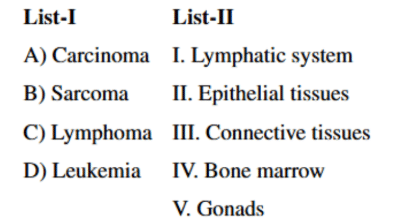
Match the following
1
A-II, B-III, C-I, D-V
2
A-II, B-III, C-I, D-IV
3
A-IV, B-I, C-III, D-II
4
A-V, B-II, C-IV, D-I
Official Solution
Correct Option: (2)
Step 1: Understand the origin of each type of cancer
A) Carcinoma: Cancers that arise from epithelial cells. Examples include skin cancer, lung cancer, breast cancer, colon cancer, etc.
B) Sarcoma: Cancers that arise from connective tissues like bone, cartilage, fat, muscle, blood vessels, and other supportive tissues.
C) Lymphoma: Cancers that originate in lymphocytes, a type of white blood cell in the lymphatic system.
D) Leukemia: Cancers of blood-forming tissues including bone marrow and lymphatic system, involving abnormal white blood cell proliferation.
Step 2: Match each cancer type with its tissue/system of origin
A) Carcinoma: II. Epithelial tissues
B) Sarcoma: III. Connective tissues
C) Lymphoma: I. Lymphatic system
D) Leukemia: IV. Bone marrow
Step 3: Compare matches with given options
Our matches: A-II, B-III, C-I, D-IV
(1) A-II, B-III, C-I, D-V - Incorrect (D is incorrect)
Step 1: Identify the organism and its life cycle.
\textit{Wuchereria} is a genus of filarial nematodes that cause lymphatic filariasis (elephantiasis) in humans. The life cycle involves two hosts: humans (definitive host) and mosquitoes (intermediate host). The infective larval stage (microfilariae) circulate in the human blood. Step 2: Analyze the given options in the context of \textit{Wuchereria larvae (microfilariae).} \begin{itemize} \item (1) Exra intestinal migration (Extra-intestinal migration): While filarial larvae do migrate within the host's body (e.g., from blood to lymphatic vessels in humans, or within the mosquito vector), "extra-intestinal migration" is a very general term. More specific behaviors characterize \textit{Wuchereria} larvae. This is not the most defining characteristic presented as an option. \item This option is not the most accurate or specific answer. \item (2) Ex-flagellation: Ex-flagellation is a process specific to the male gametocyte of \textit{Plasmodium} (malaria parasite), where flagella-like structures (microgametes) emerge from the gametocyte to fertilize female gametes. This process is completely unrelated to \textit{Wuchereria} larvae. \item This option is incorrect. \item (3) Nocturnal periodicity: The microfilariae (larvae) of \textit{Wuchereria bancrofti} (the most common species causing lymphatic filariasis) exhibit a characteristic nocturnal periodicity. This means they are predominantly found in the peripheral blood circulation during the night (typically between 10 PM and 4 AM), and their numbers significantly decrease in the peripheral blood during the day, as they retreat to deeper vessels (like pulmonary capillaries). This synchronized appearance in peripheral blood during the hours when their mosquito vectors (e.g., \textit{Culex} mosquitoes) are most active facilitates transmission. \item This option is correct. \item (4) Anisogamy: Anisogamy refers to sexual reproduction involving the fusion of two gametes of unequal size or form (e.g., large ovum and small sperm). This describes the fusion of gametes during sexual reproduction in \textit{Wuchereria} (which occurs in the mosquito gut to form larvae), but it does not describe a characteristic \textit{exhibited by the larva itself} as part of its behavior or morphology. The question asks what the larva exhibits. \item This option is incorrect as it describes a process leading to larval formation, not a characteristic of the larva's behavior.
\end{itemize} Step 3: Conclude the correct option.
The most distinct and well-known characteristic exhibited by the larvae (microfilariae) of \textit{Wuchereria} is their nocturnal periodicity. The final answer is .
17
PYQ 2025
medium
zoologyID: ap-eapce
Which of the following is an intra uterine device (IUD)?
1
Copper-T
2
Vault
3
Cervical cap
4
Implant
Official Solution
Correct Option: (1)
Copper-T is a widely used intrauterine device (IUD) used for long-term contraception.
It is inserted into the uterus and prevents fertilization by releasing copper ions that are spermicidal.
Vault, cervical caps, and implants are other contraceptive methods but not classified as IUDs.