The gene that is believed to play a key role in human language expression is
1
P53
2
FOX P2
3
TP53
4
BRCA1
Official Solution
Correct Option: (2)
The FOX P2 gene is considered to play a key role in language expression and speech development in humans.
02
PYQ 2023
medium
zoologyID: ap-eapce
Women have which type of sex chromosomes?
1
XY
2
YY
3
XX
4
XW
Official Solution
Correct Option: (3)
Human females have two X chromosomes (XX). Males have XY. The XW combination is found in birds, not humans.
03
PYQ 2023
medium
zoologyID: ap-eapce
The expression that gives the number of genotypes for multiple alleles is
1
2
3
4
Official Solution
Correct Option: (1)
The number of genotypes for multiple alleles can be determined by the expression , where is the number of alleles. This expression calculates the number of possible combinations of alleles for a given set of alleles.
04
PYQ 2023
medium
zoologyID: ap-eapce
What is the name of Darwin's ship which he used for world voyage?
1
HMS Beagle
2
KVS Don
3
LML Vespa
4
Titanic
Official Solution
Correct Option: (1)
Charles Darwin traveled on the HMS Beagle between 1831 and 1836. His observations on this journey greatly influenced his theory of evolution by natural selection.
05
PYQ 2023
easy
zoologyID: ap-eapce
Introduction of genetically modified DNA into eukaryotic cell is called:
Official Solution
Correct Option: (1)
06
PYQ 2023
easy
zoologyID: ap-eapce
Pattern Baldness in humans is an example of
Official Solution
Correct Option: (1)
07
PYQ 2023
medium
zoologyID: ap-eapce
Duchenne muscular dystrophy is an example of:
1
X-linked dominant inheritance
2
X-linked recessive inheritance
3
Autosomal recessive inheritance
4
Y-linked dominant inheritance
Official Solution
Correct Option: (2)
Duchenne muscular dystrophy (DMD) is an X-linked recessive disorder, meaning the gene responsible for DMD is located on the X chromosome. Males are more commonly affected since they have only one X chromosome.
08
PYQ 2025
medium
zoologyID: ap-eapce
If two heterozygous tall garden pea plants are crossed, the expected genotypic ratio in their offspring is
1
3 : 1
2
1 : 1
3
1 : 2 : 1
4
1 : 0
Official Solution
Correct Option: (3)
Step 1: Understand heterozygous cross.
Heterozygous tall plants have the genotype \texttt{Tt}. Crossing two such plants: \texttt{Tt × Tt} Step 2: Perform Punnett square analysis.Step 3: Determine genotypic ratio.
- TT (homozygous tall) = 1
- Tt (heterozygous tall) = 2
- tt (dwarf) = 1 So, genotypic ratio = 1 : 2 : 1
09
PYQ 2025
easy
zoologyID: ap-eapce
The number of genes located on human Y chromosome.
1
2968
2
2698
3
231
4
239
Official Solution
Correct Option: (3)
The human Y chromosome contains significantly fewer genes compared to other chromosomes. Modern genomic research provides the following insights: \begin{itemize} \item The complete human genome contains approximately 20,000-25,000 protein-coding genes. \item The Y chromosome is one of the smallest chromosomes, containing only about 200-300 genes. \item Earlier estimates suggested higher numbers, but improved sequencing technologies have refined this count.
\end{itemize} Evaluating the options: \begin{itemize} \item Options (1) 2968 and (2) 2698 are far too high - these numbers exceed even the gene count of much larger chromosomes. \item Option (3) 231 matches current scientific consensus from recent genome studies. \item Option (4) 239 is close but slightly higher than the most widely accepted estimates.
\end{itemize} The most accurate answer is: \boxed{3}
10
PYQ 2025
medium
zoologyID: ap-eapce
O-group child cannot have parents of following blood groups.
1
B and B
2
A and B
3
O and O
4
AB and O
Official Solution
Correct Option: (4)
Blood group inheritance follows Mendelian genetics.
A child with blood group O can only inherit O alleles from both parents.
Parents with AB and O blood groups cannot have an O-group child because the AB parent has A and B alleles, no O allele.
Therefore, O-group child cannot have parents with blood groups AB and O.
11
PYQ 2025
medium
zoologyID: ap-eapce
Study the following statements and pick up the incorrect statements. I. Haemophilia is an X-linked disorder due to dominant genes. II. Inheritance of colour blindness follows the cris-cross pattern. III. Haemophilia A and Haemophilia C are X-linked disorders. IV. Y-linked genes are called holandric genes.
1
I, II
2
III, IV
3
II, IV
4
I, III
Official Solution
Correct Option: (4)
Step 1: Analyze Statement I
Statement I says: "Haemophilia is an X-linked disorder due to dominant genes." Haemophilia (specifically Hemophilia A and B) is an X-linked recessive disorder. This means the gene responsible is located on the X chromosome, and the disorder manifests primarily in males (who have only one X chromosome) or in females who are homozygous for the recessive allele. It is not caused by dominant genes. Therefore, Statement I is Incorrect. Step 2: Analyze Statement II
Statement II says: "Inheritance of colour blindness follows the cris-cross pattern." Colour blindness (specifically red-green color blindness) is also an X-linked recessive disorder. The "cris-cross" pattern of inheritance refers to the transmission of a trait from a father to his daughter (who is usually a carrier) and then from the daughter to her son. This pattern is characteristic of X-linked recessive traits. Therefore, Statement II is Correct. Step 3: Analyze Statement III
Statement III says: "Haemophilia A and Haemophilia C are X-linked disorders." Haemophilia A (Factor VIII deficiency) and Haemophilia B (Factor IX deficiency, also known as Christmas disease) are both X-linked recessive disorders. Haemophilia C (Factor XI deficiency, also known as Rosenthal syndrome) is inherited in an autosomal recessive pattern, not X-linked. Therefore, Statement III is Incorrect. Step 4: Analyze Statement IV
Statement IV says: "Y-linked genes are called holandric genes." Genes located on the Y chromosome are transmitted directly from father to son. These genes are indeed called holandric genes. Therefore, Statement IV is Correct. Step 5: Identify the incorrect statements
Based on the analysis: Statement I is Incorrect. Statement II is Correct. Statement III is Incorrect. Statement IV is Correct. The question asks to pick up the incorrect statements. The incorrect statements are I and III. Step 6: Choose the correct option
The option that contains both I and III is (4).
12
PYQ 2025
medium
zoologyID: ap-eapce
Gynaecomastia is a symptom of
1
Klinefelter syndrome
2
Turner syndrome
3
Down syndrome
4
Edward syndrome
Official Solution
Correct Option: (1)
Gynaecomastia, or the development of breast tissue in males, is a key characteristic of Klinefelter syndrome (47,XXY), which is caused by the presence of an extra X chromosome.
13
PYQ 2025
medium
zoologyID: ap-eapce
The Karyotype AA + XXY leads to
1
Turner syndrome
2
Klinefelter syndrome
3
Down syndrome
4
Cushing syndrome
Official Solution
Correct Option: (2)
Klinefelter syndrome is a genetic condition where males have an extra X chromosome (XXY instead of XY).
Turner syndrome involves monosomy X (XO).
Down syndrome is caused by trisomy 21.
Cushing syndrome is a hormonal disorder, unrelated.
Therefore, the karyotype AA + XXY corresponds to Klinefelter syndrome.
14
PYQ 2025
medium
zoologyID: ap-eapce
Study the following regarding human genome project and identify the correct statements: I. The largest known human gene is located on X-chromosome.
II. Chromosome 1 has the lowest number of genes.
III. Less than 2 percent of the genes code for proteins.
IV. The human genome contains 3164.7 billion nucleotide bases.
1
I and II
2
II and III
3
I and III
4
II and IV
Official Solution
Correct Option: (3)
- The largest known human gene, dystrophin, is located on the X chromosome (Statement I is true).
- Chromosome 1 actually has the highest number of genes, so II is false.
- Less than 2% of the human genome codes for proteins, rest is non-coding DNA (Statement III is true).
- The human genome size is approximately 3.2 billion base pairs, so IV is incorrect.
Thus, correct statements are I and III.
15
PYQ 2025
medium
zoologyID: ap-eapce
Study the following regarding genetic disorders and identify the correct statements. I) Cystic fibrosis follows an autosomal dominant inheritance pattern. II) Thalassemia is caused by mutation affecting haemoglobin synthesis III) Sickle cell anaemia results from a point mutation in the β-globin gene. IV) Phenylketonuria (PKU) is an X-linked recessive disorder.
1
I and II
2
II and III
3
I and IV
4
II and IV
Official Solution
Correct Option: (2)
Thalassemia is caused by mutation in genes involved in haemoglobin synthesis.
Sickle cell anemia is due to point mutation in the β-globin gene.
Cystic fibrosis is actually autosomal recessive, not dominant.
Phenylketonuria is autosomal recessive, not X-linked.
16
PYQ 2025
medium
zoologyID: ap-eapce
Study the following and pick up the correct statements: In DNA fingerprinting, DNA is cut into small pieces at specific sites by restriction endonucleases.
Transfer of DNA strands on to the nylon membrane is called southern blotting.
The largest known human gene codes for the protein dystrophin.
Least number of genes are located in Y-chromosome.
1
I only
2
I and II only
3
I, II and III only
4
I, II, III and IV
Official Solution
Correct Option: (4)
All four statements are scientifically accurate:
\begin{itemize} \item Restriction endonucleases cut DNA at specific sites — used in DNA fingerprinting. \item Southern blotting involves transfer of DNA fragments to a membrane. \item Dystrophin is the largest known human gene. \item Y-chromosome has the least number of genes compared to other chromosomes.
\end{itemize}
17
PYQ 2025
medium
zoologyID: ap-eapce
Haplo-diploidy type of sex determination is found in
1
Wasp
2
Grass hopper
3
Butter fly
4
Bug
Official Solution
Correct Option: (1)
In haplodiploidy, males develop from unfertilized eggs and are haploid; females develop from fertilized eggs and are diploid. This system is observed in Hymenopterans like wasps, bees, and ants.
18
PYQ 2025
medium
zoologyID: ap-eapce
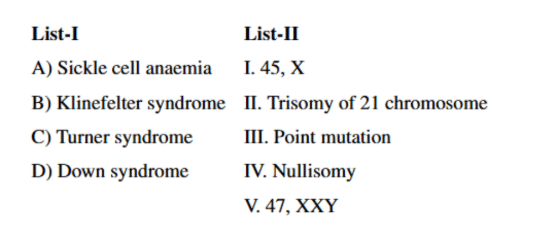
Match the following
1
A-III, B-V, C-IV, D-II
2
A-III, B-V, C-I, D-II
3
A-II, B-I, C-V, D-III
4
A-I, B-II, C-IV, D-V
Official Solution
Correct Option: (2)
Step 1: Understand the genetic basis of each disorder
Sickle cell anaemia: A genetic blood disorder caused by a single nucleotide substitution (point mutation) in the gene encoding the beta-globin chain.
Klinefelter syndrome: A chromosomal condition in males caused by an extra X chromosome, resulting in 47, XXY karyotype.
Turner syndrome: A chromosomal condition in females caused by the absence of one X chromosome, resulting in 45, X karyotype.
Down syndrome: A chromosomal disorder caused by an extra copy of chromosome 21 (trisomy 21).
Step 2: Match each disorder with its genetic characteristic
A) Sickle cell anaemia: III. Point mutation
B) Klinefelter syndrome: V. 47, XXY
C) Turner syndrome: I. 45, X
D) Down syndrome: II. Trisomy of chromosome 21
Step 3: Compare matches with given options
Our matches: A-III, B-V, C-I, D-II
(1) A-III, B-V, C-IV, D-II - Incorrect (C is incorrect)