- Red panda → Ailurus ochraceus (iv)
- Siberian crane → Grus leucogeranus (i)
- Black buck → Antelope cervicapra (ii)
- Pygmy hog → Sus salvanius (iii)
02
PYQ 2023
medium
zoologyID: ap-eapce
Choose the correct option for the matching:
Column – I
Column – II
A. Daphnia
i. Basking
B. Desert Lizard
ii. Blubber
C. Aquatic mammals
iii. Cyclomorphosis
D. Sea gulls
iv. Eliminates salts through nostrils
1
A – ii, B – iii, C – iv, D – i
2
A – iii, B – ii, C – i, D – iv
3
A – iii, B – i, C – ii, D – iv
4
A – iii, B – i, C – iv, D – ii
Official Solution
Correct Option: (3)
- Daphnia exhibits cyclomorphosis as a response to environmental stress.
- Desert lizards use basking for thermoregulation.
- Aquatic mammals have blubber to insulate against cold.
- Sea gulls excrete excess salts through nasal glands.
03
PYQ 2023
medium
zoologyID: ap-eapce
The following is comparable to a professional dinner guest
1
Competitive organism
2
Commensal
3
Parasite
4
Predator
Official Solution
Correct Option: (3)
A parasite benefits by living on or inside a host and deriving nutrients at the host’s expense—comparable to an uninvited but persistent dinner guest. Commensals do not harm or benefit the host, while predators kill their prey.
04
PYQ 2025
medium
zoologyID: ap-eapce
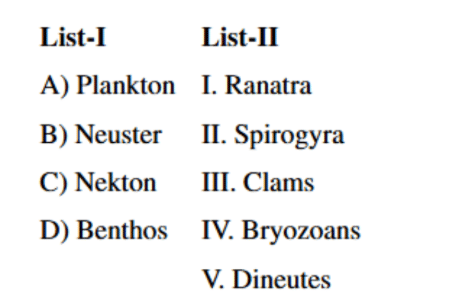
Match the following
1
A-II, B-V, C-III, D-I
2
A-V, B-III, C-II, D-I
3
A-IV, B-I, C-V, D-II
4
A-II, B-V, C-I, D-III
Official Solution
Correct Option: (4)
Step 1: Understand the ecological classifications of aquatic organisms.
\begin{itemize} \item Plankton: Organisms that float or drift in the water column, unable to swim against currents. They include phytoplankton (algae) and zooplankton (small animals). \item Neuston: Organisms associated with the surface film of water (either on top or suspended just below). \item Nekton: Organisms that are strong swimmers and can move independently of water currents. \item Benthos: Organisms that live on, in, or near the bottom (substrate) of an aquatic environment.
\end{itemize} Step 2: Match each classification from List-I with an appropriate example from List-II. \begin{itemize} \item A) Plankton: \item II. Spirogyra: Spirogyra is a genus of filamentous green algae that typically floats freely in freshwater, making it a type of phytoplankton (plankton). \item Therefore, A matches with II. Spirogyra. \item B) Neuston: \item V. Dineutes: \textit{Dineutes} is a genus of whirligig beetles. These beetles are commonly found on the surface of freshwater bodies, exhibiting behavior characteristic of neuston (specifically, epineuston, living on the surface). \item Therefore, B matches with V. Dineutes. \item C) Nekton: \item I. Ranatra: \textit{Ranatra} is a genus of water scorpions, which are aquatic insects. While they can sit and wait, they are also capable of swimming effectively in water, classifying them as nekton. \item Therefore, C matches with I. Ranatra. \item D) Benthos: \item III. Clams: Clams are bivalve molluscs that live embedded in the soft sediment at the bottom of aquatic environments (marine or freshwater). They are classic examples of benthic organisms. \item Therefore, D matches with III. Clams. \item (Note: Bryozoans (IV) are also benthic, but Clams (III) are a more direct and common example. The other options make the pairing clear.)
\end{itemize} Step 3: Combine the matches and check against the given options.
A - II
B - V
C - I
D - III Comparing this with the options:
\begin{itemize} \item (1) A-II, B-V, C-III, D-I - Incorrect (C and D are swapped) \item (2) A-V, B-III, C-II, D-I - Incorrect \item (3) A-IV, B-I, C-V, D-II - Incorrect \item (4) A-II, B-V, C-I, D-III - Correct
\end{itemize} The final answer is .
05
PYQ 2025
medium
zoologyID: ap-eapce
Cattle never feed on the leaves of Calotropis because of the presence of these chemicals
1
Cardiac glycosides
2
Lignin and chitin
3
Nicotine
4
Opium
Official Solution
Correct Option: (1)
\textit{Calotropis} contains toxic compounds known as cardiac glycosides, which are harmful to herbivores. These substances interfere with heart function, deterring cattle and other animals from grazing on the plant.
06
PYQ 2025
medium
zoologyID: ap-eapce
Which of the following statements about competition are correct? I) The competitive exclusion principle states that species with identical niches can coexist indefinitely. II) Resource partitioning reduces competition by allowing species to use resources differently. III) Unrelated species can compete, if they rely on the same unlimited resources. IV) Competitive release occurs when a species expands its niche after a competitor's removal.
1
I and IV
2
II and IV
3
III and IV
4
I and III
Official Solution
Correct Option: (2)
Statement I is incorrect because the competitive exclusion principle states that species with identical niches cannot coexist indefinitely.
Statement II is correct because resource partitioning enables species to use different resources, reducing competition.
Statement III is incorrect; while unrelated species may share resources, competition is defined more by overlap in resource use than relatedness.
Statement IV is correct; when a competitor is removed, a species can expand its niche, which is called competitive release.
07
PYQ 2025
medium
zoologyID: ap-eapce
Match the following:
List - I
List - II
A) Morphine
IV) Pain killer
B) Cannabinoids
V) Dopamine
C) Cocaine
I) Cardiovascular system
D) Benzodiazepines
II) Tranquilizers
1
A-I, B-III, C-V, D-II
2
A-IV, B-III, C-V, D-I
3
A-II, B-V, C-III, D-I
4
A-I, B-IV, C-V, D-II
Official Solution
Correct Option: (1)
A) Volvox — Phytoplankton (I): \textit{Volvox} is a colonial green alga and a typical phytoplankton found floating freely in aquatic ecosystems. B) Notonecta — Nekton (III): \textit{Notonecta}, commonly known as backswimmer, is an actively swimming insect belonging to nektonic fauna. C) Aquatic snails — Periphyton (V): Aquatic snails graze over submerged surfaces and are often associated with periphyton, the community of attached algae and microorganisms. D) Chironomid larvae — Benthos (II): \textit{Chironomid larvae} dwell at the bottom of water bodies, making them part of the benthos group.
08
PYQ 2025
medium
zoologyID: ap-eapce
The species diversity between two adjacent ecosystems is
1
-diversity
2
-diversity
3
-diversity
4
-diversity
Official Solution
Correct Option: (2)
-diversity measures the change in species composition between ecosystems.
-diversity is within a single community.
-diversity is overall diversity in a region.
09
PYQ 2025
medium
zoologyID: ap-eapce
The measurement of the overall diversity for different ecosystems within an ecological region is
1
-diversity
2
-diversity
3
-diversity
4
-diversity
Official Solution
Correct Option: (3)
Step 1: Understand different types of ecological diversity
Ecological diversity is typically measured at various scales, categorized as alpha ( ), beta ( ), and gamma ( ) diversity:
\begin{itemize} \item -diversity (Alpha diversity): This refers to the diversity within a particular area or ecosystem, usually expressed as the number of species (species richness) in that community. \item -diversity (Beta diversity): This refers to the comparison of diversity between ecosystems or along environmental gradients. It measures the rate of change of species composition along a habitat or environmental gradient, or between different communities. \item -diversity (Gamma diversity): This refers to the total diversity of a landscape or an entire geographical region, encompassing multiple ecosystems. It is a measure of the overall biodiversity within a broader region. \item -diversity (Delta diversity): While not as commonly used as the other three, delta diversity can sometimes refer to diversity within a specific taxonomic group across a large region or a measure beyond gamma diversity, but it's not the standard term for overall diversity across different ecosystems in a region.
\end{itemize} Step 2: Relate the question to the types of diversity
The question asks for "The measurement of the overall diversity for different ecosystems within an ecological region". This description perfectly matches the definition of gamma diversity, which considers the total species richness across multiple habitats or ecosystems within a broader landscape. Step 3: Choose the correct option
Based on the definitions:
% Option
(1) -diversity: Diversity within a single ecosystem. (Incorrect)
% Option
(2) -diversity: Diversity between ecosystems. (Incorrect)
% Option
(3) -diversity: Overall diversity for different ecosystems within an ecological region. (Correct)
% Option
(4) -diversity: Not the standard term for this definition. (Incorrect) Therefore, Option (3) is the correct answer.